





WAYLEEN BLOMBEFORE we look at what you should do in an emergency, let’s discuss what first aid is.
First aid is the medical skill that is acquired and applied in a situation of need, using facilities and material available to the firstaider at that time, whether one is alone or part of a team. The moment a human being becomes ill or lands up in a situation where medical attention is needed, he/she becomes a patient.
First aid is applied in a prehospital setting. It could mean the difference between life and death, as the firstaider would usually be the first person on the scene to tend to the sick or injured person/s. There are reasons why people usually don’t want to help as they are afraid, or doubt themselves. I ask you to reconsider. The true meaning of being a firstaider is not to show the whole world how great a hero you are, but to demonstrate true skill and care through professionalism and honesty. The success of practising ethical emergency medical care is a noble and honest act.
Emergency care practitioners are the unseen, unsung, silent everyday citizens who show their care and dedication towards fellow people in need.
WHY DO WE RENDER FIRST AID?
To render first aid, is to help a fellow person with an emergency. We want to do what we can as best we can for our patient. First aid can be applied not only in the workplace but also at home, and public places as well.
In order to do this we look at the aim of first aid. This is described with the 3 P’s of first aid.
To Preserve life (ensure the patient’s airway, breathing, circulation and stop bleeding)
To prevent the condition from worsening (immobilise the injury, prevent further bleeding or infection, position the patient appropriately)
To promote recovery (treat patient for shock, protect the patient from further injury or the environment)
Below we will look at different types of emergencies, and how to treat the patient accordingly, while you wait for an ambulance to arrive.
Burns
Let us say you and your family and friends decide to go to the dam for the day. There you have a barbeque, your uncle decides to make the fire, he uses too much petrol….burns himself, what do you do? First, you identify what type of burn it is.
There are 4 main types of burns:
ν Thermal burns – Caused by steam, direct contact with open flames or ice
ν Chemical burns – Caused by dangerous chemical fluids and gasses
ν Electrical burns – Electrical shock – high voltage heat which causes burns
ν Radiation burns – alpha, beta or gamma rays.
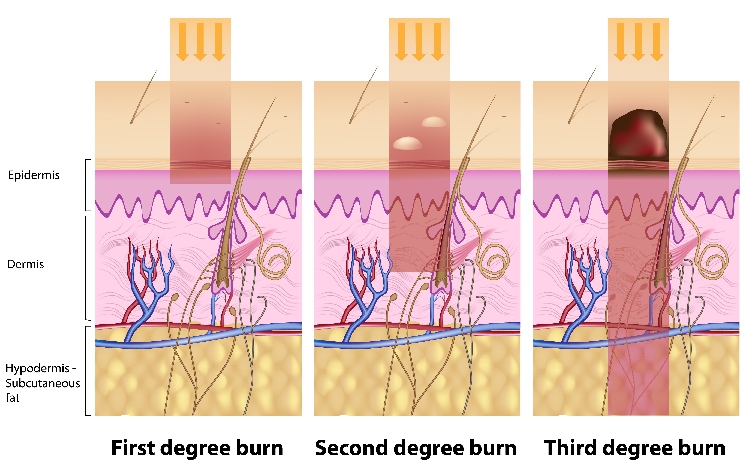
The depth of the burn wounds is determined by which layer of skin is affected during the burn. This ranges from superficial, to partial thickness and full thickness burns. The deeper the burn wound is the more severe is the damage. The single most common complication of any partial and full thickness burn wound is infection!
Superficial burns (1st degree burn) Involve only the epidermis of the skin. The patient will complain of a lot of pain and the injured part will be very sensitive to the touch. The skin is mainly red and somewhat swollen but smooth in texture. No body fluids are leaking to the outside. Healing occurs naturally within a week.
Partial thickness burn (2nd Degree burn) – It involves the epidermis and dermis. The fluid drainage and the epidermis is stripped away. The prominent red color visible is the dermis. A partial thickness burn will not always be present with the entire epidermis stripped away. If you see blisters under the surface of the epidermis, then you are dealing with a 2nd degree burn wound. These wounds are extremely painful. Healing takes 23 weeks with some scarring.
Full thickness (3rd degree burn) – A 3rd degree burn involves the full thickness of the skin right down to the dypodermis and often the tissue. The skin may vary from white and lifeless to black and charred. It is relatively painless as the nerve endings have been damaged. Fluid loss is always present in these wounds. There is considerable scarring and skin grafting may be necessary. Full thickness burns are life threatening.
YOUR TREATMENT FOR A BURN WOUND WOULD BE
ν Remove the patient from the source causing the burn or remove the source away from the patient.
ν Assess patient and initiate CPR if needed
ν Remove any tight jewellery in the burnt area e.g. rings, watches.
ν Never touch the burnt area with your hands.
ν Always use sterile gloves.
ν Rinse the affected part with lots of water for no less than 20 minutes.