



I am sitting on the veranda watching the rain and thinking about the tough times ahead. All the while I notice the large trucks filled with much-needed food and consumer goods heading for the supermarkets in the city.
The road that runs past the house is a main transport artery into and out of the city and is normally very busy. Today it is very quiet and perhaps that is why the trucks stand out.
With the rain comes the memories and I remember listening to my grandpa telling stories about the human and animal health disasters of his time. There were many since his birthday, 15 August 1913, until his death on 28 February 1996.
He was barely out of his diapers when the Spanish flu or influenza raged through the world, infecting an estimated 500 million people and killing at least 50 million worldwide. Although estimates on the exact number of deaths vary greatly, all sources concur on one thing: More people died because of the flu than because of the First World War itself. The war enabled the virus to spread and diffuse all over the world, and close to home, South Africa experienced one of the worst demographic experiences anywhere in the world. Grandpa always said that adults encouraged kids to smoke tobacco in the hope that it would keep the flu at bay.
Just a few years before he was born, Charles Nicholle discovered that the body louse (Pendiculus humanus corporis) was the carrier of the deadly typhus bacterium that caused havoc in parts of Europe. It hit Russia particularly hard; three million people are estimated to have died with some 25 to 30 million cases reported in 1922 when the epidemic was at its peak, in Russia. Vladimir Lenin is said to have declared: “Either socialism will defeat the louse, or the louse will defeat socialism.” Can you imagine how different the world’s history would have been if the louse won? The typhus pandemic was eventually brought under control during the 1940s by means of the powerful insecticide DDT and broad-spectrum antibiotics.
Grandpa had numerous stories about the Second Boer War. He repeatedly told me that someone in the family once told him soldiers fleeing the British army had no time to cook their food. They would simply shove lumps of meat under their saddles whilst riding, so that when they decided to eat, the meat would have been lukewarm. I never had the heart to tell him that I heard the same story about the Mongul army and the Monguls even had their own version of biltong called ‘borts’.
Although he was not around at the time of the war, he told stories about how sick people got from typhoid. Later on, I did tell him the quite unbelievable tale of Mary Mallon, or Typhoid Mary – the most harmless and yet most dangerous woman in America. Now, long after his death typhoid is still around and prevalent among the poor, killing a few hundred thousand people each year.
By the time Grandpa was born, smallpox had already decimated entire civilizations. He said he was lucky to have witnessed its eradication in 1980.
We never got to speak about our contemporary pandemics. Such as the fact that around 38 million people are infected with HIV-Aids. Or the 2002/3 Sars pandemic that made the world take note of the highly infectious coronavirus Sars-CoV that spread to 37 countries globally within a matter of weeks. Or that the swine flu which killed those approximately two million people between 1957 and 1958, has come back twice – first in 1968 and 1969 and then in 2009 to kill almost another million.
I am happy he never crossed paths with Ebola as we remain relatively clueless about that virus.
Grandpa did not only have to deal with the financial, psychological and economic fallout of multiple pandemics, he also lived at a time filled with animal disease and war that restricted their freedom to travel, caused businesses to close down, escalated unemployment, deprived everyone of much-needed goods and caused great emotional stress and uncertainty. Not surprising then that he shunned unnecessary luxury throughout his life.
He was still in diapers when WWI broke out, and he would have been a young man in the prime of his life when WWII broke out. In between these wars there were several uprisings and rebellions between local communities and their colonial authorities: The Bondelswarts rebellion of 1922, the Vaalgras revolt of 1924, and the Rehoboth Baster rebellion of 1925, to name a few.
As a farmer and a man with a deep love for and dependency on animals, he filled afternoons with reflections on East Coast fever that threatened to destroy the entire cattle industry until it was finally eradicated during the 1950s. There were always stories about anthrax and the struggle to get a sufficient vaccine to protect their herds against infection and their fragile farming operations against complete economic wipe-out. He also mentioned that during the 1920s they were already worried that anthrax could become a zoonotic disease.
As I sit here and watch the trucks roll by, I cannot help but ponder the outcome of it all. Like Grandpa, most will survive the pandemic. Many will get sick and most will recover. Sadly, some will not make it. There seems to be some ancient rhythm about this.
For many this will be their first real experience with social and economic turmoil this big, but as is evident from Grandpa’s life, the history of humankind is the history of viral disease. Surviving infectious pandemics is a challenge likely as old as we are.
Be safe, be kind, and protect yourself and protect others.
Photo: Christie Keulder
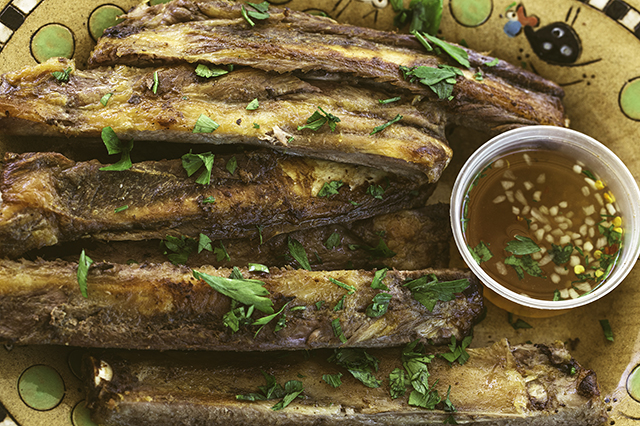
Vietnamese Spare Ribs
Ingredients:
The Ribs
• 1,5 kilograms of pork spare ribs
• 1 small red chilli, sliced, to serve
• 1 tablespoon of fresh coriander leaves (for garnish),
chopped roughly
Marinade
• 2 dry red chillies, finely chopped
• 1⁄2 cup of lime juice (or lemon juice)
• 1⁄4 cup of fish sauce
• 1/3 cup of brown sugar (or palm sugar if you have)
In an age of information overload, Sunrise is The Namibian’s morning briefing, delivered at 6h00 from Monday to Friday. It offers a curated rundown of the most important stories from the past 24 hours – occasionally with a light, witty touch. It’s an essential way to stay informed. Subscribe and join our newsletter community.

The Namibian uses AI tools to assist with improved quality, accuracy and efficiency, while maintaining editorial oversight and journalistic integrity.
Stay informed with The Namibian – your source for credible journalism. Get in-depth reporting and opinions for
only N$85 a month. Invest in journalism, invest in democracy –
Subscribe Now!