Sanitation crisis in Windhoek’s informal settlements a ticking time bomb
The Smell of rotting food, human waste and smoke hangs in the air at Epandulo, an informal settlement in Windhoek’s Moses //Garoeb constituency.
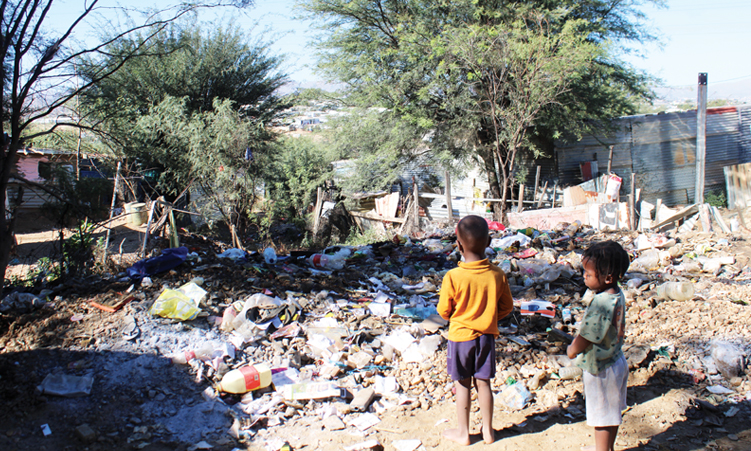
Children run barefoot through pathways of corrugated iron shacks and among piles of uncollected waste dumped in an open space opposite a kindergarten.
For parents like Natalia Theofelus, the consequences are visible in their homes.
“Children play there because it is in front of their school. They come back home with diarrhoea, flu, or sometimes vomiting,” she says, calling on the City of Windhoek to urgently develop the community.
For nearly 1 500 residents who call Epandulo home, this is not a temporary inconvenience, but a reality they have endured for 33 years.
‘Epandulo’ means ‘grateful’ in Oshiwambo. However, the residents feel they have little to be grateful for.
While other residents in Windhoek expect the municipality’s garbage truck to collect their waste once a week, Epandulo residents do not have that luxury.
The settlement, with only three taps, does not have toilets or skips, despite being created three decades ago.
Residents like Lotto Nangolo use flying toilets in the form of plastic bags, buckets and the riverbed.
“We have been waiting for toilets for over 30 years. Our community is congested and not safe. The municipality must bring us toilets,” he says.
Nangolo says having three taps for 1 500 people is inadequate.
The open area near the kindergarten has become both a playground and dumping site.
Everyday, teacher Olivia Dausas watches children arrive at Nelson Pre-School while rubbish accumulates outside of it.
WALKING far FOR WATER
Fetching drinking water for the children is another challenge because the tap is far away.
“We did a cleaning campaign last year, and it looked better for a while, but because there are no waste disposal facilities, residents continue dumping here,” Dausas says.
Current constituency councillor Stefanus Ndengu on Wednesday said it is the municipality’s responsibility to ensure residents have basic services, adding that his office can only make proposals.
Okahandja Park Section B, which The Namibian visited on Saturday, is another community struggling with sanitation and waste management. It was littered with uncollected rubbish, with no toilets and waste facilities in sight.
The settlement was formalised in 2018 and has only basic electricity and five taps.
Behind Elago Eliaser’s house lies a mountain of trash. Residents have resolved to burning the waste when it builds up to create room for more rubbish.
“It is sometimes difficult to breathe. The smoke is very unpleasant,” Eliaser says.
His daughter (6) suffered a lung infection in 2023, while he received treatment for tuberculosis (TB).
Family member Kasera Jonas coughs repeatedly while speaking. “Every other day I have flu, I’m coughing, and my chest is burning. This is a health concern for us. The city must bring us waste bins please,” he pleads.
The pile of refuse behind the house is impossible to ignore. Part of the fence broke because of the pile up. Used nappies, food and faeces were scattered around, while children weave in and out of the rubbish as they play.
During the rainy season, residents say the situation worsens as water carries waste through the settlement, spreading foul smells and increasing fears of diseases.
For people living with disabilities, the lack of toilets presents additional hardships.
Community leader Phillip Shipanga says many residents are forced to travel long distances or depend on relatives simply to relieve themselves.
The municipality has allegedly not been able to collect the waste because of a house that was built on the road, which has since been removed. However, the debris remains.
The 2023 Population and Housing Census found that 28.7% of households live in informal shacks, with urban centres carrying the largest burden, mostly in the Khomas, and Omaheke regions.
‘NOT DEVELOPABLE’
Windhoek mayor Sakarias Uunona last week said most areas were not proclaimed in the township site and were only approved recently.
“Where there are a lot of houses close to each other, some houses need to be relocated to allow that service. You cannot have a pipe under the structure,” he said.
City of Windhoek spokesperson Lydia Amutenya last week said formalisation of brownfield areas such as Epandulo are determined through community profiling, including settlement boundary mapping, numbering of structures, data verification, capturing and analysis.
According to her, Epandulo had 180 structures in 2004 and about 500 recorded in 2020.
“The areas are characterised by a steep slope and have an average gradient of about 1:5, making it undevelopable. The presence of a powerline servitude and the drainage direction runs against the sewer network.
“Given these challenges, the areas are among the informal settlement areas identified for complete relocation once suitable serviced land becomes available.”
She added that the households are provided with black plastic bags to dispose waste, which the municipality collects.
Medical doctor Ludwig Gaomab says one cannot get TB from smoke, which is transmitted from one person to another through coughing or sneezing.
He says smoke is only an irritant.
Windhoek-based doctor Calvin Thompson yesterday warned that inhaling smoke from burning waste can increase the risk of respiratory diseases such as chronic obstructive pulmonary disease and lung cancer.
He said uncollected garbage can lead to long-term effects which become breeding grounds for viruses and bacteria which cause a variety of illnesses.
“They can seep into water supplies, contaminate the surrounding soil, attract rodents and the like which carry infectious diseases. Metal tins and other rusty materials can cause diseases like tetanus if someone gets cut by such an object,” he said.