



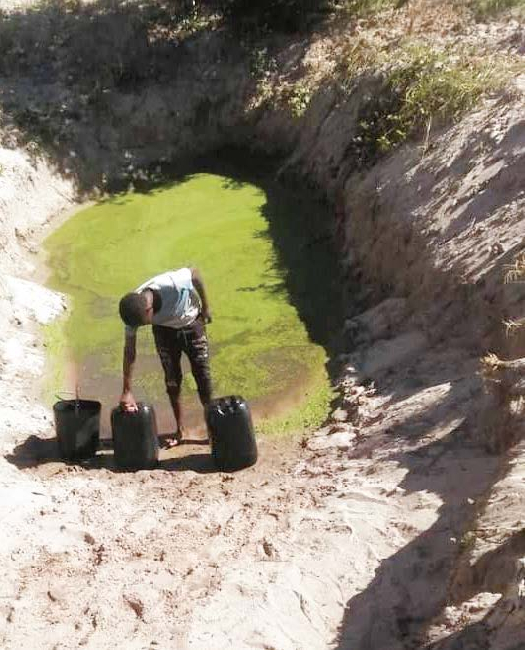
THE Covid-19 pandemic has magnified the need for clean water to prevent infection, but the community of Okankolo in the Oshikoto region continues to drink contaminated water from shallow earth dams.
The villagers have been faced with dire water shortages since independence, and have become accustomed to consuming contaminated water.
The emergence of the Covid-19 pandemic has, however, exposed them to the risk of infection as they cannot maintain good hygiene at all times.
Most of the boreholes in the area have dried up, and community members have resorted to digging their own earth dams, which they share with animals to quench their thirst.
This is said to have been an ongoing issue for many years, and several efforts made by the villagers to get access to clean, potable water, have yielded no results, they say.
Aina Amutenya, a resident of the Oluundje village at Okankolo, says they are at greater risk of contracting Covid-19 and are unable to maintain good hygiene.
“ . . . how are we able to do that when we do not have access to clean water? How can we wash our hands with dirty water and not contract Covid-19? We are tired and we want the government to assist us. We cannot drink dirty water forever,” she says.
Amutenya says the situation has made the villagers prone to diarrhoea, and children and the elderly more vulnerable to disease.
Oluundje does not have access to a healthcare centre, proper road infrastructure or electricity either, they say.
Villagers mostly commute long distances to access healthcare services.
Vilho Natangwe, another villager, says they often get sick when consuming the polluted earth-dam water.
“No one in their right mind would want to consume that dirty water. It has algae and smells horrible. We are faced with water shortages, and now we have another battle added to that.
“Every year, we are being told to wait for the government to bring us services, but nothing happens,” he says.
Oshikoto regional governor Penda ya Ndakolo in his state of the region address said the rural communities in the region are faced with severe potable water challenges, despite several efforts made to connect communities to water supply.
He said the Directorate of Water Supply and Sanitation has so far drilled about 13 boreholes at Nehale Lya Mpingana constituency, and another 13 have been installed at Eengodi, Okankolo and Nehale Lya Mpingana.
“There is an extension of the Ondangwa-Omuntele pipeline, and more thank 460 customers were registered and issued with water meters. Water tanks and tank stands have been erected at 21 schools from seven constituencies in the region. Potable water remains a challenge – especially in the rural areas,” he said.
Ya Ndakolo said the region is faced with these challenges due to poor road conditions, and the sandy and thick bush environment.
The region has been allocated N$243 185 000 for the 2021/22 financial year for the implementation of projects and programmes.