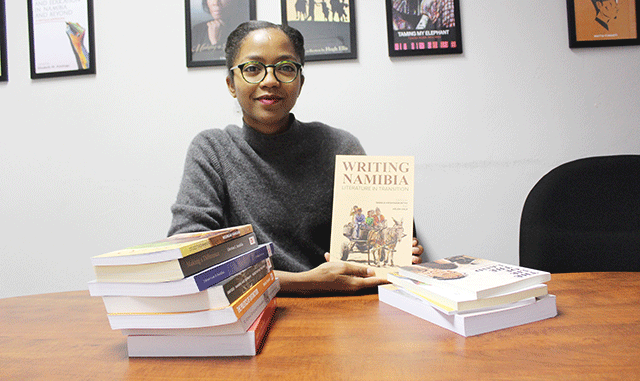
The culture of reading and writing is a vital element of academics and having a publishing house helps students and authors to share their research with the masses. YouthPaper sat down with the editorial and production manager of Unam Press, Mutaleni Nadimi, who share more about the role of the academic publishing unit.
Unam Press was established in February 2012, after a consultation was done on the need of the University of Namibia (Unam) having a publishing house.
“The results of this consultancy indicated that Unam students needed a reputable scholarly publisher to publish their research,” said Nadimi.
Much of the research published by Unam Press is very specific to Namibia and southern Africa, says Nadimi. This is because international publishers may not have the appetite for something so specific but there is a need for Namibian publishing houses to publish research based on Namibia.
“The minute we discover that the content is about something else besides Namibia and southern Africa, we then encourage those authors to look for publishing houses elsewhere because it does not fall under our scope,” clarified Nadimi.
On how to get your book published via Unam Press, Nadimi shared that there is a process that the publishing unit has established that guides Unam Press in keeping its standards high.
The publishing house has a submission process where authors submit their manuscripts through a proposal form. In these proposals, authors explain what research their material is based on.
“Because it is a scholarly publishing house, all material we publish has to be based on research,” said Nadimi.
All the manuscripts submitted go through a double blind peer review. The double blind peer review means that the reviewer has no idea who the author is and the author has no idea who the reviewer is. Unam Press facilitates this process.Unam Press has an editorial board that implements policy and approves or rejects proposals and manuscripts.
She added that authors do not pay to have their books published; what is required of them is penning manuscripts and ultimately submitting this content. The costs are covered by the Unam budget, which entails editorial, the design and the printing. “Even though the costs are covered by Unam, the author has the copyright of the content but Unam Press retains the right to publish it for a specified time period depending on the contract. The work is always copyright of the author,” she said.
Nadimi shared that some of the challenges that Unam Press encounters is not having enough copies of the books they publish at the university’s library. She also mentioned that sometimes books are prescribed but students are picky on what they spend large amounts of money on.
“Distribution is always a challenge, getting our books to the people is something we struggle with but we are visible on social media, on Unam’s website and we work with Unam’s marketing interns to publicise our books,” she said.
Despite these challenges, Unam Press prides itself on providing Namibian authors and readers with legitimate publishing opportunities.
The publishing unit plays an important role in fulfilling the vision and mission of Unam by disseminating the results of the university’s research across a broad spectrum of real world problems in order to communicate and share this information with others and contribute to nation building.
“We serve as a repository for the preservation, development and articulation of national values and culture, through the promotion of Namibian history, art and languages,” added Nadimi.
Also speaking to YouthPaper was Unam Press’s administrative officer, Fredrika Motinga, who shared that she is proud to be working for an entity that contributes to the preserving of Namibian culture and history.
“It is important that students take an interest in doing research and documenting topics pertaining to Namibia for the future generation,” said Motinga.
On the importance of doing research based on Namibia, Nadimi added that Namibian content is the material that readers are most interested in.
“Students who often come through our doors are most interested in Namibian autobiographies and novels because they want to understand Namibian history through a personal lens,” she said.
In an age of information overload, Sunrise is The Namibian’s morning briefing, delivered at 6h00 from Monday to Friday. It offers a curated rundown of the most important stories from the past 24 hours – occasionally with a light, witty touch. It’s an essential way to stay informed. Subscribe and join our newsletter community.

The Namibian uses AI tools to assist with improved quality, accuracy and efficiency, while maintaining editorial oversight and journalistic integrity.
Stay informed with The Namibian – your source for credible journalism. Get in-depth reporting and opinions for
only N$85 a month. Invest in journalism, invest in democracy –
Subscribe Now!