Three people have died after a suspected hantavirus outbreak on a cruise ship sailing in the Atlantic Ocean, according to the World Health Organisation (WHO).
Oceanwide Expeditions, the operator of the MV Hondius ship, says a Dutch husband and wife and a German national who were on board the vessel have died.
Two cases of hantavirus have been confirmed so far, including the Dutch woman who died. The causes of the deaths of the other two passengers are being investigated.
Meanwhile, two crew members are presenting with respiratory symptoms, Oceanwide Expeditions has said.
The outbreak was reported aboard the cruise ship which was travelling from Argentina to Cape Verde.
WHAT IS HANTAVIRUS?
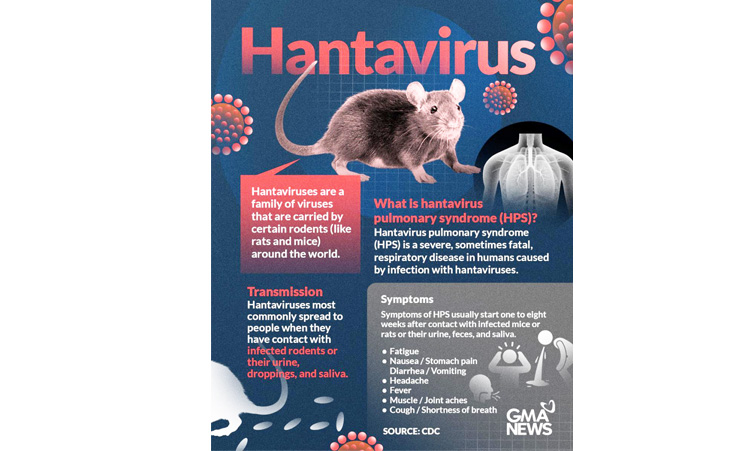
Hantavirus refers to a strain of viruses carried by rodents, primarily transmitted to humans through inhalation of airborne particles from dried rodent droppings.
Infections typically occur when the virus becomes airborne from a rodent’s urine, droppings, or saliva, according to the United States (US) Centres for Disease Control and Prevention (CDC).
Though rare, it can also spread through rodent bites or scratches.
The virus can cause two severe illnesses.
The first, hantavirus pulmonary syndrome (HPS), often starts with fatigue, fever, and muscle aches, followed by headaches, dizziness, chills, and abdominal issues.
If respiratory symptoms develop, the mortality rate is approximately 38%, according to the CDC.
The second illness, haemorrhagic fever with renal syndrome (HFRS), is more severe and primarily affects the kidneys.
Later symptoms can include low blood pressure, internal bleeding, and acute kidney failure.
CONFIRMED/SUSPECTED HANTAVIRUS CASES
A 69-year-old British national, who is in intensive care in a hospital in South Africa, has been confirmed to have hantavirus.
It has also been identified as being present in the Dutch woman who died after disembarking in Saint Helena.
Oceanwide Expeditions has said two crew members – one British and one Dutch – are presenting with acute respiratory symptoms but hantavirus has not been confirmed.
The operator says one had mild and one had severe symptoms, but both required “urgent medical care”.
The cruise ship remains off the coast of Cape Verde with 149 people onboard from 23 countries.
TIMELINE OF OUTBREAK
According to the WHO and Oceanwide Expeditions:
6 April: A male passenger of Dutch nationality developed symptoms of fever, headache and mild diarrhoea while onboard the cruise
11 April: The man developed respiratory distress and died
24 April: He was disembarked in Saint Helena and his wife, also a Dutch national, joined the repatriation. She was presenting with gastrointestinal symptoms
25 April: The Dutch woman deteriorated during a flight to Johannesburg, South Africa
26 April: She died in hospital and hantavirus was confirmed
27 April: Another passenger, a 69-year-old British man, became seriously ill and was medically evacuated to South Africa. He is in a critical but stable condition in intensive care and hantavirus has been confirmed in this patient
2 May: A German female passenger, who was presenting with pneumonia, died. Hantavirus has not yet been confirmed in this patient.
CASES REPORTED GLOBALLY
There are an estimated 150 000 cases of HFRS worldwide each year, primarily in Europe and Asia, according to a report from the National Institutes of Health.
More than half of the cases typically occur in China.
The latest data from the US shows that from between 1993, when surveillance of hantavirus began, until 2023, there were 890 cases in the country.
However, Seoul virus, one of the main strains of hantavirus that is carried by Norway rats (also known as the brown rat), is found worldwide, including in the US.
HOW IS IT TREATED?
There is no specific treatment for hantavirus infections.
Medical investigators believe the woman contracted HPS – the most common strain in the US – which led to her death.
Nests and some dead rodents were found in outbuildings of her house where she was found.
Police records showed that she searched the internet for information about flu and Covid symptoms in the days before she died.
Signs and symptoms
Hantavirus Pulmonary Syndrome (HPS)
HPS is a severe and potentially deadly disease that affects the lungs. Symptoms of HPS usually start to show one to eight weeks after contact with an infected rodent.
Early symptoms can include:
* fatigue
* fever
* muscle aches, especially in the large muscle groups like the thighs, hips, back, and sometimes shoulders
– BBC