





Anyone exhibiting in ‘Art Horizons’ the Unam Annual Student Art exhibition with Dimitri Morani Karon is about to get their first taste of being a public artist.
They are about to be largely ignored while this review focuses on the exemplary body of work presented by the poet, visual artist and rising star.
They are going to mutter under their breath at the fact that Dimitri has been identified as heads and shoulders above the rest of them. And then, if reviews are still worth anything in this world, they are going to head to the National Art Gallery of Namibia (NAGN), take another look at his work and understand why no one is talking about their run-of-the mill lampshades, indolent sculptures, uninspired photography and underwhelming textiles.
Though it seems incredibly unlikely, in addition to being a poet, Spoken Word and visual artist, Dimitri Karon is also a magician and his trick has the simple set up of patrons walking into the NAGN’s main gallery and watching as every other student’s work winks quietly out of existence.
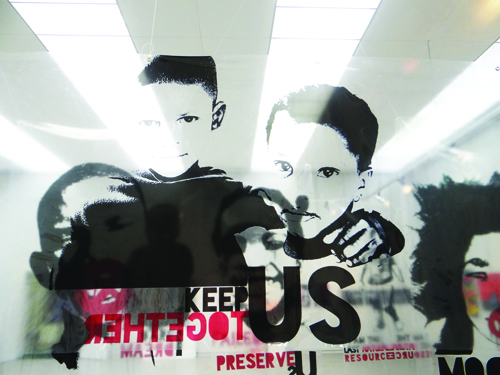
Strung from the ceiling as bold, red and black images, Dimitri’s transparent banner installation dominates the space physically as well as in terms of relevance, coherence and punchy aesthetic appeal in way that is so overwhelming everything else seems to pale to disappearing.
In a presentation whose message speaks to its form, Dimitri’s banners depict the somber youth above phrases like “They have failed us”, “I am the last natural resource”, “freedom ain’t free”, “preserve us” and “keep us together”.
Here Dimitri gives the youth a voice in stark and succinct tones while commenting on a society in which the young are not being provided for by their parents and adult society with regard to education, protection, familial stability, respect of their person and investment in their future.
Through his banners, the form of his exhibition mimic’s the youth’s future which also dangles precariously from a ceiling that keeps getting lower and lower in terms of success and survival.
This component of his collection is elegantly titled ‘The Odyssey of Morani Chapter 1’ and the theme of social consciousness is picked up in ‘The Odyssey of Morani Chapter 2’ in which Dimitri presents issues of abortion, bullying and sexual assault as well as more esoteric ruminations in words and graphics.
A lot less exciting is Dimitri’s art for advertising which presents a VAN’s campaign with the slogan ‘Levitate above the Rest’.
Rotely funky, fun and with just enough new age allusion to keep everyone happy, the collection seems like a lackluster reminder left by the Ghost of Christmas future should Dimitri not continue developing what is clearly an exceptional creative and independent spirit.
The student trailing just behind Karon in terms of skill is Barton Ting who combines graphic novel elements with photography. His work, which includes a glowing gold skeleton in big black box fringed with sometimes gruesome anthropomorphic animal cartoons is interesting and arresting but he seems to struggle to alight on a point. Not in a way that is alluringly nihilistic but in a way that seems slightly scattered.
Artist Wilhelm Brockerhoff’s Art for Advertising print piece which re-imagines a boxing poster with a man and a little boy with the line “Stop Mismatched Fights” is conceptually pretty powerful in as much as it refers to violence against children but it is not as visually stimulating as one would like. Still, he seems to be living in modern day Namibia and making strides towards coming to terms with and raising awareness about his society through his art.
Kashiya Musonda’s ‘No! Run! And Tell’ booklet with the slogan ‘Caution my future ahead’ is also accomplished and seems like a feasible and readable publication in terms of educating the youth and adults about abuse’s invisible scars, behavioural signs and psychological consequences.
Because not all art has to make some huge social statement and there is indeed the wonderful world of art for art and beauty’s sake, one must mention Isai Aindongo whose ‘Dream Come True’ is a visually pleasing painting that is all silhouettes and suggestion buoyed by a lovely use of colour especially in its blending of blues and greens in its upper frame.
Jo-Marie Kisting’s sweet, pink cardboard and rope print textiles fashioned into a pillowcase, adorned blackboard and photo frame are functional, fun and neat.
So go the stand-outs. There are neat and nice pieces. There are pieces you feel like you have seen before, better, and which don’t say much and then there is Dimitri Karon who rules them all simply because he understands what it takes to be an artist.
Everything from the colours he chose to depict his experience and observations about Namibian society to literally making his comments dwarf everything else in the room because he feels that these issues are larger than life itself elevate him above the rest.
This is because there is thought, there is coherence and there is unabashed, undeniable and visible passion in every piece he puts forward.
What remains to be said to Unam students pouting about all that hard work that says and evokes nothing is:
Always remember that you are training to be artists. You are learning how to do things so you have the capacity to do those things differently, upside down, inside out, in black and white, in technicolour or in whatever way intrepidly speaks of your soul.
Artists burn. They burst. They don’t do things in a way that is expected or boring or as close to the template as possible. They want to shock people, stir them and make them think while re-colouring reality. If that is not you, if that is not your work, then you are not an artist.
Not like Dimitri.
And not like anyone I want to see.
“Art Horizons” closes on 29 November 2013 and can be viewed at the National Art Gallery of Namibia.
– martha@namibian.com.na or marth__vader on Twitter