






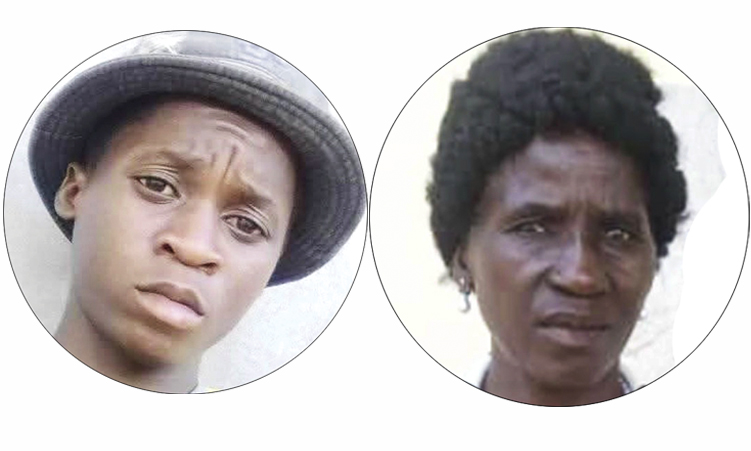
Rauha Uugwanga thought she was finally at peace after skeletal remains found in the mountains west of Otjomuise on the outskirts of Windhoek were identified as those of her missing son.
Instead, she has been left with more questions than answers.
“I’m not sure yet if the remains are those of my son,” she told The Namibian on Monday.
However, the police say they have evidence that the remains are that of her son.
Nearly two weeks ago, the police announced that the remains discovered have been positively identified through DNA as those of Beatus “Tuna” Iiyambo (25), who went missing on 11 January.
But Uugwanga is demanding answers before she accepts it as fact.
She questioned how the police have positively identified the remains as those of Iyambo when she had not provided the DNA sample she says is needed to confirm his identity due to an error on her birth certificate.
“I have been told to correct it before providing the DNA,” she says.
She says the police used an old DNA file they took when clothing with human skeletal remains were discovered in the bushes at a riverbank along the Matshitshi gravel road at Otjomuise in July.
However, police spokesperson deputy commissioner Kauna Shikwambi says this is not the case.
Shikwambi says the woman who was confirmed as Iiyambo’s biological mother was taken to the forensic pathology office at Okahao, where a reference blood sample was collected for DNA analysis.
She says about four officers were present when the sample was collected. The sample was taken to compare the mother’s DNA profile and that of the discovered human skeletal remains.
“A reference sample collection form was completed to document the collection of the blood sample.
Iiyambo’s mother, as the donor of the sample, affixed her signature to the form to confirm that she had provided the reference sample,” she said yesterday.
Shikwambi sayd the sample was then sent to the National Forensic Science Institute in Windhoek for forensic DNA analysis and compared with the DNA profile obtained from the discovered remains.
“The comparison confirmed that the remains were those of the biological son of the woman who provided the reference sample, thereby confirming the identity of Iiyambo …the identity was not confirmed through DNA testing of the remains alone, but compared with DNA samples from the confirmed biological mother,” she says.
She urges the public to provide accurate information, especially in sensitive cases, adding that it prevents confusion, misinformation and unnecessary distress for families and communities.
Iiyambo’s cousin, Elly Nekwaya, yesterday said the family was called after the discovery of the remains to see the area where it was found.
However, Nekwaya says the location did not appear to show signs that someone had been lying there.
“Even when a chicken dies at a spot, you would see that it was lying there. Signs will be there. There was no evidence that Tuna was lying there,” she says.
She says she could not question the police at the scene because the remains, including documents found there, had already been removed.
“We don’t even know whether they really took us to the area where the remains were discovered,” Nekwaya says.
Nekwaya claims the police also refused to show the family pictures of the remains before they were removed from the alleged spot.
She says the family was only shown documents, a jersey and trousers believed to belong to Iiyambo.
“The colour of the jersey and trouser, according to the mother, belong to him.
But his documents don’t show any sign of something that has been in the sun for long.
Even the clothes looked clean, but they took us to a place with sand and grass. How is that possible?” she asks.
The remains, discovered by a man who was herding goats in the area, are still in the possession of the police.
FINAL JOURNEY
Iiyambo, a Onakaheke village resident in Omusati, went missing on 11 January after travelling to Windhoek following up on a job offer to sell kapana at Otjomuise-based businessman Matheus Shapaka’s bar in 8ste Laan.
He travelled with Frans Amwaama, who was sent by Shapaka to transport him.
It was his first time in Windhoek.
The day after he arrived at Shapaka’s house, Shapaka allegedly called his mother, telling her he had arrived safely.
However, Shapaka informed that her Iiyambo did not sleep throughout the night and was hallucinating and calling out names of people from his village.
Iiyambo’s brother, Natanael Katuta, in March said his brother never showed signs of mental illness or hallucinations.