






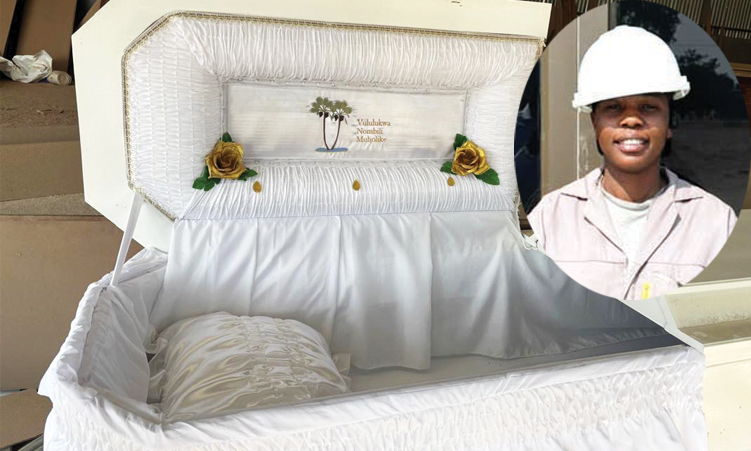
The small white coffin in front of Hendrina Hasholo is barely the length of an adult’s arm.
Hasholo carefully works on the final details, dressing the casket before it leaves the workshop.
It is a task she has performed countless times since entering the funeral industry, but this one is different.
It’s made for a newborn.
Around her, drills are whining and sawdust is covering the floor of the Shilongo Gravestone and Funeral Services workshop at Aakweenyanga near Ongwediva.
Hasholo (32) moves calmly among the timber and tools. To her, this is not a place of fear.
It is a workplace. A skill.
And the job that puts food on her family’s table.
Wearing an overall and black boots, Hasholo says coffin making is her trade. She says she and her colleagues normally finish three caskets and six coffins in a day.
“I love my work very much. This is where I get my bread,” Hasholo says.
She has been working at Shilongo since 2022, but her hands had already become familiar with timber long before she arrived there.
Hasholo studied carpentry and joinery at Eenhana Vocational Training Centre, where she learnt how to work with wood and make items such as cupboards and caskets.
Her entry into coffin-making, however, was not part of a carefully planned career.
At the time, she was simply looking for a job.
“I was looking for any kind of job, and they hired me to make coffins,” she says.
That opportunity introduced her to a trade she would eventually master.
For about a year and five months, Hasholo worked at Ndilimani Funeral Services, where she learnt how to measure, cut and assemble the different parts of a coffin.
She still remembers the first coffin she made.
“It was a half-view casket and I made it well,” she says.
She later worked at Kanekutu Funeral Services before joining Shilongo.
Years of working with timber have since turned the once unfamiliar task into a skill she carries out with confidence.
Today, Hasholo makes more than just coffins. She also makes caskets and domes, working with different shapes and sizes.
Her work does not end with assembling the wooden structures.
Hasholo also dresses and paints the coffins, adding finishing touches before they leave the workshop.
She says the work requires patience and precision. A small mistake when cutting the joints can cause problems later, particularly when the lid has to be fitted.
“If you don’t cut the joints well, it will be difficult to put the lid on,” she says.
SURROUNDED BY DEATH
Although coffins are part of Hasholo’s everyday work, she says many people are uncomfortable around them.
She believes the coffins’ shape is one reason.
“Most people fear coffins because it is the shape of a person,” she says.
For Hasholo, however, the shape is simply part of the design.
She has learnt to work with different measurements, shapes and sizes, transforming pieces of timber into objects that will accompany people on their final journey.
The occupation, however, has its quirks, she says.
Hasholo says some people attach strange beliefs to coffin making, with some even calling coffin makers witches because of the work they do.
She does not allow such beliefs to discourage her.
For her, a coffin is not something to fear – it is the product of a skill she has acquired.
It is also her livelihood.
A mother of one, Hasholo also supports her four siblings and her parents, who are pensioners.
She says visitors to the workshop sometimes ask whether she is afraid of doing this kind of work.
“I love my job,” she says.
A LADY IN THE WORKSHOP
Hasholo is the only woman among the men working in the workshop. Her presence often catches the attention of visitors, some of whom stop to watch her work.
Others encourage her to continue.
“They say it’s rare to find a woman assembling coffins,” she says.
She has also received encouragement from people who have seen her work on social media.
Being a woman has not stopped her from developing her skills, she says.
CHOOSING SKILLS
Hasholo’s journey has shaped the advice she has for young people.
She believes vocational training can provide an alternative for young people who do not perform well in conventional academic education.
She particularly encourages young women to consider vocational training and practical skills.
“They should enrol in vocational training centres. It is good to work on your own,” she says.
For her, learning a trade is a way of gaining independence.
She does not believe young people should stay at home waiting for their parents to provide for them. “They need to work to provide for themselves,” she says.
Hasholo’s colleague Carlos Kaluwapa says she has proven that skill has no gender.
“What stands out for her is that she is determined and willing to learn, willing to take on the challenges and, most importantly, willing to work hard,” he says.
Kaluwapa says there were times when work was not easy, but Hasholo kept pushing forward.
“As a male colleague, I can honestly say working alongside her has changed the way I look at women in the workshop environment.
“She has shown that women can stand shoulder to shoulder with men and contribute meaningfully and excel in a field traditionally dominated by men,” Kaluwapa says.
He describes Hasholo as a hard-working and courageous person.