





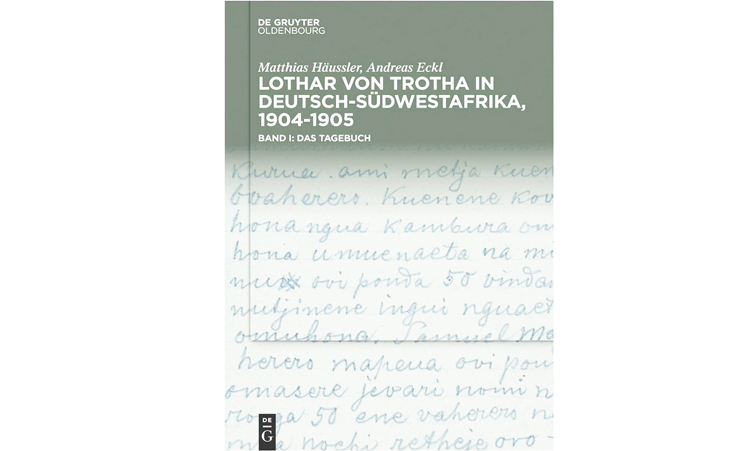
More than a hundred years after the death of Lothar von Trotha – regarded as the man largely responsible for the genocide of the Ovaherero and Nama in the colony of German South West Africa between 1904 and 1908 – his South West African war diary and photo album have finally been published.
The public has had to wait a long time for this, and not only in Namibia.
Both editors of the publication ‘Lothar von Trotha in Deutsch-Südwestafrika, 1904-1905, Vol I: Das Tagebuch’ (‘Lothar von Trotha in German South West Africa, Vol 1: The Diary’), and a second volume, of Trotha’s photo album, qualified for the project through their previous research and publication activities. Matthias Häussler is best known for his fundamental study ‘Der Genozid an den Herero. Krieg, Emotion und extreme Gewalt in Deutsch-Südwestafrika’ (‘The genocide of the Herero. War, Emotion and Extreme Violence in German South West Africa’) (2018), which has since become a standard work.
Andreas Eckl also has relevant experience. Among other things, he has published the diaries of two Schutztrupp soldiers and participants in the colonial war.
The two editors have produced an excellent edition of such an important source by Lothar von Trotha – despite restrictions imposed on them by the German Research Foundation, which was funding the project.
Looking through Trotha’s entries, nothing fundamentally new can be learnt about the time of his departure from Hamburg in May 1904 until his return in December 1905. The diarist notes the movements of troops, the course of war operations, his hobbies, his health complaints, and mixes them with often derogatory remarks about members of his staff, officers and soldiers.
The smouldering conflict with governor Leutwein, who sought negotiations with the Ovaherero, whereas Trotha categorically ruled them out, is also known.
The diary reflects Trotha’s increasing frustration after the longed-for total “victory” had not materialised at the Battle of Ohamakari (Battle of Waterberg).
He was deeply offended by Kaiser Wilhelm II’s ultimate lack of favour and the lack of applause from the German press.
However, nothing can be found about the period of persecution of the Ovaherero in the Omaheke from September to October 1904 or about the concentration camps. Trotha does not appear to have ever entered any of the camps. Only once, on 14 January 1905, does he mention the concentration camps, for which he does not feel responsible.
He regrets the instruction from Berlin not to put chains on the prisoners.
In general, the horrors of war are completely ignored. Trotha lacks any empathy for the suffering and mass death of the Africans.
Between all of Trotha’s reports on everyday life at headquarters, remarks using genocidal language flash up again and again: “The natives must be destroyed, see America” (1 July 1904); “To bring peace here, other than with rivers of blood, is wrong” (16 July 1904); “Purpose of the whole warfare, destruction of the whole nation” (3 August 1904).
Such statements match Trotha’s other letters to Berlin, for example the one of 26 October 1904 to chief of the General Staff Schlieffen: The incoming news would confirm the “gradual decline of the Herero nation in the Omaheke”.
He was not even interested in the cynical argument of preserving the labour force of the “natives”.
It is above all these passages that show Trotha as a colonial warrior who waged his campaign of destruction like a white beast and gave no quarter. “Everything will be shot to death! – Basta!”, he noted on 23 September 1904.
Throughout his life, Trotha showed no signs of remorse. What is surprising, however, is that the diary contains no evidence of extreme racism, even though Trotha was regarded as a “race fighter” per excellence.
The second volume is dedicated to the photo album of the amateur photographer Trotha. The portfolio is characterised above all by its blank spaces.
All sorts of things are shown, but the actual acts of war and their consequences are ignored. There are no dead bodies to be seen, nothing of the enemy.
The war is strangely absent from the amateur shots. The photographs give the impression of a somehow ‘normal’ colonial war.
Trotha’s portfolio thus belongs to the long and unfortunate tradition of denying the genocide and trying to banish it from individual and collective memory, as the editorial team writes.
Although it can be said that Häussler and Eckl have done an excellent job, the perspective of the Ovaherero and Nama could have been given greater consideration in detail, not least in order to avoid the danger of only remaining bound to the German historical sources.
The publication of the Trotha diary does not require a new assessment of the colonial war. It confirms the findings of the genocide to which the Ovaherero and Nama fell victim.
Individual questions, such as when the threshold of genocide was finally crossed, will have to be discussed further. For what Trotha did in the colony, the consequences of his ultimately genocidal war of extermination – he himself described his warfare as “terrorism” – he finds neither words nor images in his work.
With this summary, the two authors get to the heart of the matter.
- Joachim Zeller is a historian and author based in Germany.