



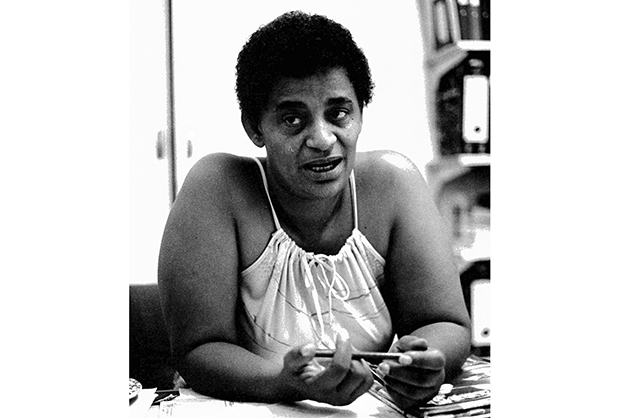
• GERSON UARIPI TJIHENUNAON 17 March 2018, one of Namibia’s most colourful politicians, Nora Schimming-Chase, was laid to rest at the family farm De Rust in the Rehoboth district, Hardap region.
As fate would have it, her funeral took place barely four days before we celebrated our 28th anniversary as an independent nation on 21 March 2018. This is a country she fought for, and served with distinction and grace. What an ironic, if cruel, twist of fate for this great woman to have been buried a few days before the 28th commemoration of our independence!
If my recollection of Afrikaans and Dutch serve me well, “De Rust” can be translated into English as “the place of rest.” It is my prayer and belief that this great daughter of the soil (as President Hage Geingob referred to her at the memorial service) has finally found rest at “the feet of her parents” after having suffered a great deal due to the illness that she had to endure during the last few years of her life.
I attended the memorial service that was held at Parliament Gardens on 16 March 2018, and was listening in awe as different speakers were weighing in on the life of this remarkable woman; just thinking to myself, “what a life!”
Different speakers paid tribute to this iconic woman in rich and expansive tones since her passing on a week or so earlier – on 13 March 2018, to be exact. I cannot claim to have been close to Nora Schimming-Chase in any way. I came to know her a little bit closer in the early 1990s shortly after our independence when she was working for the then Ministry of Foreign Affairs and I was working for the Office of the Prime Minister.
However, it goes without saying that Schimming-Chase was a household name in the Windhoek area as we were growing up in the sixties and seventies. I remember that at official level, our paths crossed on the government committee that was set up in 1998 to prepare for the Lisbon Expo (an international trade fair of sorts).
I was representing the Office of the Prime Minister on that committee, which I believe was chaired by her. During the meetings of this committee, I found her to be focused and extremely articulate.
Many of the speakers at the memorial service described her as a seasoned diplomat, a formidable debater in parliament, and a woman whose record speaks volumes as far as the accolades she had obtained in Namibia and beyond our borders are concerned.
The story of her life reads like a well-written novel; and that is an interesting coincidence because in her life, she was a gifted linguist and a first-rate literary intellectual in her own right. And according to her grandchildren’s account at the memorial service, she was a great lover of poetry too. In paying tribute to her beloved younger sister, Othilie Abrahams challenged the mourners to put Nora’s story in writing so as to encourage and educate the younger generation.
My humble contribution in this opinion piece is a response to that challenge, and I want to briefly look on the contribution of Nora’s life to the cultural and intellectual life of Namibia. In reading her eulogy, Peter Katjavivi, Speaker of the National Assembly and a family friend, noted: “Their home life was multicultural and multilingual. The children spoke Otjiherero to one grandmother, Damara/Nama to another, and Afrikaans among themselves until they learnt English at school. The parents often spoke German between themselves.”
According to Katjavivi, Schimming-Chase was fluent in Otjiherero, Damara/Nama, Afrikaans, English and German and had a working knowledge of French. She was born in the Old Location (a melting pot of cultures), on 1 December 1940, to famous businessman and community activist Otto Schimming and his wife Charlotte.
Her brother, Dr Schimming, was the first black medical doctor in colonial Namibia. She therefore had an impressive pedigree because she came from a family line of achievers. Given her strong belief in pan-Africanism, it was not surprising that later she got married to a medical doctor from the Caribbean, Dr William MacDonald Chase.
Against the backdrop of this cultural interweaving throughout her life, her story turned out to be a multicultural tapestry that seemed to have been shaped by a masterstroke into “outjina” (the Otjiherero equivalent for symphony orchestra). I recall some of the mourners whispering in confusion at the memorial service: “….but what was she…?” My answer is, she was a true Namibian!
If it was possible for Nora’s parents, Charlotte (a Damara lady) and her husband Otto Schimming (who was born to an Omuherero mother and a German father) to raise their children to identify themselves as Namibians first, what can prevent us from instilling the same culture in our children?
When you are invited to a birthday party in a certain West African country where people are very status conscious, and you meet people who do not know you, you do not just introduce yourself by name and surname only; you tell them the academic qualifications you have, and where you obtained those. I know that in Namibia we are very modest, but I want to remind the readers about a few things concerning the academic achievements of this remarkable woman.
I do not know how many of our young people realise the significance of having been educated at the Free University of Berlin, where Nora Schimming-Chase read political science, English literature, and African literature for her first degree. Do we know the value of doing a stint as an exchange student at the renowned Columbia University in New York, and another short programme at the Institute of Social Studies in The Hague?
These are the academic institutions where Nora Schimming-Chase was educated at in different times of her life, and they are not Mickey Mouse institutions; these are “big” players in the league of academia! She completed her master’s degree at the Free University of Berlin in 1968, and was admitted to do a PhD programme at the same university.
It is worth noting that normally, it is le crème de la crème students who are admitted to enrol for a PhD programme. According to the eulogy which was read by Katjavivi, her PhD thesis was entitled “The Sociological Aspects of Chinua Achebe.” Again, according to Katjavivi, Nora Schimming-Chase was later to tell him that she had lost her PhD manuscript during a visit to the US, and this was during the days before computers, and she had also not made a copy.
Unfortunately, that project was aborted; but with or without a PhD, Nora Schimming-Chase was every inch a consummate scholar.
By way of a footnote, for those who might not know who the late Chinua Achebe was, he was a Nigerian literary giant of Igbo extraction. One of his classical novels is “Things Fall Apart”, where he bemoans the clash between Western culture and African culture, where the latter has not only been marginalised, but has also come to be defined by the former in his native Nigeria. That pattern has of course been engendered by colonialism and neo-colonialism almost across the entire African continent.
I wonder what the key arguments in Schimming-Chase’s PhD thesis were, and I am sure her thesis was going to be a great piece of literature for both students of sociology and those of African literature.
Nora Schimming-Chase was a refined scholar, and a woman of substance. She was a rare breed who had an air of royalty about her. She had class and style, and oozed confidence. I hope that those who were close to her will put her full story in writing in the form of a book.
As Auntie Othilie Abrahams was to remark at the memorial service, we owe that to future generations. Rest in peace at De Rust, dear daughter of the soil.