



• Heike Becker"Words cannot be found to relate what happened; it was too terrible."
THIS is how Jan Kubas, an eyewitness to the events that followed the battle of Ohamakari in 1904, articulated his struggle to express his memories of the German pursuit of the Ovaherero into the parched Omaheke desert.Kubas was a member of the racially-mixed Griqua people who lived at Grootfontein. His testimony, and those of 46 other witnesses of the genocide that took place during German colonial rule in Namibia, were recorded in 1918 in an official British report, known as the ‘Blue Book’.
Historians Jeremy Silvester and Jan-Bart Gewald considered these statements “a rare documentation of African voices describing the encounter of African communities with a colonial power, in ‘Words Cannot Be Found: German Colonial Rule in Namibia – An Annotated Reprint of the 1918 Blue Book’.
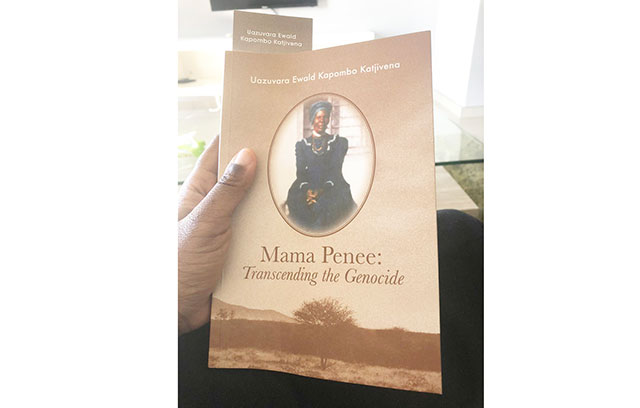
A century later we still know very little about the experience of those who lived through this first systematic mass extinction of the 20th century. A new book, which was published by the University of Namibia (Unam) Press last month, makes an extraordinary attempt to present the lived experience of the genocide. Based on oral and family history, Uazuvara Ewald Kapombo Katjivena tells the story of his grandmother, who survived the genocide as an 11-year-old. Katjivena, a former exiled liberation fighter, who returned to Namibia after independence in 1990, and is now based in Norway, narrates his grandmother’s story in a biography deeply infused with family and oral history.
In the book’s opening scene Jahohora witnesses her parents’ murder at the hands of German colonial troops in 1904. Following this traumatic experience, she wanders into the veld. The young girl survives on her own. She traps rabbits and birds, eats berries and wild honey, and occasionally feasts on an ostrich egg.
The remaining connection with her parents is cruelly cut after she is caught and forced to work for a German farmer. Jahohora suffers deeply humiliating experiences. During the ‘civilising’ washing and re-attiring, her ceremonial Herero headgear is cut into pieces and burnt by the farmer’s wife. The headgear was her mother’s significant gift for her growing daughter just before the start of the hostilities in early 1904.
Katjivena punctuates Jahohora’s personal perspective with historical facts. We read a detailed, chilling account of general von Trotha’s extermination order of 2 October 1904. Oral history however also indicates moments of humanity during an entirely inhumane era. The survivor wonders why some German soldiers saved her from certain death and gave her a chance at life while their fellows had mercilessly killed her parents. As Jajohora meets other survivors and hears their stories, she begins to understand the genocide and especially the role of von Trotha, who is locally known as omuzepe (the killer).
Surviving Genocide, and Beyond
The book falls into two parts. The first tells the story of Jahohora’s survival during the genocide. It does much more than that though. From ‘Mama Penee’, a story emerges of an extraordinary family and a deep-rooted inspiration of peace and conviviality. This transpires also in the second part of the volume, which revolves around Katjivena’s personal memory of growing up in the Okakarara area with his grandmother Mama Penee (Penee being the short form of Jahohora’s ‘Christian’ colonial name Petronella), as she was known in her later life.
Katjivena begins by telling how young Jahohora witnesses her parents being murdered at the hands of German soldiers: “The eleven-year-old girl approached the cave where she and her parents were in hiding. A series of loud cracks rang out and she turned to see where they came from. She saw her parents fetching water from the river. A line of soldiers was coming towards them. She saw the soldiers lift their rifles and aim at her parents. They fired again and her parents collapsed on the ground. The soldiers cheered.
“Almost as if she were sleep-walking, the girl went slowly towards the soldiers to embrace the same fate as her parents. As she got closer, she caught the eye of a young German soldier who stood a little apart from the others. Their eyes met, and with an almost indiscernible movement he waved his cap to indicate that she should leave, away from her parents, away from the soldiers. It was then that she realised that it was her destiny to live, and that she wanted to live.”
Following her parents’ gruesome death, young Jahohora survives using skills to scavenge from the environment that her mother had taught her. Eventually she reaches the area of today’s Khorixas and is taken in by the Damara chief as his granddaughter. Miraculously her grandmother’s brother traces her to her new home, and from there she travels on with Uncle Katunu. He had been forced to labour for the settlers but was now free. When he dies in 1907, young Jahohora is taken in by his sisters, which, as Katjivena writes, reflects the primacy of the mother’s line among Ovaherero. Mama Penee’s story turns to humiliating experiences when she has to work under the colonial administration.
Her story also indicates moments of humanity in an entirely inhumane era. In the opening scene one young German soldier turns to the girl and waves her away from certain death. In a later moment Jahohora, who has been wandering the veld, encounters a German postman who gives her a bottle of life-saving water.
Jahohora/Penee recognises that these small gestures of humanity were important for her survival. However, she is not emotionally overcome with gratitude. Katjivena comments:
“Don’t misunderstand, she had absolutely no feelings of gratefulness towards these Germans. When she later told the story to her grandchildren she always said that: ‘I was in my country and I did nothing to anyone to deserve to be threatened or to be saved, or to be forced to go hungry and thirsty by invaders in my country who turned out to be deadly assailants’.”
In an extraordinary act of courage she protects herself against rape and “having children with German men”, a calamity that happened to many other young OvaHerero women during and in the aftermath of the early 20th century colonial war and genocide. Katjivena tells this incredible episode of his grandmother’s life in her own voice: “’I made an oath that no German man would touch my body. I walked into the veld until I found a lot of nettles which I repeatedly rubbed on my arms and legs. The pain was excruciating but I repeatedly burnt my body until the swellings started to show. I wouldn’t tell my friends why I had the swellings, however often they asked me. I was happier that they thought I had some incurable disease that was possibly contagious. I never revealed my secret. That was how I got the nickname, (larva mother, after the dead skin from which the larva would emerge). Not too surprisingly, the German men stayed away from me’.”
This extraordinary account conveys that Mama Penee was a remarkable woman of immense resolve, deep thought and insight. She built upon a philosophy and tradition of love, friendship, political and personal independence that she passed on to her children and grandchildren.
Her parents and grandparents belonged to a special group of people called the , a line of ‘peacekeepers’, as Katjivena calls them. They played a significant role in their communities by helping to maintain peace among families and in the neighbouring villages. Ovatjurure were “not medicine men or soothsayers”, he insists. Rather “they served as advisors, urging those who came for advice to open their minds to peaceful solutions to their problems. As such, they never participated in disputes; they were looked upon as peacekeepers.”
Katjivena uses rich and lyrical language, with some OtjiHerero poetry in addition to the English narrative. He presents the rich metaphorical language related to the Ovatjurure peacekeeping activities. This “could be compared to a group of falcons soaring high in the sky in order to have a complete view of the society they lived in. This didn’t mean that they resolved every conflict they saw. Rather, people with disputes came to them. The various parties to a dispute would come for help to resolve their problems and reach reconciliation. This is the definition of the ‘peacekeeper’ as told to Mama Penee as a child, and it always ended with the following verse:
‘Are you troubled – yes;
Seek out the falcon – yes;
The falcon has always been and will always be your brother, your sister and your cousin.’
‘Wherever you are in the world, you will find humanity.’
In other words, wherever you are in the world, if you seek peace then you will find others who share your vision.