



THE Jamaican flag flutters outside. This is an unusual sight, especially in northern Namibia. The only flags one is likely to see around here are political party flags, and mostly the Swapo party flag, which for many symbolises their support for Namibia’s ruling party.
I am at the Uukwangula village in the Okatana constituency, about 10 kilometres outside Oshakati in the Oshana region, visiting the Tafari Art Village, which used to be an ordinary Oshiwambo traditional homestead.
I ended up here looking for a shell of a cowrie as recommended by someone on Twitter. Initially, I thought it was a shop, but to my surprise, the shop is inside the house.
Most of the Aawambo in northern Namibian villages still live in traditional dwellings, although more homes now are a combination of huts and structures of cement blocks.
Their mahangu fields surround the homesteads. So, during the growing season, the house is concealed by the tall millet stalks.
Tafari Art Village is no exception. The dry mahangu stalks left behind are a sign that this homestead too had produced during the rainy season.
“It all started with paint and a brush against the wall at the navigation of an artist…and now we see a whole art village,” says Josia Shikongo Shilongo, the man behind this creative space.
“Are you also disturbed?” Shilongo asks me, pointing at the flag which hangs on a wooden stick. Shilongo, well-known as Tafari, says it took time for him to get his neighbours to understand the different African flags that he hangs every week.
“Normally, I fly the Ethiopian flag, but this week I have put the Jamaican one. I do this in solidarity with my brothers back in Jamaica. I also do it for awareness for the people in the village so that they can learn about other African cultures,” Shilongo explains.
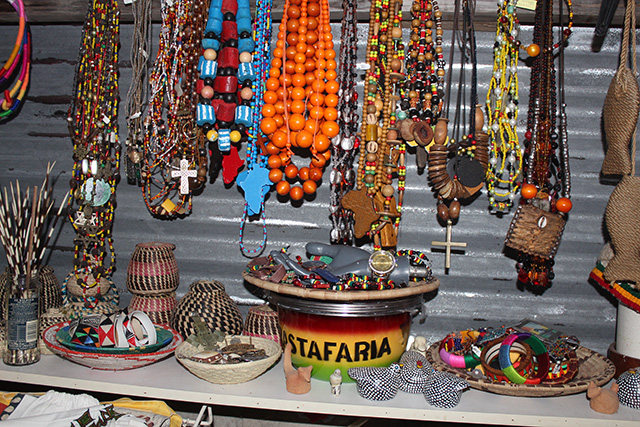
The now very colourful walls grew into something beyond colour aesthetics; it bloomed into Tafari Art Village, where visitors can camp, buy souvenirs and settle into art reading while enjoying fresh air from Namibian village life. It gets more than 100 visitors in a year.
Shilongo tells The Namibian that after returning home to Namibia in 2008 from Ethiopia, where he spent four years as part of his art residency and creating and holding art exhibitions, he decided to paint the walls of his homestead in which he was raised.
In 2008, Shilongo was a lecturer at the College of the Arts in Windhoek. But after having spent so much time abroad, penetrating the art market and rebuilding a clientele was a struggle. He left Windhoek and moved back to northern Namibia in 2014, and that is when Tafari Art Village came to life. The painted walls drew attention to his homestead, and people began to visit more often.
Now, Shilongo coordinates other creatives in his community, and accommodates their works at the art village, where he sells them at a commission. He explains that sometimes he offers his foreign visitors a different feel from the modern lifestyle. He plays cultural music, cooks traditional food, and sometimes brews traditional beer as part of the experience. This is the same message environment and tourism minister Pohamba Shifeta has been preaching. Just last month, Shifeta was speaking at the Onyofi village in the Ohangwena region during a networking session with business people from the tourism sector. He advised managers and business owners to embrace cultural tourism as visitors wish to see new things, and not a replica of what they have in their countries.
Shifeta noted that the tourism industry had shown good growth since 2016, with accommodation establishments recording nearly 60% occupancy rates across the country throughout the year.
Today, the art village offers painting classes, self-catering camping sites, an art shop, and tours into the surrounding areas. The village house also has a library which offers book lovers a variety of materials to choose from. It has Shakespeare on the shelf, and mostly history books on war and colonisers of various African countries.
“The information that you get at the art village is what they do not teach in school,” Shilongo adds.
Initially, visiting the place was at no cost. However, as it continues to gain more popularity, N$10 is charged per visitor for operational costs.
A variety of jewellery, paintings, sculptures, clothing and woven carpets can be found in the art village shop. It is open to visitors on Saturdays and Sundays. However, Shilongo, who lives with his mother and brother, says consideration to open the place to visitors on weekdays will be looked at in future.
– tuyeimo@namibian.com.na