



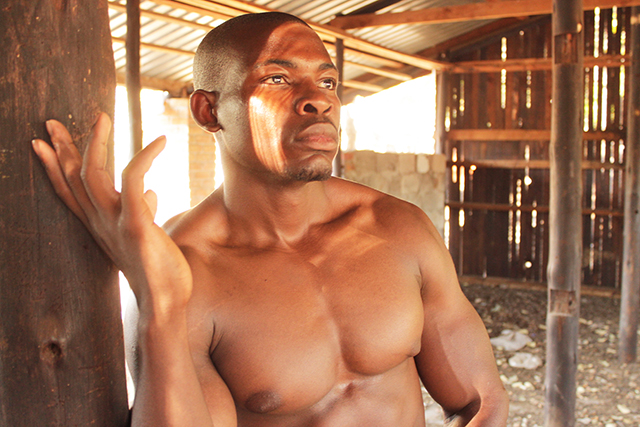
As the Ombetja Yehinga Organisation Trust (OYO) prepared to premiere ‘Kukuri’ in 2018, Unicef’s estimate of the number of Namibian children married before the age of 18 was roughly 5 400.
According to Unicef’s June 2019 report, each year 12 million girls are married before they turn 18 and globally 650 million girls and women alive today were married before they were 18.
This disturbing trend may be part of the reason ‘Kukuri’, a local film, has fared so well beyond borders. Recently nominated for an Africa Magic Viewers’ Choice Award (AMVCA) in the category of best film: Southern Africa, ‘Kukuri”s story of a young girl who must choose between tradition and following her dreams clearly resonates with audiences outside the country.
“The issue of child marriage is an important one internationally, as it clashes with many modern values such as gender equality. I think people abroad are more inclined to talk about it. Locally, we are often scared to clash with culture and being perceived as criticising traditions,” says director Philippe Talavera, commenting on why he believes the film is gaining international traction.
“Internationally, there are large movements against child marriage such as ‘Girls not Brides’. Besides that the scenery is beautiful, it is in the local language and in the end it does give a little bit of hope. I think people value those.”
Talavera’s second AMVCA best film nomination following ‘Salute!’ in 2018, the director will be attending the ceremony in Nigeria and describes the nod as a huge honour.
“Multichoice receives thousands of applications. I am humbled and excited,” he says and adds that the international success of prison drama ‘Salute!’ and child marriage picture ‘Kukuri’ is not intentional.
“We produce films to create local discussion. We want to address local issues and discuss those local issues with local audiences. This is actually what we do,” says Talavera, whose local film roll out has involved showing ‘Kukuri’ at schools and in communities, while ‘Salute!” is often screened at correctional facilities.
“We are very proud that ‘Salute!’ has been adopted by the Ministry of Safety and Security and is presented to each and every new inmate when they first arrive in a correctional facility. The international exposure is a bonus. I think our films are exportable because they resonate with people. We always spend a lot of time on the research and try to keep the stories as real and authentic as possible. People appreciate it.”
While international success is not necessarily the goal, in his bid to engage local audiences, Talavera does admit to a particular anatomy of an OYO film.
“First we have to be passionate about the topic we want to address. Then we spend a lot of time on the research and listening to people,” he says.
“With ‘Kukuri’ we went to meet girls who have been married by force and we talked with them. We really are a listening organisation. The testimonies gathered form the basis for the script. Then we try and find a cast as authentic as possible.
“For ‘Salute!’ we mixed professional actors with ex-inmates and civilians with inmates as extras. For ‘Kukuri’ we worked with non-actor, real people from a community where child marriage is happening: People who know what is done and how it is done. We try and stay as true as possible to the issue we want to address.”
Championing authenticity to best reflect lived experiences, OYO based ‘Kukuri’ on the testimony of at least 20 girls in the Kavango and Zambezi regions who were forced to marry as part of their tradition. ‘Kukuri’, the title of the film, is the name of its protagonist.
“Kukuri is a young girl from the Kavango region. She is a bright student at school and dreams of becoming a lawyer,” says Talavera. “Little does she know that her family plans on marrying her to Chindo, the local bricklayer. When the news breaks, she has to leave school. Chindo and her grandmother tell her she will only go back to school after she has given Chindo a child.”
‘Kukuri’ stars Hanty Kashongo and George Antonio as Kukuri and Chindo and Talavera hopes the film will put the local issue of child marriage firmly on the table.
“What I know for sure is that when we were working in Omega we met a 14-year-old who was married and about to give birth. I also met a 17-year-old girl married and pregnant with her second child. Child marriage is a reality in Namibia and it is totally under-reported,” says Talavera.
“Every time a girl is forced to marry, it is like a light we switch off. She could be the next director, the next doctor, the next lawyer but we stop her. We need to allow all our children, regardless of their gender, to reach their full potential.”
Describing the marriage of 13 and 14-year-old girls as a barrier to gender equality and poverty alleviation, Talavera believes the time has come to interrogate harmful local traditions.
“Culture is important and we must respect traditions, I agree,” he says. “But when traditions go against the well-being of some of its communities, then traditions themselves should start to evolve. What worked 100 years ago does not work now. Traditions don’t have to stagnate: They can evolve. I hope ‘Kukuri’ will allow us to reflect and grow as a nation, if we truly want to leave no child behind.”
‘Kukuri’ (2018) was screened at the Franco-Namibian Cultural Centre last night. As the Ombetja Yehinga Organisation Trust does not have much funding to present the film in other locations, it urges individuals and organisations interested in screening the film to contact them on Facebook and Instagram or on 061 254915.
– martha@namibian.com.na; Martha Mukaiwa on Twitter, Facebook and Instagram; marthamukaiwa.com
In an age of information overload, Sunrise is The Namibian’s morning briefing, delivered at 6h00 from Monday to Friday. It offers a curated rundown of the most important stories from the past 24 hours – occasionally with a light, witty touch. It’s an essential way to stay informed. Subscribe and join our newsletter community.

The Namibian uses AI tools to assist with improved quality, accuracy and efficiency, while maintaining editorial oversight and journalistic integrity.
Stay informed with The Namibian – your source for credible journalism. Get in-depth reporting and opinions for
only N$85 a month. Invest in journalism, invest in democracy –
Subscribe Now!