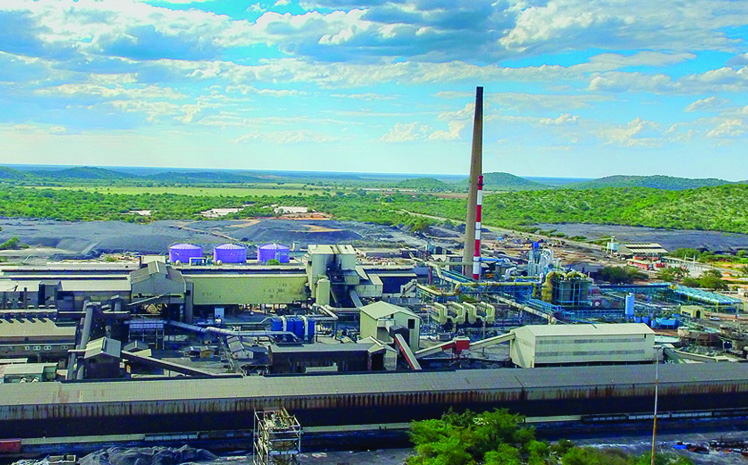
The United Nations (UN) has raised concerns over arsenic contamination and workers’ health at Tsumeb’s smelter, while owner Sinomine denies liability and outlines rehabilitation measures.
Sinomine Tsumeb Smelter chief executive Logan Lou says the company continues to implement progressive environmental rehabilitation projects to address historical contamination at the site.
The smelter has been contaminated with arsenic acid for decades.
Lou says despite the ‘grandfather clause’, a non-assumption of liabilities clause, the company is not exempt from environmental responsibility.
He says Sinomine has a financed closure plan in place that is periodically reviewed and updated with progressive rehabilitation.
“For the historical contamination, Sinomine continues to implement progressive rehabilitation projects such as phytoremediation, with the special aim to clean shallow contaminated soils, to mention a few,” Lou says.
His comments are contained in an official response letter to the UN’ special rapporteurs in August.
Lou says Sinomine has been working closely with international arsenic management experts to develop and implement a comprehensive strategy to prevent and reduce exposure.
According to him, the plan includes plant engineering improvements, upgraded arsenic management protocols for employees, targeted training, and improved personal protective equipment.
“These efforts have resulted in a marked reduction in skin-related health conditions and a strengthened safety culture across the site. All smelter employees are covered by medical insurance and have unrestricted access to independent healthcare services, including the freedom to consult private medical practitioners of their choice without any influence from Sinomine,” Lou says.
‘NO JOB-RELATED ILLNESS’
He says to date, the company’s records do not indicate any cases of occupational disease related to arsenic exposure.
Lou says the employees have the right to access their personal medical records.
Addressing concerns over water contamination, he says the smelter has not been a source of microbiological contamination in the municipal drinking water supply, as alleged.
The identified contamination issues are unrelated to smelter operations and have already been addressed by the local municipality, he says.
He also denies that the smelter shares recycled water with the municipal system.
“The smelter operates a closed-loop process water management system, in which water is recycled internally for operational use only,” Lou says.
Four UN special rapporteurs have expressed concern about the impact of arsenic and sulfur dioxide emissions from the copper smelter on workers and the surrounding community.
They specifically questioned the ‘grandfather clause’ included in the sale of the smelter to successive owners.
“The sale included a so-called ‘grandfather clause’, which works as a non-assumption of liabilities clause,” the UN letter states, noting that such provisions “foster de facto impunity” and allow continued pollution without accountability.
The smelter was previously owned by Weatherly International (United Kingdom), then Dundee Precious Metals, and is now operated by Sinomine from China.
In a letter dated 6 July, the UN rapporteurs on hazardous substances, business and human rights, environment, and water and sanitation gave the company 60 days to respond to allegations of human rights abuses tied to environmental contamination.
The letter cited that soil samples near the smelter showed arsenic levels of 229 mg/kg – potentially hazardous compared to natural United States levels of 0.1mg/kg to 40 mg/kg.
It also references worker complaints of arsenic-induced skin conditions, respiratory issues, and, in some cases, infertility or miscarriages.
According to the letter, employees requesting access to their medical records have allegedly received formal warnings or been terminated.
It also claims that under Sinomine ownership, workers must sign liability waivers before receiving test results.
Mineworkers’ Union of Namibia branch chairperson at the copper smelter Paulus Haita says: “Our colleagues have signs of arsenic-induced conditions, but they are under treatment as long as they have medical aid. But voluntary separation, which was supposed to close on 27 August, is still ongoing.
“Department heads are approaching people, saying they can offer them voluntary separation with three months’ salary in advance, and the papers are being signed there and then.”
Sinomine in June announced it was placing the mine under care and maintenance due to global copper concentrate scarcity.
The company is shifting focus towards developing a multi-metal recycling facility to extract germanium, gallium, and zinc from existing tailings.
However, this transition does not require the full workforce of 650 employees.
“Our question is what will happen to these people without medical treatment. I’m sitting with people losing their employment, they are being sent home without medical plans, and those who were on medical aid are falling off – what will happen to them and their families?” Haita asks.
The UN letter also mentions visible run-off from the facility and elevated arsenic and sulfate levels in Tsumeb’s boreholes. One showed 0.11 mg/L of arsenic – 11 times higher than the World Health Organisation’s guidelines for drinking water.
Tsumeb mayor Mathews Hangula says the municipality does daily monitoring of the town’s water supply system and monthly results do not show elevated arsenic levels.
WATER ISSUES
He acknowledges that the tailings from the dams at the Sinomine Copper Smelter flow into the town’s sewerage system, but does not affect the household use of water.
“Our water is not contaminated or unfit for human consumption. We are aware of the copper mines toxicity reports and research. We have been keeping our eyes on the situation. But I have not received any report that indicates contamination or heightened levels of arsenic,” the mayor says.
Resident Paula Siyanza disagrees, saying it is a known fact that Tsumeb’s water is contaminated.
“The council just treats the water so it has an acceptable level. Many of us have stopped drinking that water and are buying filtered water,” she says.
In an age of information overload, Sunrise is The Namibian’s morning briefing, delivered at 6h00 from Monday to Friday. It offers a curated rundown of the most important stories from the past 24 hours – occasionally with a light, witty touch. It’s an essential way to stay informed. Subscribe and join our newsletter community.

The Namibian uses AI tools to assist with improved quality, accuracy and efficiency, while maintaining editorial oversight and journalistic integrity.
Stay informed with The Namibian – your source for credible journalism. Get in-depth reporting and opinions for
only N$85 a month. Invest in journalism, invest in democracy –
Subscribe Now!