






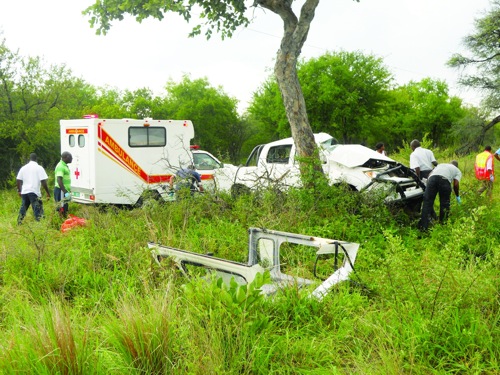
The day is placid and all is well until an urgent call from an operator breaks the silence. Someone is urgently in need of help and at a moment’s notice, it’s time to leave.
Motorists know not to get in their way but rather swerve to the left because they are aware that a life-and-death event is in occurrence. Within minutes, the ambulance swoops in on the scene of the accident and their presence is heavily felt. Observers back up and watch them work their magic, because every split-second decision makes a difference.
These men and women are known as paramedics or the paraprofessionals of the medical career who specialise in the art of emergency medical care. With equipment such as defibrillators and local anaesthetics on hand, paramedics are responsible for providing care to those who have been injured in an accident and transport them to the nearest hospital possible. Previously known as Emergency Medical Care studies as a diploma course, the Polytechnic of Namibia (PoN) has transformed the course into a Bachelor’s degree that is now known as the Bachelor of Pre-Hospital Emergency Medical Care. The took a look at what it takes to be a paramedic in Namibia…
Usually when you approach the scene of an accident, there’s blood everywhere, cars are completely wrecked and somebody could be trapped in the midst of it all, begging for help. This is where trained paramedics come in. Without supervision, they have to apply everything they know in real-life situations and have certain techniques memorised so that they can expertly provide medical care until they reach a hospital.
Nicole Thierauch, a paramedic who is currently located in Tsumeb, gave her opinion on what it takes to do the job. “It’s my dream job, but I guess it’s not for everyone. I guess you have to be specific on your p’s and q’s, though!”
Studying Emergency Medical Care requires dedication and some serious commitment, not to mention abandoning your social life. Because of the practical work it requires, students of this course have to be on point – meaning a call which comes in, which are further divided into primaries and secondary calls – could occur at any time of the day.
Luckily the theoretical experience which students have required allows them to implement everything they know in a practical manner.
This degree involves courses such as Traumatology and Medical Emergency. Traumatology goes in-depth with serious wounds and injuries by identifying them and carefully treating them, and guess what? You’re also going to have to learn paediatrics which is a branch of medicine that deals with taking care of infants, babies or children. Students who are doing the Bachelor of Medicine and Surgery (MBChB) also study similar subjects, except Emergency Medical Care is much, much shorter. If perhaps you haven’t qualified to become a doctor, this could be an alternative to it – and requires just as much passion as it would to become a doctor. Ah, and not to forget some travelling. The opportunities are endless and if you want to make a difference in rural areas around you that need help, you could be a paramedic and transfer there. Other career possibilities in this field include being a registered emergency care technician or being skilled in advanced life support.
A call depends on where you are working, Nicole said, elaborating on the slight difference between paramedics and transfers. “Primaries are calls like accidents, emergency illnesses and others.” These are some of the responsibilities that paramedics deal with. “Transfers are basically people who transport patients from one facility to the other.” Are they skilled in the art of medical care as well? Definitely.
“In Windhoek you might get an average of 15 primaries, depending on where you work. In Tsumeb, the average is about two primaries a day and two transfers, but mostly long distance.”Services such as E-Med Rescue deal with this.
This course is only available at the Polytechnic of Namibia and luckily the requirements aren’t too scary. All you need is 25 points in five subjects based on the PoN Evaluation Scale (available online or in the PoN’s prospectus for 2015) including an E-symbol in English on Ordinary level or a pass on Higher level. That’s not all. Applicants for this course must be physically and medically fit. In other words, you should be as healthy as possible because you will be put in situations which require your full health. Compulsory subjects involve Mathematics, Biology or Physical Science, so if you are in the Science field, this course could be a definite career option for you. For those who are older than 25, a Mature Age Entry Scheme is available and this requires a 60% or higher in the language proficiency test as well as 50% in the mathematics proficiency test. The mode of study for the Bachelor of Pre-Hospital Medical Care is only available on the full time mode of study and the duration of the course is three years.
• You have to have a caring nature, meaning that you have a need to help the people around you, even if they act hostile at first. Sometimes it’s the pain that forces them to do so.
• Be passionate about the job!
• Listen carefully to everything in class because one day you’re going to have to think fast if you want to save someone’s life!
• Be patient. You’re going to deal with people kicking, screaming and forcing their way out of a situation, but you have to remain calm, take your time and stay level-headed in emergency situations.
• You won’t be working alone. Make sure that you communicate as much as possible with the team around you.
• Know your emergency medical numbers! In case of a road crash, call 0819682 (the MVA Fund Call Centre), MedRescue (061 230505/6/7).