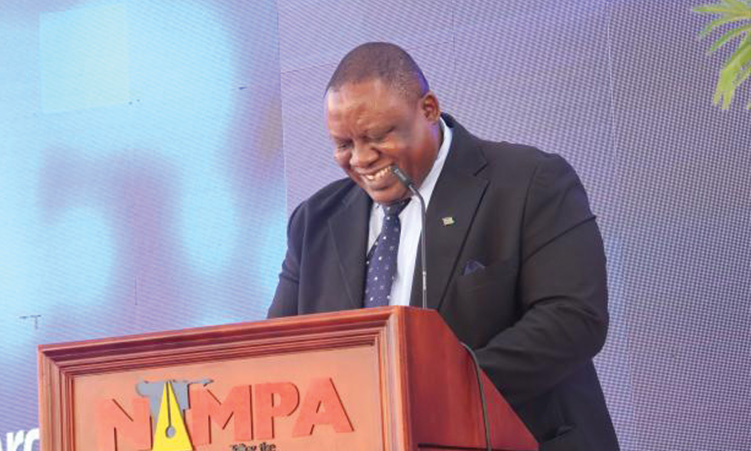





THE Windhoek municipality approved a plan by academic-cum-property developer Tjama Tjivikua to build a township that will accommodate 307 plots in Rocky Crest, despite environmental concerns.
Tjivikua, the vice chancellor at the Namibia University of Science and Technology, received land through what is called public-private partnership deals with the municipality in which they get the land free from the city, put up services such as water, and then sell it.
This type of deal has been criticised in the past by city executives for enriching property developers.
Tjivikua is into this public-private partnership through Waterberg Investment, a company he co-owns with his wife Neveara Olivier and Angela Katjimune.
The land, measuring 43 hectares (around 43 average football fields), is in Rocky Crest along the Western Bypass buffer, west of Pionierspark Extension 1. Council documents show that Tjivikua’s company wants to service 307 plots. Of these plots, 254 will be for residential purposes. It also shows that there will be two business plots, three plots for a pre-primary school, church or kindergarten, and a community hall.
There are concerns at the municipality, however, that Tjivikua’s township will have a potential negative environmental impact.
The municipality’s strategic executive for water and technical services, Ludwig Narib, said Rocky Crest Extension 5 – the area where Tjivikua wants to build his township – “falls within the Pionierspark reservoir pressure zone”.
The municipality rang the alarm bells in 2015 when it announced that pollution in the area where underground water reservoirs are located could be “life-threatening to the residents of Windhoek”.
In fact, the municipality admitted that the city would be struggling with supplying water to the proposed new townships.
The environmental commissioner, Teofilus Nghitila, however, approved Tjivikua’s township.
“Regular environmental monitoring and evaluations on the environmental performance should be conducted. Targets for improvement should be established and monitored throughout the process,” he stated.
Nghitila is infamously known for approving the controversial marine phosphate mining process in Namibia, just to be told to back off later after a public outcry over the project.
The township was approved to reduce pressure from the municipality due to the continued increase in the urban population, the document said.
“Due to its [Rocky Crest] interface with Pionierspark, and the fact that it is the most visible of the Rocky Crest Extensions on the Western Bypass, the approach taken is to raise its profile to upper-middle-class status,” the council documents said.
According to the Namibia Statistics Agency, Windhoek’s population was more than 340 000 in 2011.
According to the council documents, the new township is one way in which the city will go ahead with plans to make Windhoek a ‘Smart and Caring City’ as envisioned by the new transformational strategic plan.
Tjivikua’s company is also required to provide municipal services within the township.
The company is furthermore required to sign a development agreement following approval through the town planning process.
It is unclear whether Tjivikua and his team have changed the project’s other targets.
The Namibian in 2015 quoted a document which showed the project would cost N$112 million, while the estimated income from selling the plots was N$175 million. At the time, profit was estimated at N$60 million, which means that Tjivikua and his partners stood to make over N$20 million from the deal.
The other N$20 million profit would go to the municipality, while Old Mutual (the financier) will also get N$20 million as equal joint venture partners entitled to 33% of the profits each.
reported in 2015 how well-connected Namibians were scrambling for land in Rocky Crest.
An opinion of the city’s legal department in 2014 said: “It has become evident that various applications are received for PPPs because developers have realised that it is the easiest way to obtain super-profits by contributing only a lender’s agreement provided by a third party (bank or another financier)”.
Tjivikua’s deal is among 12 public-private partnerships across Windhoek that were mostly dished out to well-connected Namibians.
Previous beneficiaries of these types of transactions include Acacia Investments, headed by lawyer Patrick Kauta, and Sinco Investment Sixty One, which is owned by businessman Leake Hangala.