







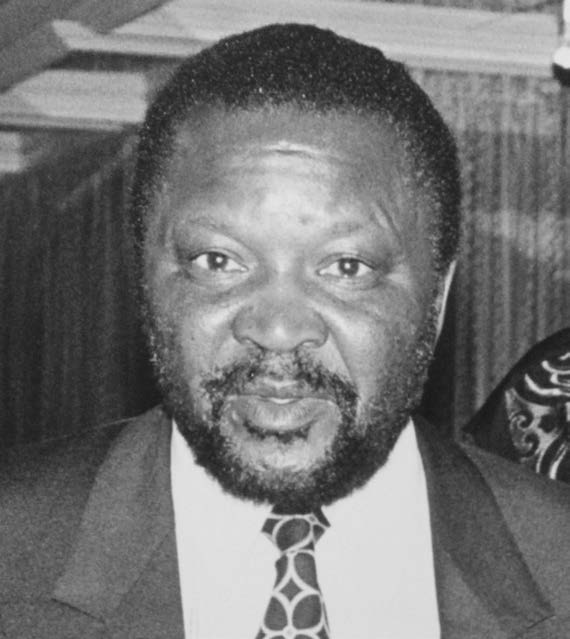
GRAHAM HOPWOODFORMER Cabinet member Ngarikutuke Tjiriange, who died on Wednesday last week aged 77, served as Namibia’s first minister of justice from 1990 to 2003.
He was also a key legal adviser for Swapo from 1970 until his retirement from public office in 2010.
Tjiriange joined Swapo in the early 1960s and left for exile in 1964. At Swapo’s Tanga Consultative Congress (1969 to 1970) he was chosen as the party’s deputy secretary for legal and economic affairs. At the time he was studying law in the Soviet Union. He became the organisation’s secretary for legal affairs in 1976.
Tjiriange represented Swapo at numerous international gatherings before independence, including meetings of the United Nations Commission on Human Rights, United Nations (UN) Law of the Sea conference, and sessions of the UN General Assembly and Security Council.
He was part of Swapo’s negotiating team on the Security Council’s Resolution 435, which set out a road map for Namibia’s independence.
Tjiriange spent 20 years as a member of the National Assembly (from 1990 to 2010), during which time he served as minister of justice for the first 13 years.
During 2000 and 2001 he was the country’s attorney general as well.
He later took up a key administrative position in Swapo – being elected as the party’s secretary general from 2002 to 2007.
In 2003, president Sam Nujoma gave Tjiriange the role of minister without portfolio, a position that enabled him to receive a full ministerial salary while completing his party duties.
In March 2005, president Hifikepunye Pohamba reappointed him as minister without portfolio, despite criticism from the opposition that the post was a waste of money.
From 2006 until 2010 he served as minister of veterans affairs – a new post that was created, following protests by former combatants demanding compensation for their years spent in the military struggle for liberation.
As minister of justice he defended the independence of the judiciary in the face of some harsh criticism of judges from some of his comrades.
Tjiriange was an effective and at times aggressive public speaker. Although temperate in most of his statements as a minister, he could speak more harshly on the campaign trail.
In the early 1990s he was the focus of allegations that drought-aid money had been used to drill a borehole on an ostrich farm he co-owned with deputy minister Nangolo Ithete.
Despite a critical report on the ‘borehole scandal’ by an official commission, no action was taken.
After his withdrawal from day-to-day politics in 2010, Tjiriange was appointed as a special adviser to the minister of home affairs and immigration in 2012.
Tjiriange authored a memoir, ‘To Hell and Back – My Experience under Difficult Colonial Rule’, which was published in 2016.
In a tribute on his Facebook page, president Hage Geingob said Tjiriange was a special adviser to the government on the issue of heritage at the time of his death.
Tjiriange also regularly contributed opinion pieces on political and legal matters to newspapers, particularly New Era.
Tjiriange was born on 12 July 1943 in Windhoek and died in the city on 23 June 2021.
* Graham Hopwood is the executive director of the Institute for Public Policy Research (IPPR) in Windhoek.