





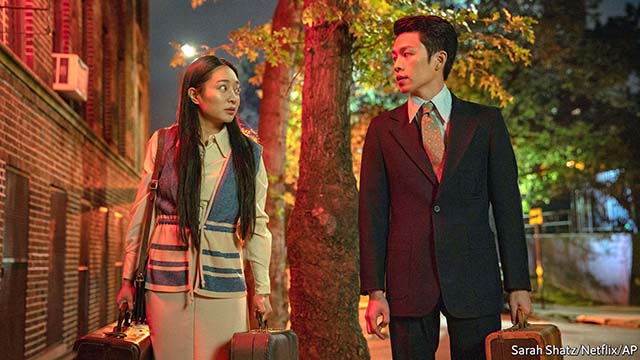
There’s always a splinter of tragedy in an immigrant story. The people left behind. Fervent promises unkept. The gnawing reality that the grass isn’t as green as in the pop songs and on the postcards.
In ‘Tigertail’ (2020), a film written and directed by Andrew Yang (‘Parks and Recreation’, ‘Master of None’), the place in the rearview mirror is Taiwan.
Left behind by a young factory worker named Pin-Jiu, who chooses an arranged marriage that affords him his American dream at the cost of a blossoming love affair, Taiwan is imbued with the rose tint of regret as the protagonist looks back from his long life in New York.
Beginning in idyllic rice fields moving to a crumbling factory and then to a gloomy convenience store and matching Brooklyn apartment, ‘Tigertail’, named for Yang’s father’s home in Taiwan, follows Pin-Jui from boyhood through young adulthood and into old age.
The story, beautifully told in Taiwan, but losing steam and intensity in America amid the present day, is familiar.
The displacement, language barriers, joy of meeting countrymen, long working hours, menial jobs, sacrifice and the generational disconnect are hallmarks of the cinematic and literary immigrant story.
Nuance is found in the central love story – the one Pin-Jui leaves behind and never quite recovers from and another, his estranged adult daughter.
A heartfelt ode to Yang’s father inspired by a trip they took to Taiwan in 2016, ‘Tigertail’ is a well-meaning but inconsistent film that doesn’t dig as deep as one would hope.
While strides are made to develop the character of Pin-Jui, played by Tzi Ma, one struggles to fully understand his continued misery and his inability to connect with his daughter and his wife.
Comments are made about him always being at work. There is a scene in which he is particularly stern when his daughter botches her piano recital, but little is offered as to why exactly (perhaps even legitimately) he feels the way he does.
After all, he is in America, home of his and his first paramour’s beloved Faye Dunaway and Otis Redding, and the place he chose over his relationship in Taiwan without so much as a goodbye.
Much is implied but very little is shown, and the viewer is left to fill in too many blanks – particularly those of the central women’s challenges and interior lives.
For those who like slow, character-driven dramas featuring languages and cultures you may not be familiar with, ‘Tigertail’ is worth watching, particularly as an earnest break from whatever you’re mindlessly binge- watching during lockdown.
There are lines you hope will never be true for you in response to the confession that you have nothing in common with your partner. “Eventually, your life together is what you have in common.”
And there are some hard truths. Sometimes the grass isn’t as green as the rice fields of one’s youth, but we must water what we have instead.
‘Tigertail’ (2020) is now streaming on Netflix.
– martha@namibian.com.na; Martha Mukaiwa on Twitter, Facebook and Instagram; marthamukaiwa.com

