






IN THE period leading up to independence, Tigers Sports Club were feared by rivals. But it was not for their excellence on the field of play, but it was because of “notorious elements” associated with the club.
It was a time when much-maligned gangs freely roamed the streets of Katutura, wreaking havoc and terrorising the community.
One such unpleasant entity had close ties with Tigers, and reportedly regularly influenced the outcomes of matches involving the premier team from the Oshandumbala suburb.
Fortunately, the club’s wily hierarchy sought to put an end to the hooliganism and clean up the club’s image before the situation got out of hand.
The transformation started with Kelly Asser, who passed on the chairman’s responsibility to Onesmus Akwenye and then Sadike Nepela, whose term came to an end earlier this month, before paving the way for the start of fellow businessman Vaino Nghipondoka’s term.
“We became associated with being disorganised and known as a misbehaving team because of some notorious elements from the community of Tigers. At the time, people started to fear Tigers and did not want to play against us. But this was not what the club’s founders started this club for, and the elders decided they needed to change the image of the club,” said Tigers executive committee member Hafeni Hiveluah.
“The forebears saw a need to organise themselves into a proper structure. They formed a structure to which the community could belong and work together for a common cause. And that is what is happening at Tigers Sports Club at the moment,” he noted.
Formed in 1926 by contract labourers from northern Namibia, Tigers are the oldest football club in the country. After winning the inaugural league championship in the mid-80s, they followed that up with regular cup successes until 1996 when the silverware began to dry up when internal turmoil surfaced.
“I think the successes went to the heads of the guys [management]. There was no strategy of where the club wanted to be. Things started falling apart,” said an Ingweinyama diehard supporter.
Once again, the club was forced to reboot as they began falling behind their rivals on and off the field of play. With no discernible solid income structure, Tigers stayed afloat thanks to contributions from generous loyal supporters.
COMMERCIALLY SUSTAINABLE ENTITY
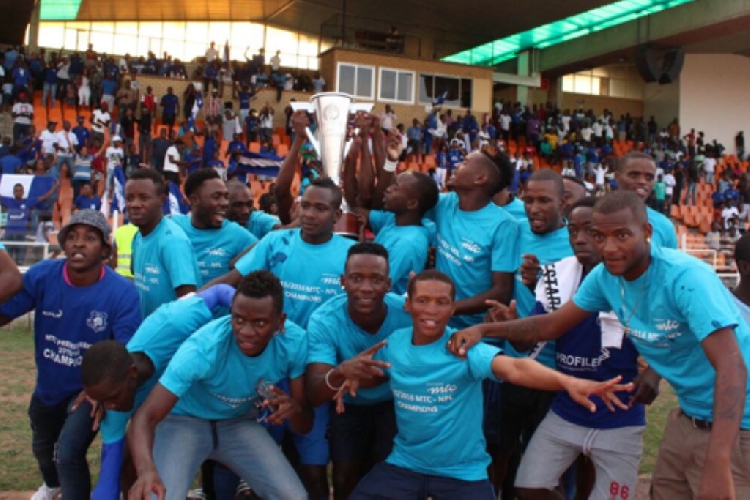
After agonising over the club’s stagnated growth, one supporter decided to save the club from its misfortune, which resulted in Tigers winning the FA Cup and league titles in 2015 and 2016.
Nghipondoka signed an MoU with the club on 29 August 2015 to turn its wish list into reality. Under the “strategic partnership”, the new entity Tigers Sports Club (Pty) Ltd, wholly owned by Nghipondoka with a board of directors and the club’s current executive committee, chaired by Turkey Ndashiiva, will manage the affairs of the club.
Chiefly, the agreement tasks both parties with turning Tigers into a “viable and commercially sustainable entity through the utilisation of the club’s rights”.
“We decided that if there’s somebody who is willing to give us resources, with a business plan, and who really wants to see the fortunes of the club improve, then let’s give him an opportunity to run the club on our behalf, we’ll take a back seat and see what evolves. The community will still be involved,” Hiveluah explained.
“There were a couple more guys interested, but we chose him because he had a clear vision of where he wanted the club to be.”
With the internal strife seemingly a thing of the past, Tigers new-look and cohesive management are looking to combine Nghipondoka’s backing with their fickle fan base in order to establish a secure revenue stream.
“Previously, there was no proper structure. We were just in survival mode. We want the club to be self-sustainable. In the last two seasons, we are seeing the fruits of this transformation in an organised structure,” Hiveluah continued.
“We are also starting to organise our supporters. Our supporters’ base is dormant, but underneath, the pot is boiling.
“We are trying to encourage people to come to the stadiums. That’s what we’ve been planning. If you look at our games from last season, with every game we played, more of our supporters started coming to the stadium.
“We are trying to involve everybody, to be a team where everybody feels part of the club and not feeling left out. This is to reaffirm that Tigers Sports Club still belongs to the community.
“The target audience is the youth. The ones on social media are the ones who can grow our numbers. They are the majority and the future of the club,” he added.
SUGAR DADDY CYCLE
The Namibia Premier League (NPL)’s timeline is dotted with many short-lived romances in which prospering business individuals declare their undying affection for their childhood club. They dazzle the desperate clubs with their fat wallet, only to leave them worse for wear once they grow bored of them.
Blue Waters, Civics, Eleven Arrows, African Stars, Orlando Pirates and Black Africa have all fallen prey to the sugar daddy cycle when their time in the limelight was tied to the spending power of their pompous blesser.
“With all due respect, I think maybe they didn’t see the big picture because about every three years, there was always one team that was way ahead of everyone else, but after the owner goes, they go back to suffering. We have learnt and saw what other teams have done, and don’t wanna fall in the same trap,” Hiveluah stated.
“In terms of the assistance he has given the club, some information is confidential. I cannot go into figures, but he has assisted the club significantly. He has assisted us in terms of financial resources, office space, equipment and the general organisation of the structures,” said Hiveluah.
“We’ve got some other investment vehicles at play as well that have been created in the same atmosphere. We have the Ingweinyama Investments and Tigers Sport Club CC that are self-generating entities, which are supposed to cater for the operational expenditure of the sports club.
At the end of the day, even if Mr Nghipondoka walks away tomorrow, we are hoping that these other entities will be able to sustain the club,” he said.