






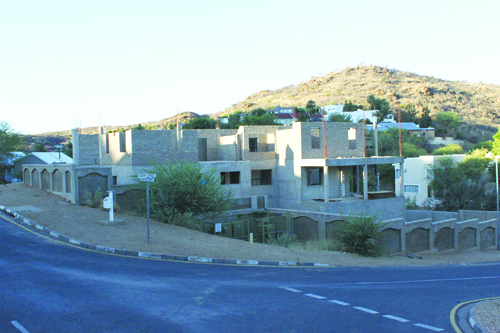
THE City of Windhoek has suffered a final defeat in a long legal battle about the approval of building plans for a new three-storey house in Windhoek’s upmarket Ludwigsdorf area.
In the latest judgement on the legal dispute about the Windhoek Municipal Council’s approval of the building plans, the Supreme Court has dismissed an appeal by the municipal council and the owner of the half-built house, medical doctor Tatenda Mawire, against a High Court order in which the decision to approve the building plans was reviewed and set aside.
With the dismissal of the appeal, the Supreme Court also ordered the Windhoek Municipal Council – but not Dr Mawire, who was found to be an innocent party in the dispute – to pay the legal costs of the three property owners who in June 2011 launched legal action to have the approval of the building plans set aside.
Dr Mawire’s lawyer, Nixon Marcus, said on enquiry yesterday that now that the approval of his client’s building plans has been set aside, Dr Mawire can apply afresh to have the plans approved. This time around, though, the City of Windhoek would have to properly consider the building plans in terms of the Windhoek Town Planning Scheme, which would include considering the impact that Dr Mawire’s new house would have on neighbouring properties, he said.
The owners of neighbouring properties, which are all situated across the road from Dr Mawire’s property, obtained an interdict to stop building work on the new house in June 2011, after they noticed that a third storey was being added to the structure being erected on the property.
In terms of the Town Planning Scheme, no residential building with more than two storeys may be erected in Windhoek without approval from the Windhoek Municipal Council. The Town Planning Scheme also states that when the council considers an application for the approval of a house consisting of more than two storeys, it must have regard “to the impact real or potential of the additional storeys on the neighbouring property”.
The City of Windhoek’s argument in both the High Court and in the Supreme Court was that Dr Mawire’s house will actually be a two-storeyed building, since the ground floor of the house is – in their view – a basement storey.
Acting Judge Kobus Miller was not convinced by that argument in the High Court, and neither were Acting Judges of Appeal Kate O’Regan, Johan Strydom and Fred Chomba in the Supreme Court.
Judge O’Regan, who wrote the court’s judgement, said the property owners, who took legal action to stop the building work and to have the approval of the building plans set aside, were entitled to expect that the Town Planning Scheme would be observed.
She stated that it was clear that the building plans were in conflict with the Town Planing Scheme’s provision limiting residential buildings to two storeys, until additional storeys have specifically been approved.
“The building in question here clearly had more than two storeys and undisputedly falls within an area zoned ‘residential’,” Judge O’Regan stated. She added that the meaning of the relevant clause of the Town Planning Scheme “is unambiguous and the building plans here were in breach of it”.
Although Dr Mawire’s house would have more than two storeys, the town council’s attention was not pertinently drawn to that fact and the council did not consider the impact the additional story could have on neighbouring properties before the building plans were approved, Judge O’Regan said.
Senior counsel Andrew Corbett represented the objecting property owners in the appeal and in the High Court. Nixon Marcus represented Dr Mawire, while Dennis Khama and senior counsel Dumisa Ntsebeza represented the City of Windhoek.