GREENVILLE — Its racist past still hangs heavy over the white south. But as with anything, it is rarely as simple as everything being bad – one of the reasons photographer Doy Gorton set out to illustrate the white south, his home, in a more nuanced light, writes James Jeffrey.
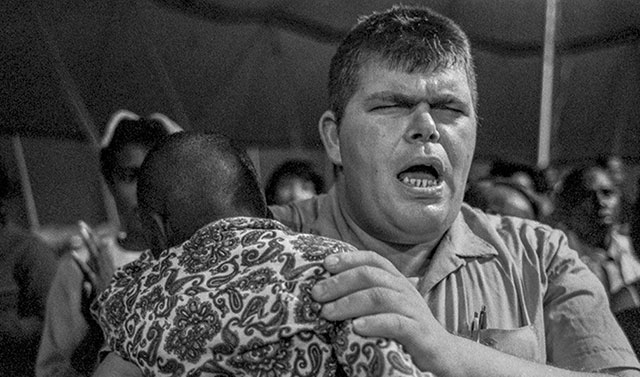
The black neighbourhood of Greenville in segregated 1960s Mississippi had never seen anything like it. Neither had Gorton when he encountered white people praying alongside their black brethren during an impromptu street-side Pentecostal revival.
When a burly young white man inside the revival tent spontaneously picked up a small black boy sitting with his family and clasped him to his chest amid thronging songs of praise, Gorton captured with his camera the sort of moment that rarely makes it into discussions about the racist white south.
Growing up in Mississippi, Gorton reacted to legalised white supremacy by joining the civil rights movement. But while abhorring the institutional racism that shaped every aspect of southern life, he retained compassion and patience for the blue-collar whites who had been left behind by the likes of mechanisation and foreign trade since the end of World War II. He also bridled at mainstream representations of the white south, which he felt didn’t effectively examine the reality and nuances, such as how class divisions informed racism, and who was really to blame.
As a result, he undertook an 18-month drive across the Mississippi Delta, documenting “the most southern place on earth,” including encounters with more progressive whites, such as those at the revival, and activists fighting for de-segregation and civil rights, often at great risks to themselves.
“It’s astonishing to me that 50 years later, the enormous sacrifices, the enormous bravery and enormous courage of ordinary white people in the deep south in dealing with race issues is not recognised,” Gorton says. “So many people suffered, but they have been passed over by history.”
IMMINENT RACE WAR
Gorton recalls how tense the region, and the country, was at the time, with talk of an imminent race war, how everything was going to blow up, with thousands killed. That a huge conflagration was avoided, he puts down, in large part, to local, ordinary whites who helped keep the peace.
Admittedly, whites who more actively pushed for civil rights typically faced economic reprisals, often losing jobs, or physical violence, even paying the ultimate price.
Kansas native James Reeb, a pastor who participated in the Selma to Montgomery civil rights marches, died in early 1965 of head injuries, two days after being severely beaten by white segregationists.
Shortly afterwards, Vilola Liuzzo, an activist who had grown up in Tennessee, was murdered by members of the Ku Klux Klan in Selma (later in the year, Jonathan Daniels, a white seminarian from New Hampshire, died when shielding a black teenager from a fired shotgun in Hayneville, Alabama).
“When it comes to who has been honoured for the civil rights movement, there are very few white people mentioned,” Gorton says.
But the subject matter alone makes any focus on whites problematic, says Ted Ownby, director of the Centre for the Study of Southern Culture at the University of Mississippi, and editor of ‘The Civil Rights Movement in Mississippi’. Other factors are probably at play.
“A lot of the white southern activists I’ve come across downplay their significance, saying that they were just the leader of an organisation, or a Christian activist”, Ownby says. “And they emphasise they were not as significant as, nor sacrificed as much as, the African Americans involved, who couldn’t go back to a safe place.”
There is also the Atticus Finch factor – the lawyer hero from Harper Lee’s ‘To Kill a Mockingbird’, who defends a black man in Alabama accused of rape.
WHITE SAVIOUR FIGURE
“There’s the danger of presenting a white saviour figure,” says Ownby, adding how Finch, while fictional, is probably the best-known representation of white resistance to racism.
“It is of creating hero worship for people whose heroism came through doing their jobs within the system as it existed. After all, the civil rights movement was about changing the system.”
After getting kicked out of the University of Mississippi for organising protests and events against segregation, Gorton joined the Student Non-violent Coordinating Committee (SNCC), the “Marine Corps of the civil rights movement,” he says, “going in when no one else did”.
But he says it was discovering the work of American photojournalist Walker Evans, best known for documenting the effects of the Great Depression, who presented people “in a way that was really very respectful, very thoughtful and very straightforward,” that motivated him to try something similar for the people he’d grown up surrounded by.
He acknowledges that offering a different angle on the narrative of the racist white south is contentious, but explains he sees a parallel with the likes of the British Empire which, despite clear flaws, in its entirety was hugely nuanced, and included “lots of people who did decent things”.
– BBC News