In the North of Namibia, on the eastern edge of the Etosha Pan, tourists fumble in the darkness for keys and water bottles, rubbing their sleepy eyes as they get their belongings together for a day in the veld.
Driving out in the creeping light, they think excitedly about the majestic animals that are heading to the waterholes: oryx, blue wildebeest, elephants, lions. Behind them, fading into the distance, small pinpricks of light poke out from Fort Namutoni’s white walls, as other guests rise and begin their preparation for the early morning safari.
Little more than a century ago, when Namibia was twisted with colonial exploitation, a band of 500 men crept in the opposite direction, approaching Fort Namutoni silently, in a race against the approaching sun.
With careful steps, they padded across the scorched earth, gripping their weapons tightly in hands clammy with nervous sweat. As the walls of the great white fort loomed closer, their chief, Nehale Lya Mpingana, gestured for them to prepare their guns. Attack was close.
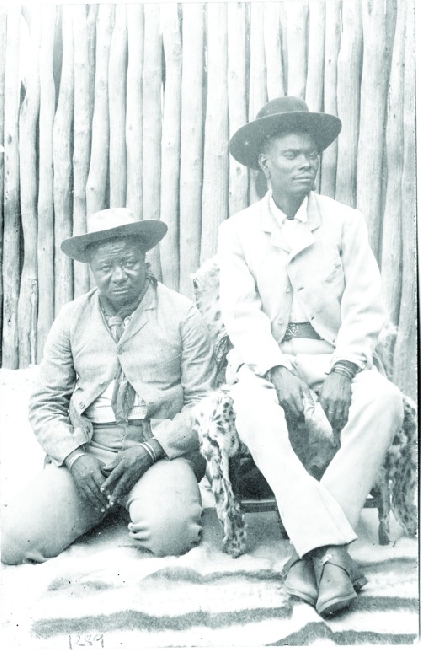
Chief of the Ondonga during the late 19th century, Nehale Lya Mpingana fought two decisive wars against colonial forces in his short life. Although he has been dignified as one of Namibia’s nine national heroes, records of his feats are hard to find. The few photographs of the man that remain are fuzzy from reproductions. In one, smudged by time, he sits relaxed in a creased suit, gazing off into the distance with a black hat tipped to the back of his head. A man kneels besides him with shoulders slumped and his jacket held together with a single button. Both look tired, worn out from the war and bloodshed.
At the time Mpingana was appointed chief, Boer expansionism was taking place across the nation. Land they acquired from the natives was largely taken through force, coercion and trickery. Aware of the approaching storm, Mpingana fortified the Ondonga people to defend the heritage and wealth of their prized land.
Many Boers travelled northwards through Namibia in search of virgin lands where they could claim political independence. They covered vast distances, enduring incredible hardships, before they reached a tract that seemed perfect for their needs. On the edge of the Etosha plain, the 50 000 acres was owned William Worthington Jordan, a South African explorer and writer. With similar pursuits in mind, he donated large parts of the land to the trekkers free of charge.
Located between Otavi and Grootfontein, he had bought the area for 300 hundred pounds from the Ovambos, in the form of 25 firearms, one salted horse and a cask of brandy. It was an incredibly cheap, and allegedly fraudulent land acquisition.
With around 500 trekkers accommodated, Jordan declared his land The Republic of Upingtonia on 20 October 1885. Tribes in the surrounding area were angered at the arrogant declaration, and in 1886 Mpingana drew a group of men together and waged a sustained attack, eventually killing Jordan.
With the demise of their leader, the republic quickly collapsed and the Boers dispersed.
As the threat of Boer expansionism receded, German colonialism became the pressing issue for the Northern tribes. The state of South West Africa was formed in 1887, and soon after, Fort Namutoni was built in the middle of their native lands.
Although it was only built to control the movement of cattle from the southern to northern areas, the fort had heavy defenses of galvanised iron and un-burnt brick. It was considered an impregnable stronghold for Imperial Germany’s Schutztruppe.
As blood was spilt across the nation, rebellion brewed to boiling point amidst the Northern tribes. On 28 January 1904, one day after the German Kaiser’s birthday, Mpingana attacked Fort Namutoni with a group of 500 men.
Despite the solid construction, inside the great walls were just seven German soldiers. Subjecting them to continuous assaults throughout the day, Mpingana’s men eventually ended their attack in the late afternoon. As darkness fell the Germans counted their ammunition; with less than 150 rounds left, they withdrew from the fort under the cover of night and ran for the hills.
In the morning light, Mpingana and his men were confronted with the empty building, filled with abandoned cattle and horses. Despite heavily outnumbering the enemy, it was still a bold victory that resonated across the land.
Only four years after his victory, on the 14 April 1908, Mpingana died under unknown circumstances. During his first inauguration, Sam Nujuma paid his respects to the often forgotten warrior: “Chief Nehale Lya Mpingana fought many battles against the trekkers and German colonial forces in our people’s resistance against colonialism and foreign invaders. To his revolutionary spirit and his visionary memory, we humbly offer our honour and respect.”