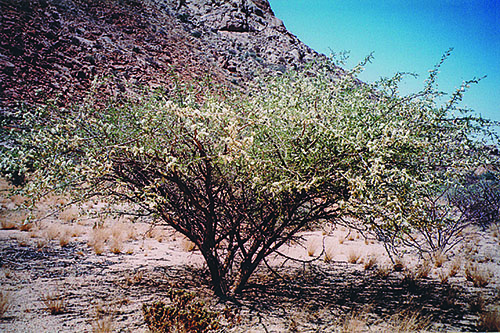
LUISE HOFFMANNAS a rule all Namibian acacias have paired thorns, yet like every rule this on too has its exception, namely the three-hook acacia (photo) and the flame-thorn, both described below.
The three-hook acacia is a V-shaped shrub, branching from near the base and often has a distinctly flat to concave crown. It only becomes really conspicuous when covered in its long white flower spikes any time from October to January. Owing to its shape it may easily be taken for a black-thorn acacia until one inspects it closely and notices the thorns arranged in groups of three, two pointing upwards, one downwards.
Names: E. three-hook acacia; A. driehaakdoring, geelhaak; H. orupunguya, omuyere, omuhengehenge; omuryangava (meaning: rhino browse this shrub); omungondo (NBRI) Nd&Ky. omuyele. The botanical name Acacia means ‚with thorns’. The three-hook acacia found in Namibia is Acacia senegal var. rostrata, a variety of A. senegal found in northern Africa, which produces gum arabic, used in the food and pharmaceutical industries, in producing shoe polish and lickable adhesive for postage stamps and envelopes etc.
The name rostata means ‚beaked’ and refers to the shape of the short and flat, sharply pointed pods, which remain on the plant for quite a while, simplifying identification.
The three-hook acacia occurs from about Gibeon up to the northern border of Namibia and from the Pro-Namib up to about 17°E. Preferring stony soils rich in limestone, it can be spotted from the public roads around Usakos, along the road from Outjo to Khorixas, near Brakwater and along the B1, where it crosses the hill to the east of the Omatako Mountains.
The pods of the three-hook acacia are eaten by game and livestock. A root extract is used to treat gonorrhea, while extracts of bark and leaves are used to cure colds, eye infections and diarrhea ,and to stop bleeding. In the northwest branches are used for hedges.
The flame-thorn (Acacia ataxacantha) is not usually very visible from our major roads, but is mentioned here due to the atypical arrangement of its thorns, which are scattered along the branches like those on a rose bush, hence the German common name “Rosendornakazie” or Afrikaans “rankroos”. A more obvious feature are the dark wine red pods, giving rise to the name ‘flame-thorn’ or Afrikaans “vlamdoring” and most visible during autumn.
Names: G. Rosendornakazie; A. vlamdoring, rankroos, katnaald; Nd. omudhilankono; Ky. enghono; Hi. oruweyo. The specific name ataxacantha means‚ „atypical thorns”.
The flame-thorn occurs in the Kunene region and from about 16°E eastwards up to Rietfontein on the Botswana border. Thriving equally well on sand and dunes as on stony slopes, it may form shrubs up to 8 m high. However, more often it is a scrambling shrub of about 3 m, forming sharp-thorned impenetrable thickets. The twice divided leaves can reach a length of 6 – 16 cm with tiny hooked thorns on the rachis. Creamy to white, the flower spikes are slender in comparison to those of other acacias and they can reach a length of 10 cm.
In the Kunene region the strong and elastic wood is preferred for the construction of bows.
In an age of information overload, Sunrise is The Namibian’s morning briefing, delivered at 6h00 from Monday to Friday. It offers a curated rundown of the most important stories from the past 24 hours – occasionally with a light, witty touch. It’s an essential way to stay informed. Subscribe and join our newsletter community.

The Namibian uses AI tools to assist with improved quality, accuracy and efficiency, while maintaining editorial oversight and journalistic integrity.
Stay informed with The Namibian – your source for credible journalism. Get in-depth reporting and opinions for
only N$85 a month. Invest in journalism, invest in democracy –
Subscribe Now!