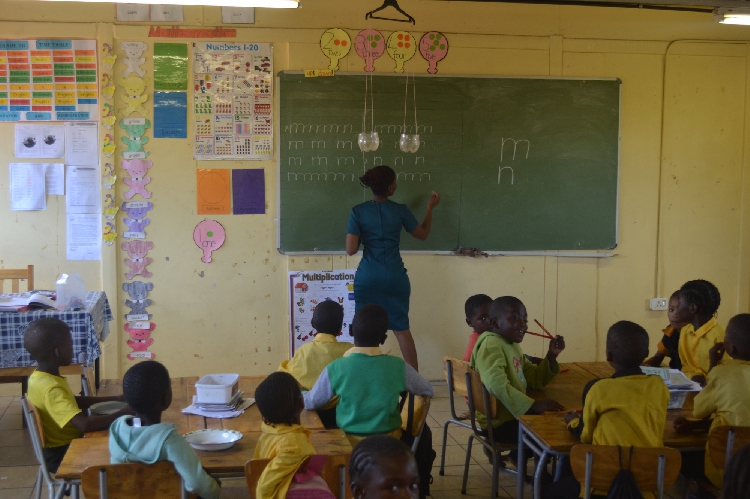
THE young teacher steps out of his classroom and walks into the baking sun at the Drimiopsis Primary School in Omaheke region to meet us.
Dressed in a neat formal shirt and trousers, he leaves his disciplined classroom unattended for a few minutes to speak to us.
The environment around the school is very still since all the classrooms are in session, with only a few learners roaming around the blocks.
Not too far from where we are standing, some tent classes have been erected because of the large inflow of learners, a reminder that not only is there a shortage of qualified teachers but a shortage of classrooms as well.
Unombuiro Upi does not hide the fact that teaching is not his cup of tea. “I’m just here to make money while I wait for interviews for another job,” he said, unhesitatingly.
His true love, he told us, lies in agriculture because it is one of the subjects he teaches and he has a diploma in that field.
“But I do not have a qualification in teaching,” he said, describing teaching as “just standing and conveying a message to the kids”.
There are 26 teachers at the school, and seven of them are unqualified. Most of them teach at junior primary level. Omaheke has 157 unqualified teachers. Upi also doubles as a mathematics teacher for Grades 5 and 6 because the school struggled to attract a qualified teacher. Just like many others, Upi picked up teaching experience along the way.
Education ministry statistics show that about 60% of the 4 500 unqualified and underqualified teachers are teaching at the junior-primary level.
Government said teachers trained for the junior level are teaching at senior grades. A Grade 12 school-leaver, Winnie Paula /Goagoses (20), teaches Grade 2 at the Mphe Tuto Primary School.
/Goagoses said she was beside herself when she was asked to teach Grade 2.
The first few days were tough, but she warmed up to the environment after induction. “I think my learners are doing well,” she stated.
George Tjerivanga is an unqualified history teacher at the Mokganedi Thlabanello Secondary School, and said he was surprised to get the job.
“They just told me: here is your class and the syllabus – teach!” he noted, adding that he had to familiarise himself with the teaching concept first.
“I had to read a few history books and consult fellow teachers on the subject,” he said.
The principal at the school where Upi teaches, Jogbeth Katjira said a qualified mathematics teacher declined the job, and “so we had no choice but to give the job to an unqualified teacher”. Katjira said at her school, teachers come and go after they are groomed and qualified.
“Most of the unqualified teachers are furthering their studies, but after obtaining their qualifications, they leave to teach in urban areas,” she lamented.
Katjira suspects that a lack of proper accommodation could be why they are failing to attract more qualified teachers.
“Our teachers are not doing their jobs wholeheartedly because they are stressed as there is no proper accommodation for them.
Currently, there are three teachers sharing one house,” she explained. Mphe Thuto Primary School principal Monica Bohitile said she is tired of hunting for qualified teachers.
“Every year, we mentor and take unqualified teachers through inductions but once they are qualified, they apply somewhere else, and then we must begin the whole process again,” said Bohitile.
Minister of education Katrina Hanse-Himarwa said the shortage of qualified teachers, especially at the foundation level, is one of the factors hampering numeracy and literacy skills.
To remedy the situation, government has introduced the first diploma programme targeting teachers at pre-primary level this year.
The three-year distance course, which will enrol 1 000 teachers nationally at a time, is expected to cost about N$2 million.
Omaheke rural schools struggle to attract qualified teachers, despite the N$1 700 bush allowance the state offers.
Nantu general secretary Basilius Haingura believes teachers are refusing to work in deprived areas because the bush allowance is too small.
Omaheke education director Peka Semba believes the future looks bright, with Unam graduates joining them this year.
“The demand for unqualified teachers will become less as we go along, although it will take some time,” he stated.
In an age of information overload, Sunrise is The Namibian’s morning briefing, delivered at 6h00 from Monday to Friday. It offers a curated rundown of the most important stories from the past 24 hours – occasionally with a light, witty touch. It’s an essential way to stay informed. Subscribe and join our newsletter community.

The Namibian uses AI tools to assist with improved quality, accuracy and efficiency, while maintaining editorial oversight and journalistic integrity.
Stay informed with The Namibian – your source for credible journalism. Get in-depth reporting and opinions for
only N$85 a month. Invest in journalism, invest in democracy –
Subscribe Now!