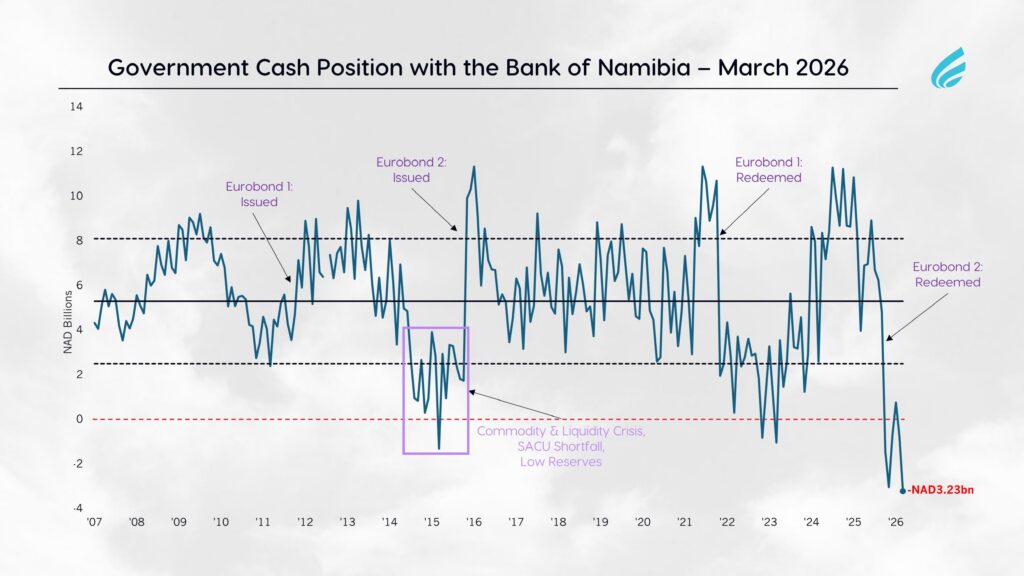
Every month, the Bank of Namibia (BoN) releases its financial statement, with a line item in the liabilities section reflecting the government’s cash position at the bank. One can think of this facility as the government’s bank account, which they use for day-to-day spending.
Revenues flow in and expenditures flow out consistently, and as the cash position is budgeted for, it generally remains in positive territory.
The government has only really moved into ‘debt’ (overdraft) with the central bank on five separate occasions, with the latest value, March 2026, showing the largest deficit in recorded history at -N$3.2 billion.
The government’s financial year ends in March, and large drawdowns on their cash position this month are expected as they tie up all loose ends.
In April, we expect this position to improve as it is one of the months when Namibia receives its Southern African Customs Union inflows, but starting from -N$3.2 billion means they are likely to dip in and out of an overdraft position for the remainder of the year.
The 2025/26 financial year (FY) was a bit of a perfect storm for BoN with regards to funding the government deficit. The Eurobond redemption happened along with local redemptions, including the GC25 and GI25, while domestic growth was not where it was expected to be, which in turn reduced projected government revenue figures as well.
The final domestic funding requirement for the financial year was N$26.5 billion, but one could theoretically add the N$3.2 billion overdraft with BoN to that to show the net cash needed to finance the government’s activities over the financial year.
That equates to a huge amount in historical context, with the next largest domestic funding requirement coming in at N$18.4 billion in FY 2021/22.
The outlook for domestic growth and revenue generation for the government is not looking positive either, and considering the low base of cash the government is starting the financial year with, along with their sizeable deficit, they are going to have to raise a similar amount from the domestic market for this financial year to fulfil some of their spending promises.
That is going to translate into debt becoming more expensive for the government, meaning they will have to raise more to cover it, beginning a self-defeating spiral.
– Oliver Diggle is an economist at Cirrus Capital