





It is no secret that the odds against meat are stacking up. Our beloved kapana is under attack, globally more so than locally, but perhaps not for very long. Slowly but surely the wheels of dietary change are turning, away from meat and dairy and toward plants.
To save the planet we all need to shift from a meat-and-dairy heavy diet, to a plant-based one and although cattle get the blame for much of it, all animals should be included, according to those in the know.
In short, the problems with animals are thus: “[…] we are told by celebrity chefs and food writers, is to keep livestock outdoors: Eat free-range beef or lamb, not battery pork. But all this does is to swap one disaster – mass cruelty – for another: Mass destruction. Almost all forms of animal farming cause environmental damage, but none more so than keeping them outdoors. The reason is inefficiency. Grazing is not just slightly inefficient, it is stupendously wasteful. Roughly twice as much of the world’s surface is used for grazing as for growing crops, yet animals fed entirely on pasture produce just one gram out of the 81g of protein consumed per person per day,” states the article ‘Goodbye – and good riddance – to livestock farming’ in The Guardian.
For a growing number, it is difficult to argue against the evidence that livestock production is the single largest driver of habitat loss.
It is one thing to tell the world to give up eating meat and consuming dairy but getting them to actually do so could be a task not unlike coming to grips with the Holy Ghost.
At this point in time the expected sustainability gains from meat alternatives differ widely. Protein transformation and processing tends to limit the sustainability of high-tech options. Another significant challenge stems from the complex social coordination needed to enable meat alternatives, and lastly more research is needed on meat alternatives with greater sustainability.
According to the report ‘Meat alternatives: An integrative comparison’ published in Trends in Food Science and Technology; “[N]ovel alternatives, including novel meat proxies (cultured meat, plant-based meat alternatives), insects and novel protein sources (like algae) receive increasing attention”.
But we do not yet have plausible socio-technological pathways for their further development.
But the world over, people are not ready to give up meat just yet. In most traditional communities, farmed animals such as cattle have great social and cultural value over and above their economic value. To expect these communities to stop farming with animals is to ask them to stop being who they are. Quite literally. Thus, expect resistance and expect a lot of it, and that is only one element of the no-meat conundrum.
There are currently investigations into the sustainability and desirability of many plant-based meat proxies and meat alternatives from various animal and novel sources: Insects, cultured meat and algae are some of the more prominent examples. There is, however, currently no answer to the pertinent question of whether, and for whom, these alternatives to meat can provide both a plausible and a desirable future.
Can you imagine Namibia without meat? The answer to this question is far more complex than simply converting to veganism. Just how would a desert country like us with very, very little arable land, and insufficient and unpredictable rainfall like us, produce and eat its way out of the meat conundrum? As is, we have to import a very large proportion of our food at great cost. It is possible that plant-based alternatives to meat would require even more food to be imported, and that such alternatives might be priced out of reach for the poor.
Transitions are highly political. There is currently little indication that there is political will for Namibia to even consider non-meat alternatives. Meat still has high social status, and economic interests in the meat chain.
Just think of all the abattoirs, butcheries, regulatory bodies, transport companies, farms, tanneries and restaurants that make a living from meat and all its by-products, and one may be able to understand the scope of the transformation.
To make matters even more complicated, add our insufficient technological know-how on novel (plant) protein foods and it might almost seem like a bridge too far.
Of course there is hope. Efforts to combine ‘rewilding’ the land and livestock farming are currently being experimented with, amongst others by the Cheetah Conservation Fund here locally. Combining livestock farming with community-based tourism is another well-documented example.
Examples such as these suggest that wildlife is part of the solution, not the problem. And that includes predators, small and large. Conservation may be the only way to offset the cost of livestock farming. But that would mean we need to create non-agricultural jobs elsewhere in the economy. By giving more Namibians paid non-agricultural employment, we may reduce their dependence on livestock and their vulnerabilities to droughts and disease whilst picking up some additional slack caused by rewilding and conservation.
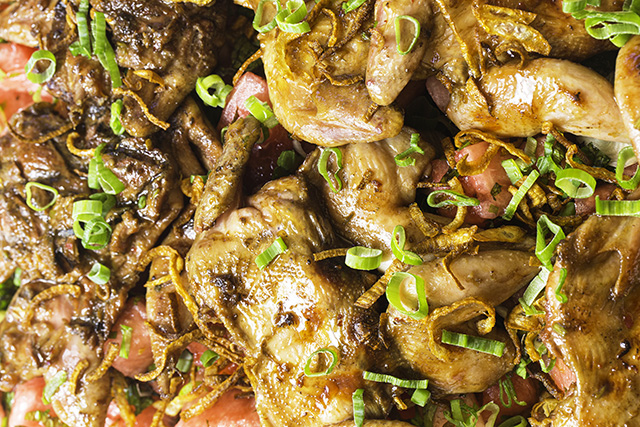
Just this weekend I discovered quails produced here locally in Namibia. We had a most delightful quail braai and even the quail novices among us ate to their heart’s content.
It may prove that the times are changing here in Namibia too.
Bon Appétit!
• 1⁄2 cup light soy sauce
• 1 tablespoon oyster sauce
• 1⁄2 cup water
• 1 small onion, minced
• 1 tablespoon rice vinegar
• 1 tablespoon palm (or brown) sugar
• 1 tablespoon dried chilli flakes
• 1 pinch Szechuan pepper

