




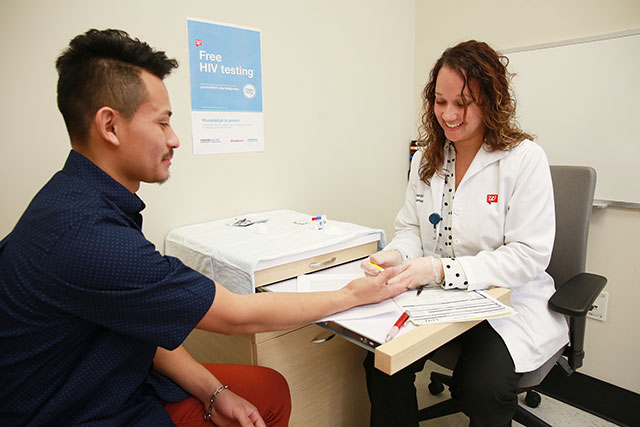
Most people experience fear and anxiety at some point when getting tested for HIV. Even if they have been faithful, they might worry that their partner has put them at risk by cheating.
We know getting tested for HIV is important for our health, relationships, lives and futures. So why are people, particularly men, not keen to get tested?
With World AIDS Day being commemorated tomorrow, The Weekender looks at what can be done to change this behaviour.
World AIDS Day is an opportunity for people worldwide to unite in the fight against HIV, to show support for people living with HIV and to commemorate those who have died from AIDS-related illnesses.
Speaking to The Weekender, counsellor Mercia Gawanas says one of the reasons men avoid getting tested is impatience. “Men are impatient and normally the counselling and testing session lasts at least 45 minutes,” said Gawanas.
Another reason, says Gawanas, is that men believe if their partner is tested, the result will also reflect theirs.
“Many men do not want to be seen at testing sites unless their partner drags them,” she says. “Another reason they shy away from getting tested is because of having multiple partners.”
To change this, Gawanas encourages index partner testing and urges men to not be scared to search for such information. Index testing is a focused HIV testing services (HTS) approach in which the household, family members (including children) and sexual partners of people diagnosed with HIV are offered HTS.
HTS helps to prevent HIV transmission by identifying HIV positivity and informing individuals, partners, couples and families of their HIV status and counselling them to develop appropriate measures to prevent or minimise HIV risks in sexual behaviour, alcohol and drug use, and other behaviours.
For Stanley John-John Higoam, pre and post-counselling is very important in the approach to get more men to know their HIV status. “The stigma of society we are living in and that of the health system also plays a vital role. We need a compulsory approach to testing on every visit to both state and private health facilities. Together we can do better,” said Higoam.
On the other hand, Collins Kambimbi mentioned that women are strong and are taught how to handle pressure from childhood. “So it’s easy for them to accept things that come their way. However, men are not taught how to handle pressure and other things that come with adulthood. Men are told to man up but are not shown how. This is why men avoid getting tested for HIV because they are not emotionally strong,” said Kambimbi.
Adding to the conversation, Ndeapaantu Niipele said men should be encouraged to live better and make healthier choices. “Women too are afraid to get tested, not only men. This should be done when someone is mentally ready for whatever the outcome might be,” said Niipele.
Gabes Nepembe commented that men have poor understanding when it comes to infectious diseases. “The majority of us think going for HIV testing is a death penalty. I have seen someone who wanted to be intimated on anti-retroviral therapy without being tested for HIV, just because his partner tested positive. The fear of being diagnosed with HIV is very high in men,” said Nepembe.
