A recent landmark sale by the South African auction house Strauss & Co of linocut prints by Namibia’s most acclaimed artist, John Ndevasia Muafangejo, set records with one piece, ‘Zimbabwe House’, selling for N$410 375.
The modern-day value of Muafangejo’s art is in stark contrast to the reality of the ‘people’s artist’ who, while putting Namibia on the international art world map, is said to have been virtually penniless when he died aged 44 in November 1987.
The auction, titled ‘African Lion: John Muafangejo Works from the Orde Levinson Collection’, offered more than 100 prints and original (cancelled) lino blocks and also saw the 1975 print ‘Elephant is Killing a Lion in Funny Way’ sell for N$175 875. In total the auction raked in N$3,4 million.
The Namibia-born Levinson is a well-known art collector and scholar based in Oxford in the United Kingdom. He bought Muafangejo’s copyright, numerous prints and original blocks at the posthumous auction of his estate in 1989 for N$210 000 – at the time a considerable amount.
Levinson’s passion for Muafangejo was inspired by his mother, Olga Levinson, who was a well-known patron of the arts in Namibia. For many years since Levinson acquired the copyright there has been controversy and tension, felt particularly by local arts organisations that advocated for Muafangejo’s legacy to be utilised to benefit local Namibian artists.
The Namibian Arts Association has the largest collection of Muafangejo artworks in the country, while the National Art Gallery of Namibia currently has 37 Muafangejo works in its permanent collection.
Born in 1943 near the Kunene River in southern Angola, Muafangejo – the sixth of his mother’s eight children – grew up in a traditional homestead herding cattle during the day.
“Following the death of his father in 1955, his mother returned to her own family at the mission station Epinga in northern Namibia. Here Muafangejo encountered formal education and Christianity for the first time,” says Annaleen Eins, former head of the National Art Gallery of Namibia (NAGN), who worked closely with the distinguished artist.
Muafangejo attended St Mary’s Anglican mission school at Odibo, where his artistic skills were recognised and arrangements were made for him to train at the Evangelical Lutheran Church Art and Craft Centre at Rorke’s Drift in KwaZulu-Natal. There he learned linocut and printmaking techniques such as etching and also carpet weaving, first from 1967 to 1969 facilitated through the Anglican Church and again in 1974/5 through the Arts Association.
In between he returned to teach and establish an art school at St Mary’s. In 1971 he held the first of several solo exhibitions in Windhoek and represented South Africa at the São Paulo Biennale.
“There was a misconception that Muafangejo was South African, not Namibian,” says Desiree !Nanuses, acting chief curator and collections curator at the NAGN.
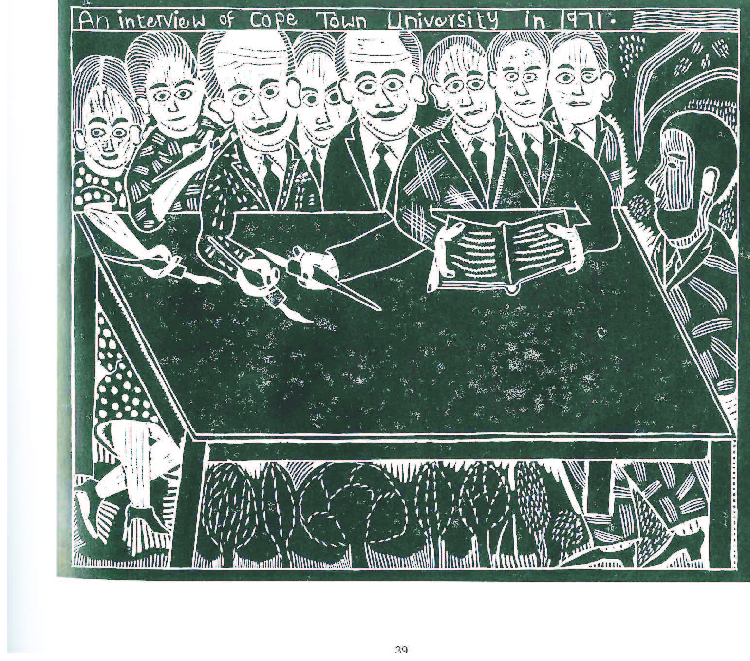
“He studied in South Africa and produced a number of very important works there, notably the autobiographical ‘An Interview of Cape Town University in 1971’ (1974), which portrays the artist’s failed application to study art in Cape Town. It’s an inspiring artwork, especially because of the legacy of Muafangejo thriving amidst such challenges. He showed resilience, tenacity and grit to become Namibia’s first international artist, paving the way for so many others.”
Muafangejo liberated and empowered young black artists then and in the decades to follow. He shattered the glass ceiling at a time when black people were oppressed and discriminated against daily.
“Some historians, writers and academics have seen Muafangejo and printmaking as naive and primitive but this is far from true,” says !Nanuses. “While Muafangejo’s direct references to contemporary political events are rare, his prints refer to the repressive regime at the time, and he often used Zulu and Owambo history to provide indirect comment. He strongly commented on the political and social role of the church in resisting and opposing an inhumane and unjust regime.”
Deeply inspired by religion, nature, history and the political struggle, Muafangejo died before Namibia gained independence, but his work reflected the anticipation of liberation.
“Prints often included satirical, critical, despairing and humorous comments on events, people and everyday life. His autobiographical artworks are accompanied by text. The genius mind required to utilise the writing back to front to print it in exact order – how intricate and meticulous that process is. Muafangejo’s incorporation of text into his prints exemplifies his excellent craftsmanship,” says !Nanuses.
Certainly if there is an artform that Namibian artists have succeeded in, it’s printmaking, and much of its popularity is due to Muafangejo’s enduring influence.
Artist and curator Actofel Ilovu first encountered Muafangejo’s work when he came to Windhoek to study at the College of the Arts.
“As an art student from the northern part of Namibia, I didn’t really know what art was, what qualifies to be called arts,” Ilovu says. “I fell in love with Muafangejo’s black and white prints not only because it’s black and beautiful but because he also tells what is happening in his life and environment. He was an activist.”
Ilovu believes Muafangejo’s legacy does not benefit local artists due to the copyright of his work being owned privately, and says Muafangejo’s artistic talents were not truly valued while he was still alive. “His work was undermined and sold on the street like crafts.”
“For us within the visual arts sphere, the John Muafangejo Arts Centre has trained many – as he was educated and opened horizons for others to explore printmaking as a technique,” says !Nanuses.
Namibian artist Herman Mbamba recently acquired a Muafangejo print which was a gift from a close friend. He began his studies in 1999 at the John Muafangejo Centre before going on to attain BA and MA degrees at the National Academy of Fine Arts in Oslo, Norway, where he is currently based.
“I have always had a fascination with Muafangejo’s work. This particular piece is so representative of Muafangejo’s oeuvre and means a great deal for me. I recall vividly the many times I frequented the NAGN, just to see the permanent collection.
“I felt the need to acquire works by Namibian artists, especially black Namibian artists because these works represents for me, from a historical point of view, a value of significance. Furthermore, it’s about repositioning the dynamics of power – because it’s well documented, that few black Namibians have the financial power to partake within that realm.”
She further describes Muafangejo as a modest person, despite all the success, recognition and fame he experienced.
“He was always modest but with dignity and humour. He was self-assured in his art and guided by his Christian belief that all human beings are equal before God. Throughout his short and often difficult life, Muafangejo visually expressed his doubts, confusions and joy with positivism and creative uniqueness, as well as unselfconscious honesty. He was very sensitive to all the atrocious, violent and inhumane actions of politics.”
Artist and former NAGN head Joseph Madisia also knew the legendary printmaker personally.