




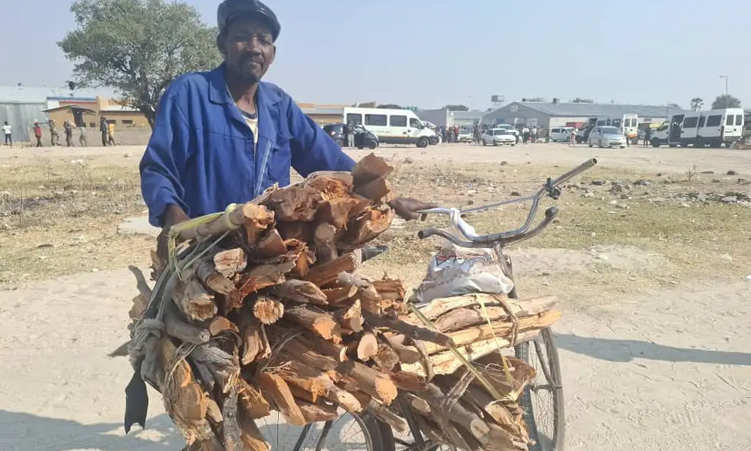
The bicycle is old and heavily loaded with bundles of firewood.
Every morning before sunrise, Petrus Johannes (45) grips the handlebars and begins pushing it towards Oshikango. He cannot ride it. The load is simply too heavy.
Instead, the father of five walks nearly 10km from Oihole village in Angola to Namibia, hoping the firewood strapped to the bicycle would earn him enough to feed his wife and children.
For Johannes, the bicycle is not just a means of transport. It is the difference between putting food on the table and going home empty-handed.
“I cannot ride it because the bundles are too heavy,” he says. “I have to push it all the way.”
For the past five years, selling firewood has been the family’s only source of income. Every trip begins with hope and ends with uncertainty.
Each bundle sells for N$20. On good days, Johannes earns enough to buy maize meal, cooking oil and other household necessities.
On bad days, he pushes the same heavy load back across the border without selling a single bundle.
“Sometimes I return home without selling anything,” he says.
Whatever little he earns goes straight towards feeding his family.
CONSTANT FEAR
But making a living is not only about finding customers.
Johannes says he lives in constant fear of losing the one thing that makes his business possible.
He says the police, security guards and officials from the Helao Nafidi Town Council confiscate bicycles and firewood from vendors found selling outside the designated open market.
“Then I have to pay N$500 to get my bicycle back,” he says.
For someone who survives on N$20 bundles of firewood, such a fine can wipe out weeks of earnings. Losing the bicycle is even worse.
“Even now, if they see me talking to you here, they will confiscate my bicycle,” he says.
“If they take it, I will not be able to sell for a long time, because I cannot afford another bicycle.”
Johannes says the town council requires vendors to sell from the open market, but he says the market attracts few customers and competition among traders is fierce.
“I push my bicycle around town so that people who want firewood can buy,” he says.
His struggle is shared by many informal traders trying to earn an honest living at Oshikango.
MORE THAN JUST FOOD
For Fransina Nghihangelwa (41), the streets of Oshikango have paid for far more than food.
Selling fat cakes, oshikundu and fish has helped her support her children, who are studying at a university in Windhoek, pay municipal bills, and keep her household running.
“This is where I get money to pay rent for my children and my municipal bills,” she says.
She says she has, however, repeatedly lost the very goods she depends on.
Nghihangelwa says town council officials and the police have confiscated the basins she uses to sell her food in three times.
“They told me if I wanted my things back, I had to pay N$500,” she says.
She claims that whenever she went to collect her confiscated goods, the food was gone.
“I don’t know where they put my merchandise. Maybe they eat it,” she says.
What hurts most, she says, is the way vendors are treated.
“The way they chase us from the streets is like we have stolen diamonds.”
She says officers often tell them they are simply enforcing municipal by-laws.
“They tell us they did not make the laws. They are only enforcing them.”
Although traders are encouraged to use the open market, Nghihangelwa says business there is slow because customers rarely visit.
“At the market we pay N$25 every day. If you fail to pay, the next day they will not allow you to sell because you owe them,” she says.
SUPPORTING A GRANDMOTHER
For Ottilie Haufiku (26), selling cooked chicken is how she supports her grandmother in Angola.
She says she makes N$200 from each sale, but has to spend N$60 on yet another live chicken and a further N$20 on firewood and other ingredients.
She says she, too, has experienced the loss of her merchandise.
When The Namibian visited Oshikango last month, one of the vendors was selling from the back of her bakkie.
Whenever she spots police officers, she quickly closes the vehicle’s canopy.
“It is the only way to stop them from taking my things,” she says.
She recalls an incident when officers drove her vehicle to the police station.
“They only gave me back my things after they saw me crying. They told me I should apologise to the security guards. I did that, and then they gave me back my things,” she says.
‘MAINTAINING ORDER’
Helao Nafidi mayor Darius Shaalukeni says the town council’s efforts are aimed at maintaining order at the town, but stresses that the council does not support the unlawful confiscation of people’s belongings.
He says he cannot confirm or deny vendors’ claims that some confiscated goods are not returned, but warns that if such incidents are happening, they amount to theft.
Shaalukeni urges vendors whose goods are confiscated to document the process by taking photographs, where possible, to help the council investigate complaints.
“If they have a smartphone, they should take photos so that we can follow up with whoever took their things,” he says.
The mayor says vendors found selling at unauthorised locations are issued fines of N$500, saying the measures are part of efforts to regulate trading activities at the town.
The Local Authorities Act 23 of 1992 allows local authorities to regulate illegal trading and provide for the impounding and disposal of goods.