




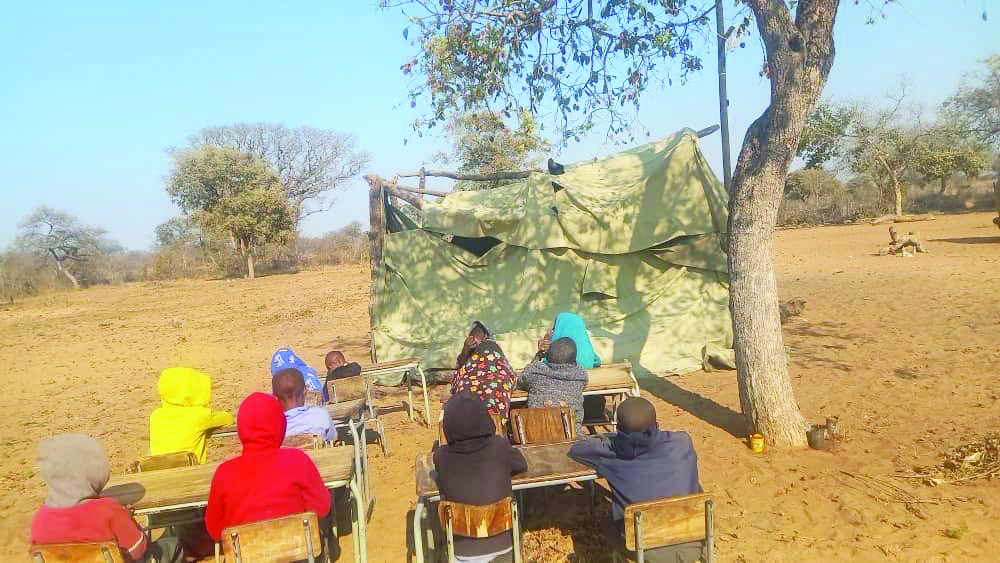
Parents have removed pupils from Kavango West’s Nyege Junior Primary School over dilapidated, unsafe tent classrooms, leaving the school with just 15 children.
The school in the Mpungu constituency was established in 1971 but has been operating without proper classrooms since it was moved closer to the road near Nkurenkuru in 2022 because of recurring elephant threats.
The school has allegedly had about 30 pupils over the years, but parents are now sending their children to other schools due to poor conditions.
The remaining pupils are in grades 1 and 2 – all taught together in one small tent.
The principal allegedly resigned in 2020 due to the school’s poor condition, a parent says.
Markus Vilho (52), whose five grandchildren are attending the school, says the tent is frequently damaged by strong winds. He says the pupils do not have enough chairs, with as many as three sharing one chair.
“The other schools are far. During rainy and windy weather, the children endure it. Build classrooms, even just a temporary shack,” he says.
Jesaya Siwogedi (60) says he removed his three grandchildren from the school last year because he felt the learning environment was unacceptable.
“We don’t have a problem with the school. The education is good, but the learning environment is not conducive at all. The government must fix it. We don’t want tents,” he says.
Parents like Annakky Sikongo (48) and Bertha Kamunoko say they have no choice but to continue sending their children to the school because alternative schools are too far away.
The closest alternative school is about 7km away, Kamunoko says.
She says travelling that distance would place an additional financial burden on families that cannot afford transport and other related expenses.
“The ministry must come see the condition of the school. When you see it, is when you act. They must fix it so the kids can learn in a safe environment,” Kamunoko says.
The school tent was allegedly destroyed by the wind on Tuesday, forcing pupils to be taught in the open.
Parents are now calling on the Ministry of Education, Innovation, Youth, Sport, Arts and Culture to visit the school and address its infrastructure needs.
Kavango West Regional Council senior spokesperson Matheus Hamutenya on Wednesday confirmed that the education directorate and the ministry are aware of the school’s condition.
He said infrastructure and staffing needs across the region are, however, addressed according to available financial resources and priorities, including pupil enrolment, overcrowding, infrastructure conditions, water and sanitation needs and the urgency of each school’s requirements.
“The directorate acknowledges the challenges at the school have existed for an extended period. The continued use of temporary infrastructure at the school is therefore a result of competing infrastructure priorities and limited resources rather than a lack of recognition of the school’s needs,” he said.
He said the one teacher currently at the school was recruited through the ministry’s normal procedures and is paid by the ministry.
Hamutenya said the ministry is committed to improving Nyege Junior Primary School’s environment and will consider appropriate interventions as resources become available and as the school’s enrolment and infrastructure needs evolve.
The education ministry is yet to respond to questions on the matte