



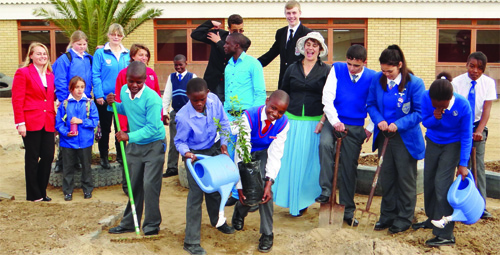
LIFE SKILLS teacher at the Swakopmund Primary School, Annemarie Mater has embarked on a ‘school gardening’ project that she hopes will ultimately contribute to food security for poor children.
Mater works with orphans and vulnerable children (OVCs) and is also involved with the national feeding programme, which gives maize meal at schools.
“Our school receives maize meal two to three times a day which the school uses to cook, but this is not enough to ensure academic performance. Most mothers are single and many have no or insufficient assistance from fathers, so I am really trying my best to supplement the food by providing something with nutrients. I would love to give learners soup once a week as well,” Mater said.
She hosted a workshop ‘Setting up a school garden’ earlier this month and is already receiving support from the Ministry of Education and local companies such as E-build, Benthin, Essential Hardware, Lawn & Star, and Efekto to supplement the national feeding programme. The Ministry of Agriculture, Water and Forestry supplies fruit trees; Namdeb has been recruited to provide garden training manuals and certificates; and seeds are donated by SIDA (Swedish International Development Coorperation Agency). Others involved in the project are councillor Anthony Bessinger, Little Foot, E-Build and Greenfields. Erongo education inspector Ernest Olivier, and Robeam Ujaha, on behalf of the ESD Project, delivered speeches.
The workshop also involved presentations by Martha Kamati and Marianina van Deventer (both local teachers who had great vegetable garden results)and demonstrations of how to prepare soil for trees and seedlings, caring for them and eventual harvest.
The idea of a terrarium (plant in an enclosed bottle) was shown that eventually creates its own micro climate. A demo terrarium will be placed at the RCE room at the Municipality of Swakopmund, and schools are welcome to observe the developing of this project in future and order their very own custom-made terrariums from aquatics.
Mater adapted this project from Malmö, Sweden, during her visit in February as part of the “Education for Sustainable Development” project of the Municipality of Swakopmund in cooperation with the Municipality of Malmö.
The aim of having a school garden is to create awareness on the importance of food production on a small scale. It is also to stimulate learners to develop practical skills.
“We would really like to expand this project to the rest of Namibia,” Mater said.