







YOUTH organisations and politicians have expressed mixed reactions to a government proposal exploring compulsory national service to tackle youth unemployment and instil discipline in young people.
Swapo Party Youth League secretary Ephraim Nekongo says the programme could promote discipline, patriotism and civic responsibility while equipping young people with practical skills that could help them become self-reliant and create employment for themselves and others.
“We have made a call to the government that National Youth Service must be compulsory,” he says.
Nekongo says some of the skills young people need cannot be acquired at university.
He uses China as an example, saying he had observed a strong sense of patriotism among young people there.
The government could determine the appropriate age at which young people should undergo the programme, Nekongo says.
He says national service could help address unemployment by equipping young people with practical skills and encouraging them to become self-reliant.
Additionally, the programme could help address poor discipline by keeping young people engaged in productive activities.
The government would, however, need to invest more resources in the National Youth Service (NYS) before expanding it, he says.
Limited funding prevents the NYS from making full use of existing infrastructure, the secretary says.
“The programme of young people without young people, it becomes not for the youth.”
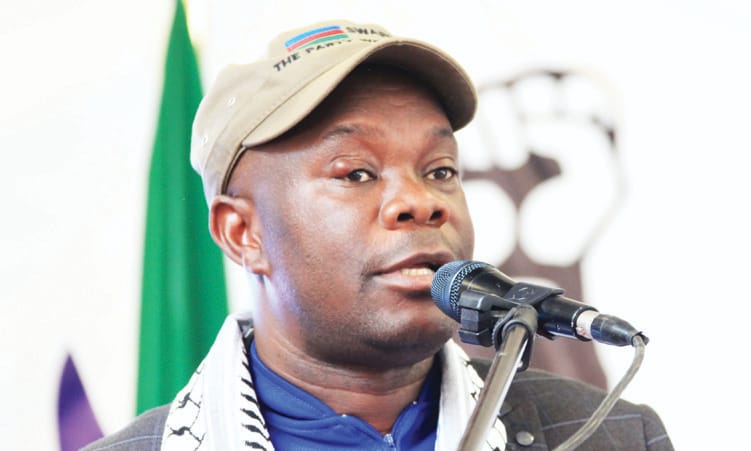
Nekongo says youth representatives should be included in structures responsible for planning and overseeing programmes affecting young people.
His comments come after an announcement by minister of education, innovation, youth, sport, arts and culture Sanet Steenkamp on Monday that the government is exploring compulsory national service, particularly for school-leavers. The minister said the proposal was receiving increasing national attention, but cautioned that any move towards compulsory national service would require consultation, policy and legislative processes.
“The government is currently exploring the possibilities and implications of such a policy direction,” she said.
Steenkamp said the NYS faces growing demand for its programmes, with about 18 000 young people applying for the 17th recruit intake in 2026.
She told The Namibian yesterday that the government is still exploring the possibility of compulsory national service and cannot provide further details at this stage.
“It is just a consideration that we are exploring,” she said.
REACTION
Students Union of Namibia board chairperson Benhard Kavau says national service might provide young people with training and structure, “but training alone will not transform society when the very leaders who are supposed to set the standard continue to fail as role models”.
“You cannot preach discipline to the youth while tolerating corruption and misconduct among those in authority,” he says.
He questions the assumption that compulsory national service is the solution to indiscipline among young Namibians. Kavau says if the government is genuinely concerned about discipline, corruption, crime, and moral decay, it must first confront the conduct of the older generation and, particularly, those in positions of power.
Namibia National Students Organisation (Nanso) spokesperson Ndayola Mulongeni says the organisation supports compulsory national service, provided it is designed to benefit young people and does not negatively affect their education.
“We wholeheartedly support the proposal,” she says.
Mulongeni, however, says the government would need to provide adequate resources to prevent the programme from becoming a box-ticking exercise. She says Nanso wants to be involved in discussions around the initiative.
Highland Youth Organisation chairperson Meda Nghixulifwa says his organisation would also support compulsory national youth service.
“We would likely opt for it to be compulsory. [There is] a demographic of unemployed youth who are lying idle. If the government doesn’t come up with a way to solve this, they will become the government’s problem somewhere down the line,” he says.
Nghixulifwa says the youth is the most innovative and energetic demographic.
“If you do not have an avenue to translate that resource – those ideas, that energy – then that demographic [will use that energy] elsewhere. It won’t be used for the benefit of the country or the government,” he says.
He says it is, however, important that youth organisations are consulted if and when a formal policy is designed.
Landless People’s Movement Youth and Student Command spokesperson William Minnie believes the issue must be approached with “intellectual seriousness” and within the framework of Namibia’s constitutional democracy.
“Our position is therefore that the government should not proceed from the assumption that compulsion is automatically the appropriate solution,” he says.
REGIONAL EXAMPLES
Member of the National Assembly Martin Lukato says he has introduced a motion for compulsory national service because he believes it could help address youth unemployment.
“When I introduced this motion for national service to be compulsory in Namibia, other people thought that it was a joke,” he says.
He says the motion, which he introduced in the National Assembly on 26 June 2025, was primarily intended to address unemployment among young people.
The topic had been discussed in parliament as far back as 2009.
Two African countries already run mandatory national service programmes for their youth.
In Ghana, all graduates of universities, colleges, and vocational colleges are required to work for 12 months through the country’s National Service Scheme.
Nigeria also runs a mandatory service year for all its graduates, called the National Youth Service Corps.