



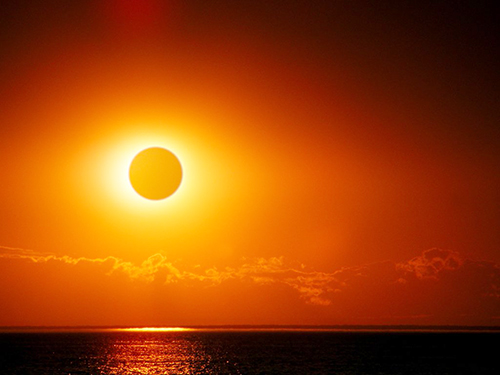
•RICHARD INGHAMNorse legend has it that two giant wolves roam the sky – with Skoll chasing the moon and its brother Hati going after the sun.If either manages to sink its teeth into its prey and hold it back, an eclipse occurs, the story goes.
Tales of cosmic wolves may once have been a useful way of explaining the weird and scary interval when the sun, the source of life on Earth, is briefly extinguished.
For astronomers, though, total eclipses occur when the moon sneaks between Earth and the sun, and the three bodies align precisely.
By quirky celestial symmetry, the moon as seen from Earth is just broad enough to cover the solar face, creating a breathtaking silver halo in an indigo sky pocked by daytime stars.
The moon will do this trick again today for the only total solar eclipse of 2015, with a dramatic backdrop provided by Nordic islands on the roof of the world. Then on Saturday the lunar magician will bemuse us again, this time with exceptional tides.
The reason: Earth’s satellite will be a ‘supermoon’, which happens at its closest point to our planet, called a perigee.
This, and the moon’s alignment with the sun, will add to the gravitational pull on the seas – creating what is literally a high point in the 18-year lunar cycle.
“The eclipse and the tide are linked,” says Kevin Horsburgh, head of the Marine Physics and Ocean Climate research group at Britain’s National Oceanography Centre (NOC).
“For an eclipse to take place, the sun, the Earth and the moon need to be in a straight line, which is also an essential condition for high tides.
“And for particularly big tides, the moon needs to be directly overhead at the equator at the time.”
Today, the moon’s shadow will alight on Earth’s surface at 07h41 GMT in the eastern central Atlantic, according to Britain’s Nautical Almanac Office.
By 09h13 GMT, seen from a point about 700 kilometres south of Greenland, the sun’s face will be completely obscured.
This ‘path of totality’ will follow a 5 800-kilometre curve across the farther north Atlantic, into the Arctic Ocean.
It will cross land in the Faroe Islands, a Danish archipelago halfway between Iceland and Norway, and the Norwegian island group of Svalbard.
“The path (of totality) ends at the North Pole at 10h18 GMT,” veteran astronomer Fred Espenak says on the specialist website EclipseWise.
Partial eclipses – which resemble a bite taken out of the sun – will be visible from Iceland, Greenland, Europe, North Africa, western and eastern Asia, ending at 11h50 GMT.
London will have its deepest eclipse since 1999, with 85% of the sunlight blotted out.
The celestial ballet will on Saturday result in major tides most perceptible in Canada’s Bay of Fundy, on the French Atlantic coast, in the Channel and North Sea – but even the Mediterranean will feel the difference.
Weather is a big influence on a tide’s fierceness – gales can whip up surges able to test the mighty barriers that protect the Netherlands and London from flooding.
In 2010, a sea surge, driven by a storm called Xynthia, flooded parts of the Vendee coast on France’s Atlantic seaboard, killing 41 people.
In an age of information overload, Sunrise is The Namibian’s morning briefing, delivered at 6h00 from Monday to Friday. It offers a curated rundown of the most important stories from the past 24 hours – occasionally with a light, witty touch. It’s an essential way to stay informed. Subscribe and join our newsletter community.

The Namibian uses AI tools to assist with improved quality, accuracy and efficiency, while maintaining editorial oversight and journalistic integrity.
Stay informed with The Namibian – your source for credible journalism. Get in-depth reporting and opinions for
only N$85 a month. Invest in journalism, invest in democracy –
Subscribe Now!