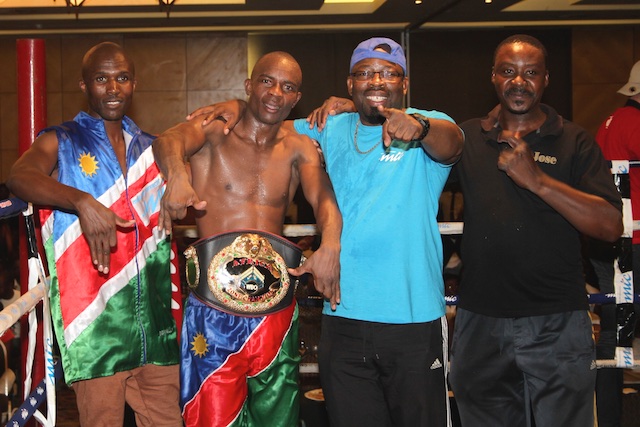
NESTOR Tobias had to overcome many obstacles during his career in boxing to reach the top, but his commitment and drive saw him doing just that.
When his promising career as a boxer was cut short due to injury, he turned to training and promotion, and after years of hard work he has almost single-handedly put Namibian boxing on the world map. He has produced two world champions and promoted several world title bouts, while he has also won numerous national and continental awards as a top trainer and promoter.
The man who is also known as the ‘Don King of Namibian boxing’ has travelled the world and ‘seen it all’ through boxing.
“I’ve enjoyed my career to the full, as a boxer, as a promoter or as a trainer. Boxing took me very far and introduced me to the world – I’ve visited many countries, I cannot remember any class in the plane that I did not fly. I’ve met all the beautiful people, I’ve met ugly people, the worst and the best, I met everybody. I know the world and I’m just happy that I could do it all through boxing,” he said.
Tobias was born and raised in the northern Namibian village of Etundja but his interest in boxing only came later in his teens when he was schooling in Tsumeb.
“There was a boxing club and I saw some of the boxers won trophies so I also wanted to do that. I was quite a street fighter then and beat up a lot of kids, so I thought why don’t I also join boxing. My first day at the gym they gave me a bigger guy to spar against, so I beat him up and then they gave me another one and I also beat him up, I was just throwing punches.”
“But the next morning when I woke up my head was paining and my body was sore so I thought no, this is too much pain, so I didn’t go to the gym again.”
Tobias dabbled in karate a bit, but it didn’t hold the same thrill so he returned to boxing and soon started making a name for himself.
He made the Far North team and then later the then-South West Africa team after becoming the national junior champion in his weight category. He had also excelled as a middle distance runner at school and due to his sporting prowess was offered a job at CDM in Oranjemund.
In 1986 he made the South African boxing team and won the South African junior middleweight title the following year, but due to sanctions his prospects down south were limited.
“By 1988 I was hoping to go to the Seoul Olympics, I had qualified, but because of the sanctions I could not go and there was nothing I could do. I was enjoying my boxing, but I could not participate internationally,” he said.
By 1989 Harry Simon had also made the South African boxing team and after Namibia gained independence in 1990 the two boxers were of Namibia’s most talented sportsmen at the time. They both represented Namibia at the All Africa Games in Cairo where Simon won gold to qualify for the Olympics, while Tobias reached the quarterfinals. He still had a chance to qualify through the African Championships in Casablanca, but as fate would have it, this chance was also denied to him.
“Harry and I went to train in South Africa to prepare for the Olympics, but then people started saying that we had turned professional. It wasn’t true, but the boxing board in Namibia called me to say that we were suspended. I had to go back to Namibia to sort it out, but although they later lifted the suspension, I missed the trip to Casablanca for the African Olympic qualifiers, so that was the end of my Olympic dreams,” he said.
Simon did go to the Olympics where he lost a controversial first round fight, but that was his last amateur bout and by 1993 he and Tobias turned professional in South Africa.
Tobias’ pro career got off to a great start as he won his first seven fights but since he was now a Namibian, he could not fight for the South African title.
“I was going to fight for the title, everything was sealed and signed, but then they said I could not fight for the title because I’m not a South African. They said I had to renounce my Namibian citizenship if I wanted to fight for the title, but I could not do that – I am a patriotic Namibian and although they offered me good money I told them I cannot do that,” he said.
Tobias continued boxing and by 1999 finally got a chance to fight for the IBO junior middleweight title, but his dreams were once again dashed.
“I injured my shoulder during training and it got worse in some fights. I went to see a specialist and he said I’d have to have an operation but I did not want to do that so I just quit boxing,” he said.
“I was lying around in bed, thinking what to do with my life. I didn’t have an opportunity to go to university and sport was all I knew, and through my time at CDM I was also a qualified soccer and athletics coach. But I was more qualified in boxing and I knew there was a lot of talent in Namibia, but nobody was doing anything to develop it,” he said.
By 2000, Tobias started the Nestor Sunshine Boxing Academy and registered as a trainer and a manager with the Boxing Control Board and by the next year he also got his promoter’s license.
“There were promoters in Namibia, but they weren’t doing anything, nothing was happening here. Maybe they thought if you have a license, money will just come to you, but they didn’t know that you must put in money to make the fight happen,” he said.
Frans “Rambo” Hantindi was Tobias’ first drawcard and after travelling to South Africa, Angola and Botswana to build up his record he promoted his first fight in Namibia in 2001 when Hantindi won the WBA Pan African welterweight title.
At first there were not too many professionals around and he mainly used amateurs on his undercards, but his stable steadily grew as other boxers started to catch the limelight.
Paulus “Hitman” Moses already started as an amateur with Tobias, but after turning pro he soon became Tobias’ main drawcard. He built up an impressive unbeaten record and by 2006 won the WBA Pan African lightweight title, and the following year the WBA Inter-continental title as well.
By 2008 the Hitman had become the mandatory challenger for the WBA lightweight title, but Tobias had to first deal with boxing impresario Don King to tie up a world-title fight.
“At first it was difficult to penetrate the world market because these big promoters, they dominate and dictate things. Hitman was number one for two years so I decided to go to the States to meet Don King. We didn’t have any choice, we had to sign up with Don King, but it was a good experience and Hitman got his chance to fight for the world title,” he said.
Tobias went on to promote his first multi million-dollar bonanza in Windhoek with Moses’ first title defence and since then more champions and mega-promotions have followed.
Paulus Ambunda became Tobias’ second world champion in 2013, while Immanuel Naidjala got a crack at the world title that he lost the following year.
Besides that, Tobias has produced numerous African champions and highly rated boxers and he believes the future of Namibian boxing looks bright.