





As Swakopmund’s desert sands conceal unmarked graves, descendants of genocide victims say the pain of one of Namibia’s darkest chapters continues to echo across generations.
Between 1904 and 1908, German colonial forces carried out an extermination campaign against the Ovaherero and Nama people after uprisings against colonial occupation, land dispossession and the seizure of cattle.
Thousands died through massacres, starvation, forced displacement into the Omaheke desert, and imprisonment in concentration camps at Swakopmund, Shark Island at Lüderitz and in other parts of the country.
Historians widely recognise it as the first genocide of the 20th century.
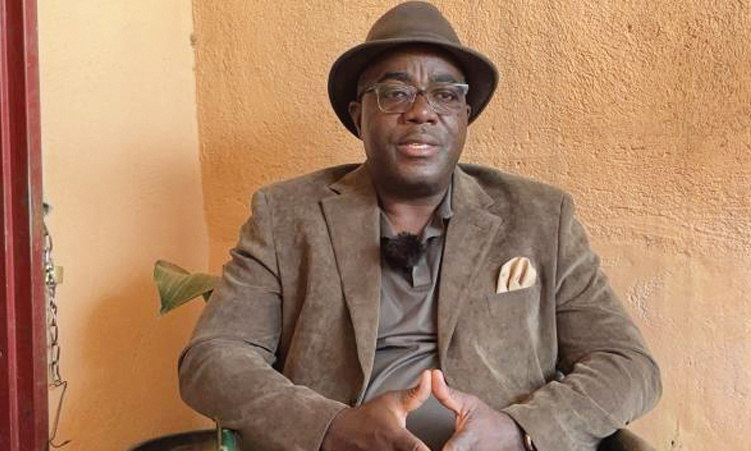
For senior headman and Ovaherero Traditional Authority leader chief Jeremiah Mujahere of Otjimbingwe, the wounds are etched into the land itself.
“I can still take you to gravesites where human bones can be found underground,” he said during an interview ahead of Namibia’s Genocide
Remembrance Day commemoration yesterday.
“When you stand there, you feel as if this could have been your great-grandfather or your uncle.
That pain remains with us,” he said.
Mujahere spoke about Otjimbingwe, regarded as Namibia’s first colonial administrative centre and one of the country’s most historically significant settlements.
Long before modern Namibia emerged, missionaries, traders, colonial authorities and traditional leaders converged there.
The settlement became a centre of missionary education and administration during the 19th century.
The Augustineum Seminary and teacher-training college, founded by Rhenish missionary Carl Hahn in 1866, began at Otjimbingwe before later moving to Okahandja.
The institution became one of the foundations of formal education in Namibia.
The Paulinium Theology School also traces its roots to Otjimbingwe, which for decades remained a centre for theological training in the country.
Namibia’s first post office was opened there on 16 July 1888, when the settlement briefly became the de facto capital of German South West Africa.
“This place was once the centre of learning and leadership, but today many people pass through without understanding its importance,” he said.
At the centre of the settlement still stands the historic Rhenish Missionary Lutheran Church, one of Namibia’s oldest churches, constructed between 1865 and 1867.
Nearby stands the Pulverturm, the colonial tower built in 1872 to protect ammunition, trade goods and settlers during attacks linked to conflicts between colonial forces, Nama groups and Ovaherero fighters.
The tower later became part of the German military presence at the settlement and remains one of Otjimbingwe’s most recognisable structures.
A similar colonial tower still stands at Omaruru, where German forts and lookout posts were used during military campaigns and later during the genocide period as colonial forces tightened their control across central Namibia.
“These places are not just buildings; they carry the memories of what happened here,” Mujahere said.
Mujahere described how entire communities were uprooted during the genocide, with many survivors fleeing to Botswana, Angola and South Africa.
“Some people no longer know exactly where they belong because they lost their land, their language, their dignity and their confidence,” he said.
According to the chief, communities were never properly assisted to heal.
“We must first acknowledge that these communities still carry pain.
You cannot heal people if you ignore what happened to them,” he stressed.
Mujahere said justice cannot only be about financial agreements or political negotiations between governments.
Instead, affected communities should have been fully included in discussions between Namibia and Germany regarding reparations and reconciliation.
He expressed frustration over the neglect of historically important settlements such as Otjimbingwe, adding that despite its significance in Namibian history, development has largely bypassed the area.
“This is where so much of Namibia’s history began, but development has passed us by,” he said.
Mujahere called for investment in vocational training centres, tourism infrastructure and stronger preservation of heritage sites to transform Otjimbingwe into a centre of remembrance and economic opportunity.
“There are many places that still need to be declared heritage sites. We need these places preserved so future generations understand what happened here.”
He welcomed the official recognition of Genocide Remembrance Day on 28 May but said commemorations should centre the voices of affected communities.
“This day must have meaning; people who carry the pain should be given the space to tell their stories,” he said.
Historian Uahimisa Kaapehi, who chairs the genocide committee for the Erongo region, echoes many of Mujahere’s concerns, saying many Namibians still do not fully understand the scale of the genocide.
“Women were raped, families were separated, children were killed and people died in concentration camps at Swakopmund and on Shark Island,” Kaapehi says.
He says his own mixed German and Ovaherero ancestry traces back to the rape of his great-grandmother during the colonial era.
“There was no agreement; there was force and violence. That blood is still in me today,” he says.
Kaapehi says descendants continue to carry psychological trauma, discrimination and identity struggles linked to atrocities committed more than a century ago.
He criticises the lack of detailed genocide education in Namibian schools, saying many citizens, including some leaders, know little about what happened.
“If our own people do not know this history, how can they understand the pain?” he asks.
Kaapehi says he and other researchers are now working to document oral histories from affected communities to preserve stories passed down through generations.
Part of that history is preserved in the privately owned Swakopmund Genocide Museum, founded by Namibian activist and artist Laidlaw Peringanda, whose great-grandmother survived the Swakopmund concentration camp.
Inside the museum are haunting black-and-white photographs of emaciated prisoners, German colonial troops, concentration camp scenes and grieving families.
Old newspaper clippings, testimonies and historical documents line the walls.
Some photographs show Ovaherero and Nama prisoners forced into labour under harsh coastal conditions, while others depict survivors standing frail behind barbed wire fences.
Among the museum’s symbolic artefacts is an Otjiherero headdress known as ekori, returned to Namibia after decades overseas.
The headpiece serves as a reminder of how communities lost not only land and lives, but also culture and identity during colonial rule.
Just a few kilometres from the museum, stands another reminder of the colonial era: the controversial Marine Denkmal, or Marine Memorial, erected at Swakopmund in 1908 to honour German soldiers.
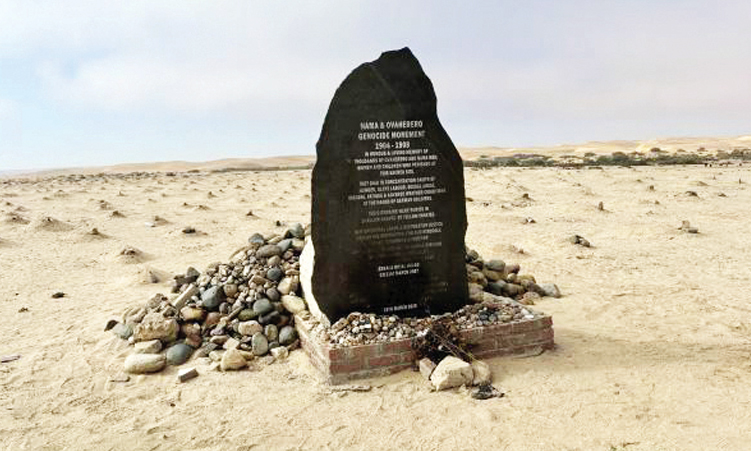
Photos: Isabel Bento (Nampa)
Over the years, activists and community groups have repeatedly called for the monument’s removal or return to Germany.
In 2015, protesters splashed red paint on the statue during demonstrations demanding its removal.
Yet the memorial still stands today. Some residents and heritage groups argue it forms part of Namibia’s colonial history and should remain as a reminder of the past, while affected communities say its continued presence deepens historical wounds.
Meanwhile, preparations were underway at Swakopmund for this year’s regional Genocide Remembrance Day commemoration.
Under the theme ‘Honouring the Past, Healing the Present and Inventing the Future’, the commemoration aimed to bring together descendants, historians, traditional leaders, government officials and community members.
Erongo governor Natalia |Goagoses says the event aimed to promote historical awareness, strengthen national unity and encourage intergenerational dialogue about healing and justice. – Nampa