




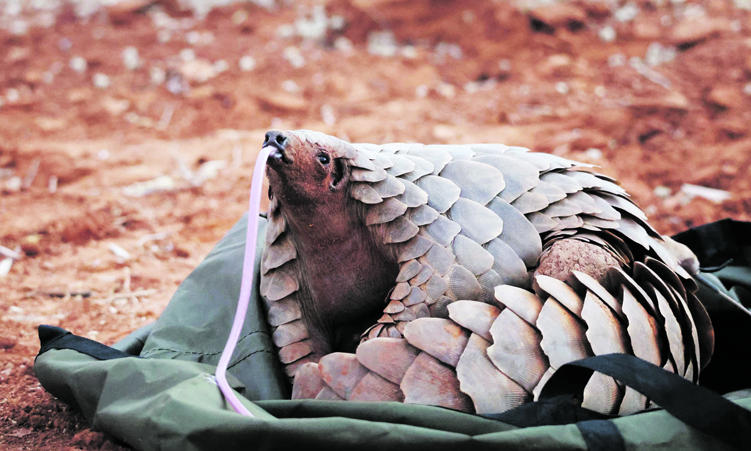
When Sparky arrived at the Pangolin Conservation and Research Foundation (PCRF) in March this year, there was little certainty that the injured pangolin would survive.
A severe electric-fence shock left him critically ill, unable to eat independently or walk straight. The shock paralysed his tongue.
“When he tried to move, he would walk in circles and sometimes even tumble over,” PCRF founder Kesley Prediger says.
He had fluid in his chest, extensive tissue damage and a severe wound to his tail that became necrotic. Prediger says the team did not know whether the damage was permanent or whether he would return to the wild.
“He arrived weighing around 9.3kg, but as his condition deteriorated, he was unable to eat normally and his weight dropped to below 8kg,” she says.
Prediger says the pangolin required intensive veterinary treatment and constant monitoring, going through blood tests, imaging, nebulisation and intensive wound care. He also had to be sedated twice a day to eat.
“We stopped looking too far ahead. The goal was to get him through,” she says.
Prediger says the team bonded with Sparky during his treatment. He became fond of their boots, stealing them to play. He also had a habit of finding fresh cow dung and rolling in it.
“He was quite the character and grew incredibly close to the team caring for him,” she says.
Yet, despite his playful personality, his future could not be predicted.
For nearly two months, the pangolin, which travels at night to trace and locate ants and termites, continued walking in circles.
The victories began slowly.
Sparky started walking straighter four months later and his interest in food returned. Eventually, he regained the use of his tongue.
Pangolins need their long, sticky tongues to catch and trap ants, termites and larvae from underground nests.
“Without it, Sparky could never survive independently in the wild,” Prediger says.
She says Sparky seemed “ridiculously” proud of his recovery, often stretching his tongue out in front of the team as if showing them it worked.
He began feeding independently, searching for ants and termites. Eventually, he was spending between four and eight hours outside, doing what the team had once feared he might never do again – being a wild pangolin.
“After everything we had watched him go through, it was impossible not to celebrate with him,” Prediger says.
His wounds healed. His strength returned and his weight climbed beyond 11 kg.
After five months of rehabilitation, Sparky was ready to go back into the wild.
He was released late July through a “carefully managed soft release”, Prediger says.
“There’s always something bittersweet about releasing an animal you fought so hard to save. For months, our lives had revolved around Sparky, whether he had eaten, how he was walking or simply going to make it,” she says.
Back in the bush, Sparky found piles of dung and rolled in them. Prediger says the moment felt like Sparky celebrating his recovery.
Today, Sparky is free again.
He finds his own food, chooses his own burrows and moves independently through his habitat. He is still being monitored through GPS and very high frequency tracking tags.
Every two to four weeks, the PCRF team locates him for a health assessment and weight check.
Prediger says Sparky’s five-month rehabilitation provided valuable lessons on treating, rehabilitating and monitoring critically injured pangolins, helping improve the chances of future rescues.
She says his recovery highlighted the importance of collaboration in pangolin conservation, as the foundation worked with Brookfield Zoo Chicago to provide specialised nutritional support.
“A powdered diet developed by Brookfield Zoo Chicago helped sustain him until he regained the ability to eat,” she says.
The founder says the collaboration has benefited other critically ill pangolins and contributed to an increase in the survival rate of rescued and released pangolins in Namibia from 40% to more than 90% since 2023.
Prediger has been recognised for her work in rehabilitating and returning critically ill pangolins to the wild and is set to receive Brookfield Zoo Chicago’s Rising Conservation Leader Award for her contribution to pangolin conservation and the collaboration between conservationists in Namibia and the United States.