




To be really good at something, you have to do it a lot. Over and over and over again until you can do it without thinking about it, until it becomes second nature and happens naturally.
Until you have reached perfection and can do it no better. Until you stand on top of the proverbial mountain with your victorious fist in the air. You have done it!
But then what?
Most stories about extraordinary achievements end on top of the mountain. They tell you nothing about the trip down, or very little about life thereafter. It is all about that single moment, the achievement.
Some people move onto new challenges once they achieved their goal. Others repeat the achievement until it becomes second nature, nothing but a habit.
There is comfort in habits. They give us confidence. They make us glide through life like a graceful dancer across a freshly polished wooden floor. They become the path of least resistance.
Cooking is very much like that. You apply the same technique to the same set of ingredients over and over and over again, until you have reached perfection and can do it almost without thinking and with your eyes closed.
In a restaurant, this is a good thing. Confidence and consistency in skill and technique mean consistency in quality, which means the patron gets exactly what he or she expects every time he or she visits. Back in the kitchen, the cooks know exactly what to do, when to do it and how to do it. Everyone, in the back and in the front, is happy.
If you have to think and name two or three of your favourite home-cooked meals, chances are that these would be dishes that were cooked and eaten more often than most others: mom’s milk tart, grandma’s lamb stew or quince jam. These favourites were cooked more often because the cook had confidence in producing them to a standard that everyone loved. Everyone loved the way she cooked them, and so they became the go-to dishes for special moments for their ability to bring comfort and happiness. They have become habits.
This also happens on an even larger scale: regions, cultures, communities and nations become known for specific elements in their food culture. What they cook, how they cook it and when they cook it all become entrenched as food and cooking habits. That hardly ever changes.
Changing habits is no easy matter, even when there is great promise of despair in keeping that specific habit. As a species, we do not like change. Why else would we continue with behaviour that is to the detriment of our planet, our species, our plants and our animals?
In my quest to better understand our traditional ingredients and cooking methods, I am often confronted with just how habitual a food nation we are.
Let us, just for a minute, consider one of the oldest and most revered ingredients in this country: mahangu or pearl millet (pennisetum glaucum).
It is an ingredient that has been around for thousands of years. Yet, other than making oshifima and oshikundu, we do not do a whole lot with it. It is not commonly used in our bakeries or our restaurants. It has not made its way into our breads, pasta or our dumplings.
Yes, I know about the commercial cookies, but what else? It is as if we do not think about mahangu. As is so often the case in our country, there is no innovation.
No curiosity and determination.
No energy and commitment.
Sadly, just habit.
Food habits and traditions, for all the good they do, do have a darker side.
They prohibit change and discourage innovation.
Because it is used frequently and in a comforting, predictable manner, mahangu no longer inspires anyone. It is not an ingredient that grabs the imagination of local chefs, bakers or food scientists. Instead it is deemed stale, bland, one dimensional, and condemned to the modern wastebasket that is traditional village life.
Let them have their oshikundu.
Because it is such an old and global ingredient, it is not difficult to find inspiration for cooking with mahangu.
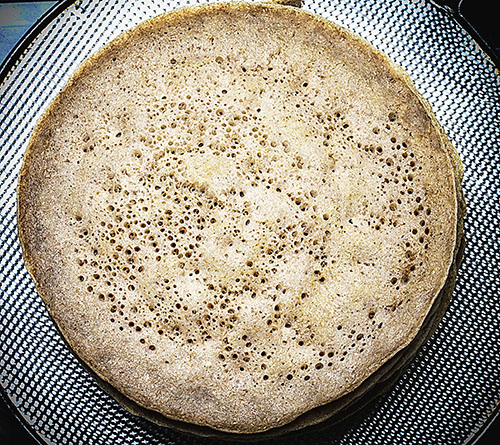
Mine I found in the traditional sour, fermented sponge bread of Ethiopia called injera.
They make theirs with teff, I made mine with mahangu. The key to this bread is its sour flavour that is the result of the fermentation of the dough. It takes about a day for the dough to be ready so some planning is required.
In my quest for mahangu sponge bread, I learned an important lesson: there is no need to simply discard all that is habit or tradition. Very often one person or culture’s habit or tradition is another’s innovation.
Happy innovating!
• 1 cup bubbly sourdough