When asked to imagine the distant future, most people will envision some kind of dystopia.
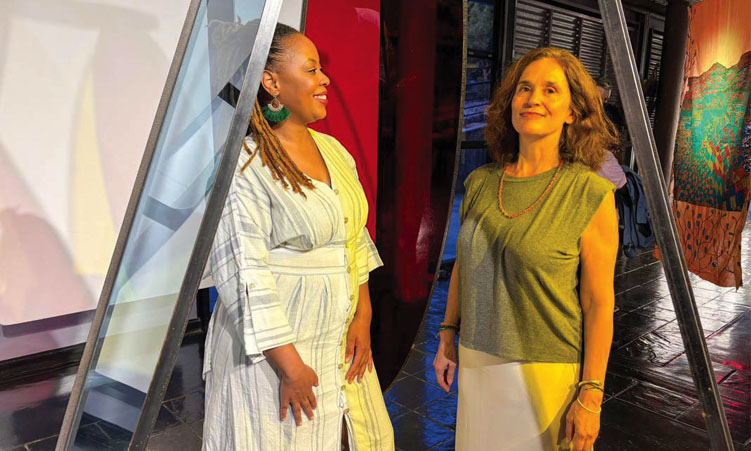
In ‘Solarpunk: A Story of Sand and Energy’, currently on display at the Franco Namibian Cultural Centre (FNCC), artists Vitjitua Ndjiharine (Namibia) and Rocío Asensi (Spain) dare to dream differently.
Imagining a positive future in contrast to the doom and gloom of speculative popular culture, the artists take to the majestic Namibian wild to envision a future powered by nature, rooted in Namibian traditions and strengthened through technology.
‘Solarpunk’ is the product of a residency supported by Eunic Namibia and curated by The Project Room.
“What truly matters is not only the exchange of ideas, but the momentum those ideas can create for positive change,” said European Union ambassador to Namibia, Ana-Beatriz Martins at the exhibition’s opening.
“Imagination is not an escape from reality, it is a first step towards change for the better.”
With Eunic Namibia’s support, Ndjiharine, Asensi and their team travelled to Swakopmund and Spitzkoppe where the earth, air and light informed their radically optimistic vision for the future.
Inspired by the areas’ yellow sunrises, blue skies, red deserts and green accents, Asensi created a Perspex installation that recalls the form of traditional Namibian huts.
At the exhibition’s recent opening, patrons were encouraged to step into Asensi’s installations and view the world through a different lens. The Perspex panels additionally suggested the ability to harness the sun in the fashion of solar panels while punctured metal plates caught the light in an approximation of Namibia’s starry sky.
“If you want to construct a new society, we need to change our minds and views,” says Asensi. “You look through the colour and everything changes.”
In a photographic installation by Adam Smaruj, Asensi’s work is seen as it should be, within Namibia’s dramatic landscapes.
The effect is both striking and serene as the artist’s recycled spherical sculptures suggest a groundedness and harmony with the natural world.
While Asensi’s vision of the future is more minimalist in function and form, Ndjiharine’s installation is narrative and populated.
In a trio of cheesecloth textiles, Ndjiharine imagines communities at bountiful tables in natural landscapes, she honours the mythical tree of her Ovaherero culture and speaks to the importance, as well as to the safeguarding of indigenous traditions and culture.
“My approach to ‘Solarpunk’ was thinking about the natural abundance of Namibia,” says Ndjiharine. “Another thing we have in abundance is our oral traditions and our folktales and how these connect us to the land.”
Drawing on the Ovaherero creation myth of the Omumborombonga tree, which is said to have spawned the first people, Ndjiharine conceives a future anchored in indigenous mythology and wisdom.
“The Omumborombonga tree is a living ancestor. There’s this idea that we’re connected to this tree,” says Ndjiharine.
“I wanted to think about this concept of a natural ancestor and nature as kin, instead of something that we own or something that we get to exploit.”
Ndjiharine’s application of cheese cloth, used to strain milk and make cheese, represents an element of domesticity in her work and underscores ideas of community.
“There’s a lot of thinking about the home, embodiment and thinking about Solarpunk as a lived experience that is happening now as opposed to something in a distant future,” says Ndjiharine.
“I wanted to think about how we can start from where we are?”
On the side of the FNCC building, a series of banners ask questions such as: “How will storytelling influence the technologies and systems we build?”.
In ‘Solarpunk’, Ndjiharine and Asensi are these storytellers and the patrons, engaged in their various pursuits, are encouraged to respond.
While Asensi imagines the technology, Ndjiharine imagines the people and ‘Solarpunk’ comes to life as an inquiry, a spark and as a shared dream made tangible.
‘Solarpunk: A Story of Sand and Energy’ will be on display at the FNCC until 13 November.
– martha@namibian.com.na; Martha Mukaiwa on Twitter and Instagram; marthamukaiwa.com