



SIX government entities are at risk of losing tens of millions of dollars invested with the SME Bank as it stands accused of questionably investing close to N$200 million in South Africa.
The Bank of Namibia (BoN) believes the money might never be recovered after investigating investments made with South Africa’s Mamepe Capital and Venda Mutual Bank.
In an affidavit filed at the High Court last week, BoN governor Ipimbu Shiimi said he had “reasons to believe that the investments allegedly made by the third respondents [SME Bank] in South Africa are likely lost”.
The affidavit forms part of evidence in the ongoing court case in which the SME Bank’s ex-directors and senior executives are challenging the legality of BoN’s decision to dismiss them under the Banking Institutions Act.
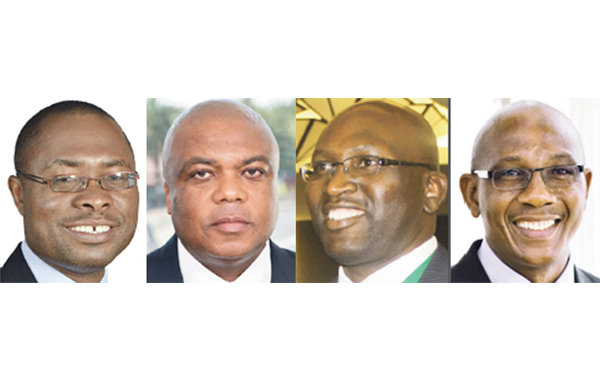
The executives and directors challenging the BoN action are former CEO Tawanda Mumvuma; finance manager Joseph Banda; manager for treasury Alec Gore; vice board chair Enock Kamushinda; board member Ozias Bvute; and board chair George Simataa.
The SME Bank has a history of being funded by government, and getting huge investments from state-owned companies. The Namibian government owns 65% of SME Bank, while 30% is owned by Zimbabwe’s Metbank and 5% by Worldeagle Investments, which is owned by controversial Zimbabwean businessman Kamushinda.
In the affidavit, Shiimi named the Government Institutions Pension Fund (GIPF), the Road Fund Administration (RFA), Agribank, the Social Security Commission (SSC), NamWater and the National Energy Fund (NEF) as some of the state-owned entities that have invested with the SME Bank.
Shiimi said the SSC invested N$150 million, GIPF N$100 million, and NEF N$260 million. NamWater initially invested N$140 million, but forced the SME Bank to pay back N$90 million. NamWater is still owed N$50 million.
BoN realised that the SME Bank was in trouble when its auditors BDO tipped off the central bank that it was concerned about the N$200 million invested in South Africa.
“Not long after the BDO revelation, I was contacted by the minister of finance regarding the failure by the third respondent [SME Bank] to repay the matured investment made by NamWater,” Shiimi said in court papers.
NamWater wanted the SME bank to repay its N$140 million, but the troubled bank said it did not have the funds. Shiimi said he then met with SME Bank officials to discuss their financial troubles.
“They argued that the liquidity challenges were related to capital which they needed to get from the main shareholder [the Namibian government] amounting to N$340 million that they committed themselves, which has put them in the squeeze,” Shiimi stated.
Shiimi said he told the SME Bank officials last year that their situation was grave, that their sustainability was in doubt, and that they were breaking several banking regulations, including liquidity requirements.
He also said the SME Bank eventually paid NamWater around N$91 million, but most of the amount had to come from government.
As a result of the SME Bank’s “inability to honour its obligation to NamWater, government had to inject N$78 million” into the bank to enable it to repay NamWater.
Despite holding more than N$780 million in deposits, mostly from state-owned entities, the SME Bank could not repay NamWater’s N$140 million.
Shiimi also revealed that SSC’s investment with the SME Bank had maturity dates of 13 June 2017 for N$30 million, N$70 million for 15 September 2017 and N$50 million for 13 December this year.
The Namibian reported last month that the SSC wanted some of its money back.
Shiimi said he had a conversation with SSC board chairperson Johannes !Gawaxab about the recall of part of the money, and was informed that there was internal disagreement at the SSC about whether the investment should be withdrawn, and over whether it had been properly authorised.
“The relevant board did not authorise the investment in the first place,” Shiimi stated in the damning court filing, which exposes SSC CEO Milka Mungunda, who has insisted that procedures were followed when making the investment with the troubled bank.
Shiimi brought up the SSC link to prove that no major investor had withdrawn its money as alleged by the former executives and directors, who are demanding reinstatement at the SME Bank.
Referring to the N$196 million that was invested in South Africa, Shiimi said: “It is likely that those amounts are lost (based on information at hand), and the bank is and was satisfied that the third respondent SME Bank is insolvent [no longer able to meet its financial obligations] or unlikely to be solvent, since the capital funds would – in that event be depleted.” Simataa, however, has accused BoN in court papers of carrying out a flawed investigation, lacking knowledge of the investment transactions which the SME Bank made in South Africa, and of having acted in haste without first trying to understand the matter at hand.
According to Simataa, the SME Bank had N$153,9 million in an account under the name “Mamepe Nominees” at Venda Mutual Bank at the end of December 2016, and also had a further N$27,2 million invested with Mamepe Capital at the same time. He stated that he and the other applicants in the case “strongly refute the allegation that the funds invested in South Africa are lost”. Underscoring the graveness of the bank’s perceived financial situation, on 6 March 2017, around the time when the national budget was released, Shiimi wrote a letter to industrialisation minister Immanuel Ngatjizeko, stating that the SME Bank might need an injection of N$250 to N$300 million if it failed to recover the investments in South Africa.