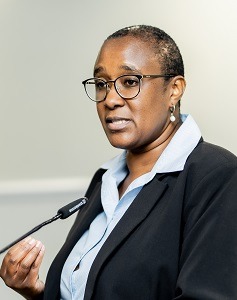





Under the stage lights of Jakarta’s Erasmus Huis, Shishani & Sisterhood are completely at home. The Namibian-born artist greets the crowd in the large cultural centre in Oshiwambo, guiding them through the appropriate responses, then welcomes the audience in Indonesian, which elicits jovial sounds of appreciation.
This meeting of language and ultimately culture is at the heart of ‘Forget to Remember’, a storytelling concert that unearths matriarchal stories of resistance, resilience and might from Namibia, Indonesia and Suriname, three countries connected in their experience of Dutch colonialism.
‘Forget to Remember’ is the title of the showcase – a moving, powerful patchwork of Namibian, Indonesian and Surinamese women sewn with song, dance, spoken word, music and movement – but it is also the name of a song. One that asks a question boldly, as a whisper and as a refrain: “How long will we keep on forgetting?”
“The title suggests that remembering is an act and so is forgetting. In many cases, the ‘powers that be’ wilfully chose to forget the full story. Women and queer people have been wilfully erased out of history, out of decision-making positions – all of this is part of the European colonial project,” says Shishani.
“Amid all the violence of the present day, 500 years of colonialism and its aftermath, it is clear that ‘remembering’ and ‘commemorating’ as a country reflects power structures.”
Shishani shares that in The Netherlands, the Second World War is commemorated nationally each year, but the history of Dutch colonial rule does not get the same attention.
“Many migrants live in The Netherlands due to this history, however, our stories have not been recognised fully, let alone dealt with properly,” Shishani says.
“Understanding that western European countries are wealthy due to massive colonial exploitation changes the perspective of being a ‘decent social country’.”
In the context of the performance, artists Shishani, Tieka Masfar, Asih Nije-Sungkono, Wulan Dumatubun and Jomecia Oosterwolde remember awe-inspiring national leaders, the unsung heroism of female family members and acknowledge ongoing conflict in West Papua through a rendition of ‘E Mambo Simbo’.
Celebrating formidable Indonesian advocate for women and girls’ rights Raden Kartini, fearless Keumalahayati leading an army of Aceh’s widows against the Dutch and Portuguese, brilliant strategist Queen Nzinga of the Ndongo and Matamba, as well as the legend of Ma Paanza, fleeing slavery and secreting rice to ensure the survival of her community in Suriname.
‘Forget to Remember’ tells some stories we may know and others voiced or observed gingerly in the sanctity of the artists’ homes.
“The starting point of our show is our female family line. As much as there are cultural differences, women and gender queer people around the world have many of the same experiences and challenges.”
Each living in The Netherlands, all carving out lives in the diaspora and kindred in having to grapple with the lasting effects of Dutch colonialism, Shishani & Sisterhood makes its debut in Indonesia with an affecting offering that is at once performance, history lesson and an invitation to preservation.
“Have you ever listened to the stories of the women in your family?” asks Masfar.
It’s a simple question but one that makes many people of colour born to parents who survived the injustices and trauma of colonialism and apartheid, Namibia’s connection to the Dutch, tremble.
To ask is to pick at scabs, to risk bleeding through tightly fastened tourniquets and to turn back the clock to a time that many of our elders have done their utmost to forget.
“Coming from the families we come from, that have gone through so much trauma, speaking and asking questions is not easy,” says Shishani.
“I feel like we, as a group, have been healing each other just by sharing and finding out how much we have in common,” Shishani says.
“I think the project also opened up conversations within our families because you want to know more. We need to ask questions to whoever we still have, our parents, aunties, uncles or grandparents.”
In an Oshiwambo song titled ‘Kuku’ and through storytelling, Shishani honours the ensemble’s matriarchs. Masfar and Nije-Sungkono dig deep into their own histories, which begin in Indonesia, and, like Shishani, Dumatubun, Nije-Sungkono and Oosterwolde, found their way to The Netherlands.
‘Forget to Remember’ has and continues to tour The Netherlands and Shishani & Sisterhood do three shows in Indonesia. They hold creative writing, performance, African dance and music workshops at schools and perform first in Solo, Jakarta and finally in Bandung.
“We found out that the first Asia-Africa conference was held in Bandung, Indonesia, in 1955, to strengthen countries in their road to independence,” says Shishani.
“This type of solidarity is needed, especially now in rising racist right-wing governments around the world,” Shishani says.
“We need a different type of leadership based on connection, not repression. We need leadership that reflects society, which means ample representation of women, indigenous and minority groups.”
Through music and dance that draw on Namibian, Indonesian and Surinamese rhythms, folklore, knowledge and movement, ‘Forget to Remember’ fashions a shared language of remembrance that witnesses personal and collective history and lights a way to a conscious future.
“I feel like I have ancient songs in me that need to be heard,” sings Shishani ahead of a final question.
“How do we want to carry these stories into the future? How are we creating that space?” Shishani asks at Erasmus Huis, after resounding closing applause.
“How, in our day-to-day, can we create a world that we want to live in?”
– martha@namibian.com.na; Martha Mukaiwa on Twitter and Instagram; marthamukaiwa.com
In an age of information overload, Sunrise is The Namibian’s morning briefing, delivered at 6h00 from Monday to Friday. It offers a curated rundown of the most important stories from the past 24 hours – occasionally with a light, witty touch. It’s an essential way to stay informed. Subscribe and join our newsletter community.

The Namibian uses AI tools to assist with improved quality, accuracy and efficiency, while maintaining editorial oversight and journalistic integrity.
Stay informed with The Namibian – your source for credible journalism. Get in-depth reporting and opinions for
only N$85 a month. Invest in journalism, invest in democracy –
Subscribe Now!