TO shift development to the central coast and realise the government’s vision to establish Walvis Bay and Swakopmund as logistic hubs for the southern African region, a second desalination plant “must” be built, according to minister of agriculture, water and land reform Calle Schlettwein.
“This is so that we can stay ahead and can say ‘water is not a problem, we will give you water when you want to invest here’, instead of ‘when you come, we promise to give you water’. Investors do not react on promises, they react to factual situations. That is why we say the desalination plant is no longer a contention, it is a reality. We will build it,” he said during the groundbreaking ceremony of the Kuiseb collector 2– Schwarzekuppe–Swakopmund-pipeline near Walvis Bay on Saturday.
The minister spent the last week visiting several sites crucial to the complex integrated water supply system at the coast, as well as the mines, which consume 50% (12 million cubic metres a year) of the water supply in the region, with the other half going to the coastal towns.
Statistics presented by the ministry indicated that by 2050, the annual water demand for the coastal areas will be around 36 million cubic metres, while Windhoek and en route users will be consuming around 32 million cubic metres per year over the same period.
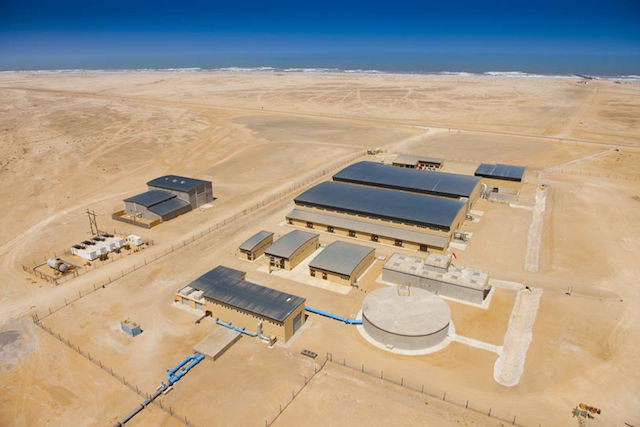
The Orano plant, just north of Wlotzkasbaken, has an annual output capacity of 20 million cubic metres. It is operating below capacity.
The new plant will be built close to the old plant.
Schlettwein said it was a “large project”, and, although he did not mention any figures, previously suggested costs indicated that the new plant with a capacity of about 30 million cubic metres could cost up to N$10 billion.
“A new plant will, therefore, be constructed by placing the project into a public-private-partnership through which private capital is leveraged, private operational capacity is roped in, while NamWater remains the owner of the water,” he said.
While the new plant is aimed at resolving water production restraints in the coastal region, Schlettwein said cost comparisons of water supply infrastructure development for Windhoek and the coast have resulted in a “good argument” that many industries can be settled at the coast where there is a limitless water source (the ocean) that can be desalinated.
“We have talked about integrated water management systems for a long time and we believe that in the central area, around the capital, Windhoek, we are running into a situation where the resources we tap into to satisfy the water need are becoming limited. We must, therefore, go further and further away from Windhoek to tap into additional sources,” he said, adding that to pump water inland requires major power output, as the ocean is the lowest part of the country.
Orano spent about four years negotiating with the government over an offer to sell its Erongo plant, as capacity there decreased significantly as uranium prices plummeted, resulting in the Trekkopje uranium project (which was supposed to be the main beneficiary of the desalinated water) going into care and maintenance.
The government, however, turned down the offer.
Schlettwein on Saturday said while he can confirm the continual need of the Orano plant, the demand for water also equally confirms the need for the new plant, which will exploit new technologies and bring about increased security of water supply.
“That’s where we are now; we are going to use both – the new and old – to have long-term security. It will also have an impact on price. The more effective the plant is, the cheaper the price and that would speak for a modern, newer plant,” he said.
He added that plans are to start and be completed as soon as possible, especially considering that Orano’s seawater intake system, and supply pipelines to the various consumers are available. “I think we are in a good position to deliver quickly.”
Email: bottomline@namibian.com.na
In an age of information overload, Sunrise is The Namibian’s morning briefing, delivered at 6h00 from Monday to Friday. It offers a curated rundown of the most important stories from the past 24 hours – occasionally with a light, witty touch. It’s an essential way to stay informed. Subscribe and join our newsletter community.

The Namibian uses AI tools to assist with improved quality, accuracy and efficiency, while maintaining editorial oversight and journalistic integrity.
Stay informed with The Namibian – your source for credible journalism. Get in-depth reporting and opinions for
only N$85 a month. Invest in journalism, invest in democracy –
Subscribe Now!