






Scientists are expanding research into the deaths of desert elephant calves in north-western Namibia amid concerns over rising mortality rates.
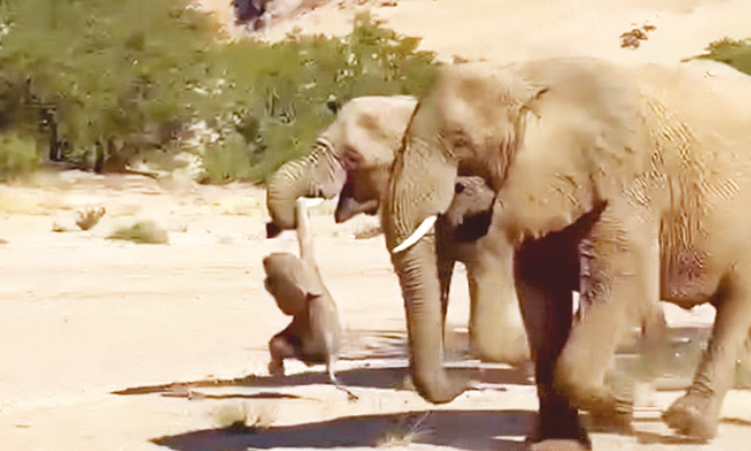
The research follows the death of a newborn calf whose final hours were captured on video and shared by Elephant-Human Relations Aid (EHRA).
The organisation says the calf was only a few hours old when it was filmed struggling before it died shortly afterwards.
EHRA says tourists had gathered near the calf at the time, adding unnecessary stress to an already vulnerable situation.
While the cause of the calf’s death remains unknown, the organisation says it is working with Daniella Chusyd, an assistant professor at Indiana University in the United States, to investigate possible causes of calf mortality.
The research will analyse genetic and field samples, as well as stress levels in desert elephants, to better understand what is affecting calf survival.
Experienced safari guide Atanasius Gawiseb, who has worked in north-western Namibia since the early 2000s, believes increasing human activity around elephants could be contributing to stress.
However, he says research is needed to establish the exact cause.
“When I started guiding in this area, we were successful with newborns.
We were not having these problems,” he says.
Gawiseb says elephants are now frequently surrounded by tourist vehicles.
“There are always cars around them and the viewing distance is very close.
They have no privacy,” he says.
He also expresses concern about the growth of tourism infrastructure and off-road driving in elephant habitats.
“There are too many lodges and camps in the area, which means too many vehicles.
Off-road driving has also damaged the area. The guides don’t worry about the sensitivity of the soil,” he says.
Gawiseb urges tour operators, guides and self-drive visitors to give elephants more space.
“We must obey the rules and give the animals time to relax.
It could be something else, but I think stress is playing a role.
The elephants are moving more than they used to. They are restless.
The young ones probably do not have enough time to breastfeed or rest. What do we expect the outcome to be?” he asks.
The Ministry of Environment and Tourism says it supports the study.
Ministry spokesperson Vilho Hangula says the ministry is among several stakeholders involved in the research, together with EHRA and Ongava Game Reserve.
“The ministry is aware of this research. It is basically about stress and genetics of the elephants across their range in Namibia, and more stakeholders are involved, like the Ongava Game Reserve, the Ministry of Environment and Tourism and of course, EHRA.
“The ministry shares in the concerns of other stakeholders and is definitely interested in understanding the factors contributing to high calf mortality in the Ugab dwelling elephants.
Therefore, the research is fully endorsed and supported by the ministry,” Hangula says.
EHRA has called on visitors to keep a respectful distance from elephants in the wild to allow them to behave naturally without unnecessary disturbance.
The organisation says members of the public can also support the research by joining its elephant research expeditions or contributing towards the study, which aims to provide scientific evidence to help protect Namibia’s desert elephant population.