






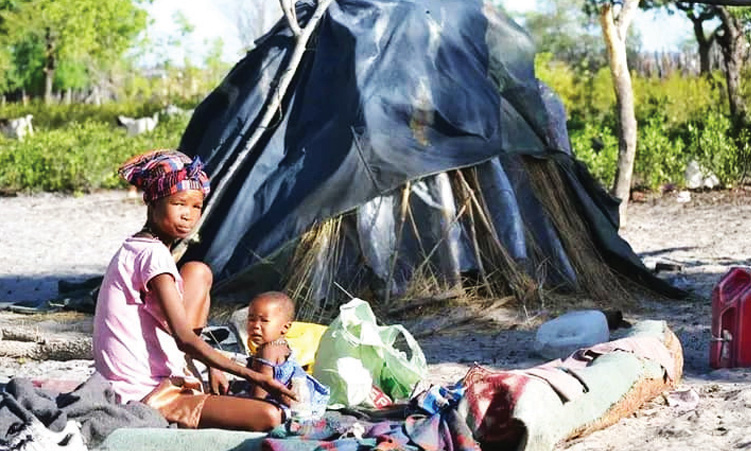
Kafita Silas (12) and his community in the Palasa informal settlement face extreme poverty, relying on food scraps, government aid, and the generosity of strangers to survive.
The almost-teen wakes up each morning in his mother’s plastic shack, where he shares cramped quarters with six other people.
They live in a shared epundo, or clan, at Palasa at Eenhana in the Ohangwena region.
Kafita puts on his barely clean grey school pants and a tattered blue shirt, and washes his face with water from a bucket shared among the children.
Luxuries like soap or a wash cloth are non-existent.
Barefoot, he heads to school alongside his friends, who wear worn-out shoes known as ‘froggies’.
This is the harsh reality of their lives.
SLEEPING ON AN EMPTY STOMACH
The three children set out for school at around 06h00. Despite their circumstances, the morning is pleasant.
“We like going to school early in the morning, because we get to eat porridge there,” says Kafita, who went to bed the night before without any supper.
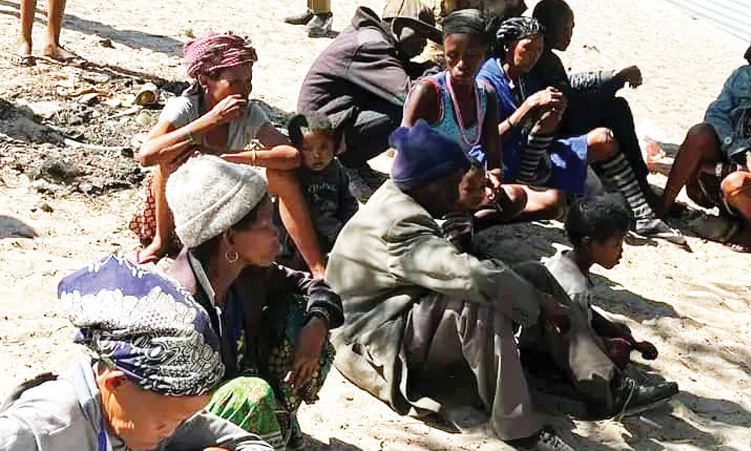
“We like to eat at school because there is no food at home. If we don’t eat at school, we’ll spend the whole day hungry. When we return home, there is still no food,” he says.
SCOURING DUSTBINS
After school, they scour the town for discarded food in dustbins. This daily routine is essential for their survival.
“If we find something good or substantial, we take it home to share with everyone. Sometimes, good Samaritans see us wandering through town and take us to shops to buy us bread and cooldrinks. We really appreciate that,” Kafita says.
“Inside the trash bins, we sometimes find bread, apples and meat. Although they may be spoiled at times, it doesn’t matter to us; we will take it home, and our elders will share it among those who are present.
“Our parents expect us to go out in search of food every day after school and each morning on Saturdays and Sundays,” says Elias Peter, another San child.
Ndahafa Haipa (28) does the same. With a baby on her back, she treks from Palasa to the town’s meat market, where she expects to get odd jobs running errands for meat vendors who, in return, will pay her by giving her unwanted and barely edible parts from the inside of a slaughtered animal, usually a goat.
Along with her child on her back, she heads out along the familiar route, a seven-minute walk from Palasa.
Early in the mornings, the meat vendors slaughter goats and cattle to be sold as kapana at the market.
Haipa knows just where to go.
“I have to get here early before other people do . . . When people slaughter, some parts of the animal are discarded because they are apparently not fit for consumption, but we, the San people, would eat them, and nothing will happen to us. We feed our children the same food we eat, and nothing ever happens,” she says.
Haipa finds meat vendor Secilia Hauwanga about to start her day. She greets her and asks if she could be of any help.
Hauwanga asks her to fetch water at a nearby tap, which is used to clean goat guts and intestines after the slaughter.
After the slaughtering is done, Haipa gets her payment.
On a piece of cardboard, swarming with flies, she has a collection of the unwanted internal parts of the just-slaughtered goat.
She is happy.
“This is what I came here for, to get some food to eat. Back at home, we will cook this and eat it with maize meal pap. This is just enough to feed five people. We are more than 20; we all eat together. I’m hoping others have also managed to get something to take home,” she says.
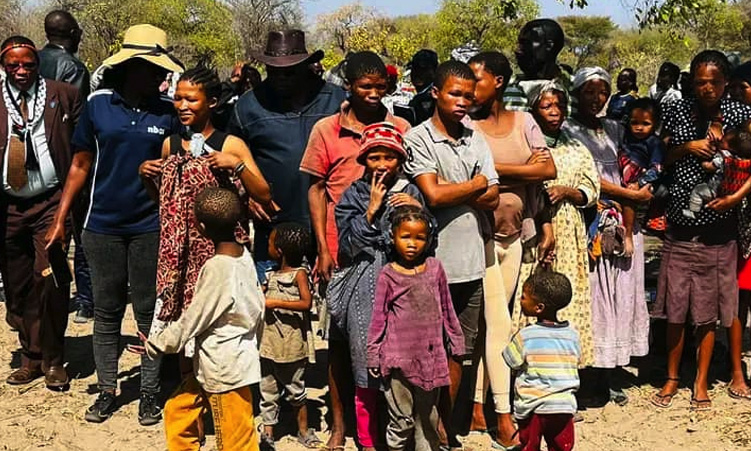
Haipa says while she and her community depend on drought-relief food from the government, which is supposed to be distributed every three months, this has declined over the years.
LITTLE DROUGHT-RELIEF FOOD
“We will go hungry if we don’t come out and look for food, because the relief has not been distributed in more than six months. Sometimes I think the government forgets our existence even though they have us registered and know where we live,” Haipa says.
Back from school, Kafita and his friends have no time to spend at home or remove their school uniforms.
In a group of five, the youngest being seven, they head towards the town. Along the way, barefoot, they search for discarded food.
“We walk to areas where they have the huge trash bins, and the oldest of us, which is me, would climb into the bin and see what is inside. Whatever I find, I throw out to the others to keep in a plastic bag.
This is our routine throughout the town. If we don’t get anything, we proceed to stand at the entrance of the shops to beg. People would sometimes give us some money, buy us some bread, or just ignore us,” he says.
‘SELLING ITEMS’
Puleinge Thomas, the regional development planner under the of Office of the Vice President who is tasked with the distribution of aid to the marginalised community, says the distribution of food to the San community is done on a monthly basis where each adult in the household receives two bags of maize meal, a can fish, beef, dried beans, soya, mild cooking oil and salt. He says despite this, the marginalised community ended up selling the items.
“People who are better off in the community target these San people’s food relief because they know that they love alcohol. Imagine getting a glass of tombo for a bag of maize. The people are taking advantage of them. These people don’t have any land where they can produce.
“When they sell off the items, they says are depriving their children. We tried to talk to them, but all they say is that the items were theirs to do whatever they wished, “ says Thomas.
Daycare owner Rosalia Haufiku, who runs a centre at Palasa, explains that most of the San children need help and assistance.
She says many children drop out of school before they even complete their primary education due to poverty.
LIQUOR ISSUES
“They really need assistance. Most get pensions and drought relief, but they don’t know how to sustain the relief they get. Most of the elders sell the food to get money to buy tombo and other types of liquor, and when they do get pensions, they will always have to give it to shebeen owners who take advantage of them by giving them items on credit during the month,” explains Haufiku.
However, many of the town’s residents view the begging and trash-bin rummaging children with indifference.
“We are used to them; they are like that by nature, very lazy and never want to work. The parents just want money to drink alcohol and forget to feed their children. It’s their way of life,” says Eenhana resident Absalom Tuhafeni.