


• HENRY POPETHE high demand for West Africa’s rosewood timber, specifically from Chinese markets, has spawned corruption across the region’s forestry sectors, siphoned millions out of its economies, and accelerated the effects of deforestation and forest degradation.
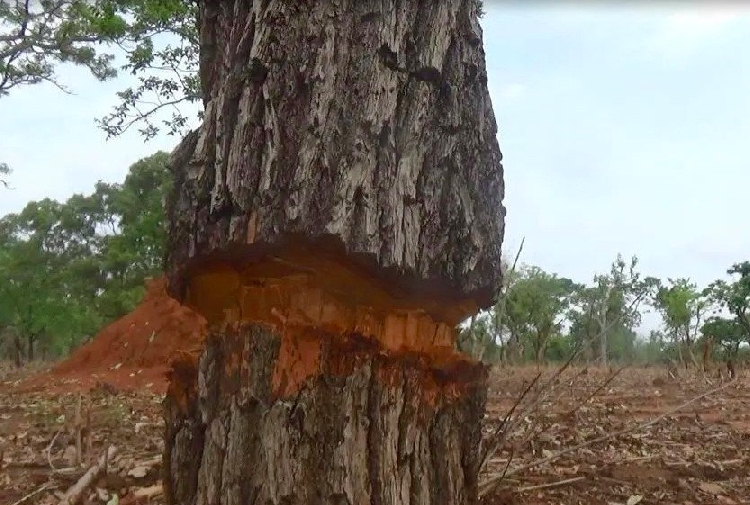
This is the same wood the Chinese were cutting down in the Okavango regions during 2018/19.
Despite it becoming more and more difficult to legally harvest the timber, traffickers are keen to keep up with international demand, and have resorted to smuggling it out of Cameroon into Nigeria, bribing forest guards and border authorities in the process before exporting it, Africa Uncensored has reported.
Rosewood, which comes from an endangered species of trees known as kosso, is a rare raw material coveted for its fodder, medicinal uses, and luxury upholstery.
These trees can only be found in nature within West Africa’s Sahelian region, a belt of land that spans 5 400km from the Atlantic Ocean to the Red Sea.
While the bark of Kosso holds medicinal properties, the tree’s real value lies in its wood, which is adored by many when crafted into luxury upholsteries, specifically across several Chinese markets.
More than 1,4 million kosso logs travelled through Chinese ports in 2016 alone, according to an Environmental Investigation Agency (EIA) study, which researches the criminality of environmental abuses.
The market’s potential, however, is staggering.
While the value of the 1,4 million logs in raw material form was estimated to be US$300 million, China’s 2017 luxury upholstery market, as a whole, saw a turnover of US$35 billion, according to Africa Uncensored.
To sustain such demand for elegant and beautiful furnishings, China relies heavily on its importation of high-quality timbers such as Kosso.
Where one country prospers, however, others falter.
Across the 2 000km-long Cameroon-Nigeria border, traffickers discreetly enter Cameroonian forests and illicitly harvest logs of rosewood, which are then smuggled into Nigeria.
Reportedly, Nigerian authorities aid and abet the traffickers by providing them with documents that falsely say the timber was harvested in Nigeria.
This process allows the wood to be illegally exported to China in plain sight.
Africa Uncensored reports that this illicit enterprise is responsible for the accelerated destruction of endangered forests, a loss of employment, and the siphoning of government tax revenue.
Meanwhile, loopholes within existing laws, lackadaisical regulatory bodies, and corruption among Nigerian government officials and community leaders sustain China’s demand for the harvesting and exportation of kosso.
Between January 2014 and June 2017, this demand was quantified as more than 40 shipping containers – each about 6m long – filled with rosewood logs exported from Nigeria to China on a daily basis, according to the EIA.
The Museba Project, a non-profit media organisation dedicated to watchdog journalism in Central Africa, has learnt from a rosewood trafficker it takes little effort to appease this web of corruption.
Reportedly, all it takes is a bribe to the attending forestry and security agents in order to move the timber from Cameroon’s forests to the Nigerian port of Lagos.
For those operating on the ground, they say the money they are paid is more than enough to offset the risk.
Africa Uncensored has quoted woodcutter Abdou Yadji (40) as saying he was approached by a Nigerian businessman who offered him 5 000 naira (US$12) for every two-metre piece of rosewood he could deliver.
“If I sell him the timber, I could become rich within a short period,” Yadji told the outlet.
This open-season mentality has accelerated the effects of deforestation and forest degradation throughout the Sahelian region, according to the EIA.
Countries such as Gambia, Ghana, Benin, Burkina Faso, Sierra Leone, Cameroon, and Nigeria have seen their forests shrink faster than they can be replanted due to illicit logging.
Nigeria, for instance, has reported that over a 20-year period it has suffered an annual 2,38% loss of its forests and biomes, which in total accounts for 409 650 of its nine million hectares.
– Organised Crime and Corruption Reporting Project
In an age of information overload, Sunrise is The Namibian’s morning briefing, delivered at 6h00 from Monday to Friday. It offers a curated rundown of the most important stories from the past 24 hours – occasionally with a light, witty touch. It’s an essential way to stay informed. Subscribe and join our newsletter community.

The Namibian uses AI tools to assist with improved quality, accuracy and efficiency, while maintaining editorial oversight and journalistic integrity.
Stay informed with The Namibian – your source for credible journalism. Get in-depth reporting and opinions for
only N$85 a month. Invest in journalism, invest in democracy –
Subscribe Now!