



Many of us have read books or watched documentaries on how robots are going to ease the workload of human beings and how knowing how to code, assemble pieces and operate robots will be crucial skills to have in the near future.
Bjorn and Kirstin Wiedow of FABlab Namibia are keeping up with the times and opened the Robot School Namibia recently. got the opportunity to visit the school and spoke to staff members and enrolled pupils to discuss the dynamics of the school as well as how coding helps young people think out of the box.
Deborah Ajibola, a teacher and facilitator, told YouthPaper that the school officially opened its doors on Monday, 2 July but the idea to have a school of this nature has been around since 2017. “Initially we had a pilot group where we had 15 pupils from Physically Active Youth to see if it was going to work out. It turned out successful so we started advertising at the beginning of this year and we currently have about 100 pupils enrolled,” said Ajibola.
Any school-going child between the ages of six and 14 is eligible to apply, but Ajibola stressed that it helps to enroll young people who are naturally fascinated by coding or programming.
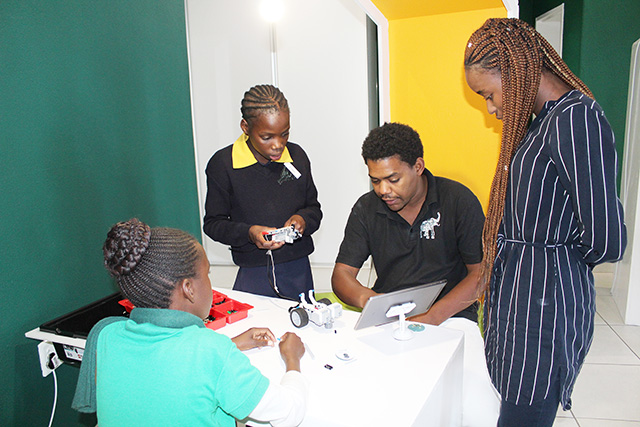
Ajibola mentioned that the school teaches young people basic coding skills and in their lessons, they relate real life situations to coding. “At the moment, we are busy teaching them how to make robotic fork lifters. They are building the robots and will programme these robots to act as a fork lifter,” she shared.
On the benefits of coding for young people, Ajibola said that coding teaches young people how to think outside the box and be innovative. For Ajibola, coding is having a problem that requires you to take strategic steps to solve it. “If you have that mentality of solving problems step by step, you will apply that way of thinking in real life situations and thus be good at handling crises,” she said.
Adding onto the conversation about the benefits of coding, coordinator of Robot School Namibia Macveren Kapukare shared that robots are taking over jobs and a lot of other things. Kapukare believes young people knowing how to assemble and operate robots will give them an advantage in the future. “Robots cut labour and costs. We do not have to let humans do hard labour,” said Kapukare.
Robot School Namibia offers tuition on two levels, according to age groups. The younger pupils are enrolled in the ‘We Do’ level whilst the elder pupils are entolled in the ‘Milestone’ level. “It is a two-year curriculum for now but we plan to grow every year by adding more content and teaching them more things about robots,” said Kapukare.
Kapukare added that for now the school is focusing on teaching basic coding so that the pupils can fully comprehend what coding is all about. “In the near future, we will have holiday coding lessons where pupils who are not enrolled at the school can also have the opportunity to learn how to do programming,” said Kapukare.
Classes at Robot School Namibia are offered five days per week in the afternoon after normal school hours.
Trish Zinhu, one of the enrolled pupils at the school, told YouthPaper that she is finding the lessons insightful so far and her love for coding keeps growing. “I am happy to be learning about coding because I believe coding will help me to be creative and think of ways of solving problems in my life,” said Zinhu.
Erikka Hamundjebo, another pupil at the school who dreams of making her own robots for picking up litter in her community, told YouthPaper that the coding lessons she is receiving will help her with her projects in the future. “I am from Katutura and littering is common in that environment so I believe building a robot that will pick up trash will keep my community clean,” said Hamundjebo, adding that she also hopes to make a robot that will help her parents with chores when they are older and no longer fit to do hard labour around the house.