




Road transport experts have criticised the installation of speed humps on major highways around Windhoek, warning that the measure could increase accidents and congestion rather than improve road safety.
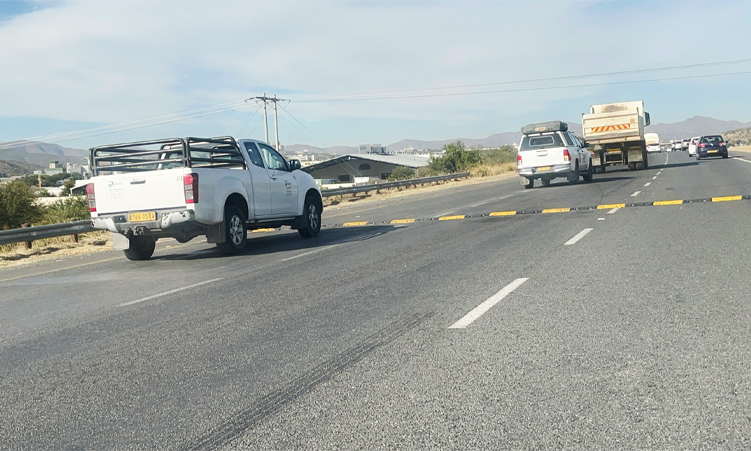
The Roads Authority, in collaboration with the Ministry of Works and Transport, installed speed humps along the B1 Western Bypass, between the Independence Avenue interchange near Katutura Hospital and the Lafrenz interchange to reduce motor vehicle accidents.
Similar measures will also be implemented on a section of the A1 road between Prosperita and the Windhoek Country Club Resort, according to a statement issued by the authority on 4 June.
However, road experts say the ministry should build crossing bridges instead.
Independent Patriots for Change shadow minister of transport Nelson Kalangula has called for the construction of pedestrian bridges, saying speed humps on highways slow the flow of traffic.
He says the move will cause road accidents because the humps are not visible from a distance.
“A highway brings about efficiency in logistical measures, speeds traffic, and decongests as far as that is concerned. Speed humps on a highway beat the purpose of the highway,” he says.
He says there are better ways to reduce accidents on the road.
“One of those is the construction of pedestrian bridges,” he says.
In an interview with Desert FM, minister Veikko Nekundi says the speed humps are a temporary measure, adding that there are plans to put cross-over bridges for pedestrians at four designated spots once funds are available.
These are the road between Windhoek Country Club and Prosperita, the bridge opposite Katutura Intermediate Hospital, the road from Shandumbala to China Town, and the Eneas Peter Nanyemba Road road to Natis.
“But that is in the long-term, once the funds are available. Right now speed humps will be installed to save the lives of our people,” he says.
Nekundi says the move was influenced by the statistics on motor accidents involving vehicles and pedestrians.
He says motorists speed during rush hour, without thinking about pedestrians crossing. He says a number of road accidents have happened this year alone.
“As the government, we have the absolute responsibility to ensure citizens’ lives are protected. The only measure we could take is to ensure we manage and control the speed limits of drivers to save lives,” he says.
The Namibian on Friday observed how the installation of speed humps slowed traffic flow.
Nekundi, however, says the humps do not bring vehicles to a stop, but limit their speed to allow pedestrians to cross.
“There is no reason why motorists should be concerned. What we need is patience and to appreciate the effort. At most, Namibian drivers are intolerant of others and pedestrians,” he says.
“We are a state with different stakeholders, and everyone’s rights must be respected at all times,” he says.
Nekundi says traffic signs will be set up to direct and control the flow of vehicles, with installations to be finalised by the end of this week.
He urges motorists to drive normally and to be cognisant of their speed limits, while pedestrians should only cross the road when it is safe to do so.
The construction on sections of the B1 Western Bypass and the A1 road south of Windhoek started on Friday, and were ordered by Nekundi.
Namibia Bus and Taxi Association secretary general Penda Nakathingo says a thorough assessment should first be conducted to determine the cause of accidents.
He says installing speed humps on the highway is not a solution.
“The solution could be a crossing bridge like the one at Eros, instead of putting up speed humps on the highway. We are not against the idea, but it needs a thorough assessment,” he says.
Nakathingo says the speed humps only increase congestion.
PETITION
An online petition against speed humps on the Western Bypass was launched, attracting more than 2 500 signatures within three hours of being launched.
The petition was started by Charlo Rittmann, who argues that the speed humps are disrupting traffic flow and increasing travel times for motorists.
He says the highway was designed to allow the efficient movement of vehicles and not to serve as a pedestrian crossing point.
According to the petition, the introduction of speed humps has led to increased congestion, delays and frustration for daily commuters.
While acknowledging the need to improve pedestrian safety, Rittmann says pedestrian bridges would be a better solution.
“I urge our local government and transportation authorities to reconsider their strategy and prioritise the construction of pedestrian bridges. This change will not only improve the commuter experience but will also ensure the safety of all road users.”
GOOD MOVE
Meanwhile, road safety activist Felix Tjozongoro says the public must appreciate the ministry’s efforts to reduce road accidents.
He says the speed humps are temporary, and can be removed anytime.
“Despite concerns of the speed humps not being clearly visible, the road signs are visible. We road users have the habit of not reading road signs,” he says.
He believes the move will reduce road fatalities.
“What we want to call for is fly-over bridges, especially at Natis, NamPower, and China Town for pedestrians to cross the road without engaging with cars on the road. The speed humps are temporary measures, but ultimately the minister is looking at fly-over bridges,” he says.