





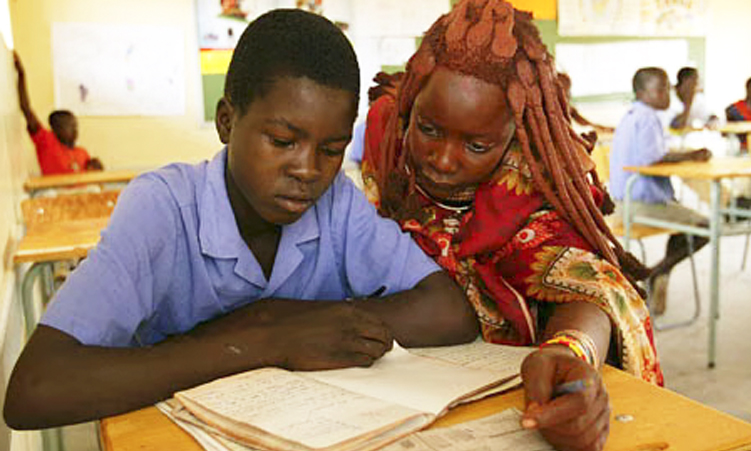
Across Africa, millions of children grow up speaking African languages at home but are later expected to learn through English, French or Portuguese at school.
This transition can make learning difficult, particularly when pupils are required to understand new concepts in a language they are still developing.
For example, in Namibia, pupils switch from mother-tongue instruction to English in Grade 4 at the age of nine or 10 – a change that has been linked to poor reading comprehension and lower academic achievement (though national statistics are not available).
We are education researchers who study teaching and learning in rural contexts, with a particular focus on how the use of multiple languages can support reading comprehension. In a recent study, we looked at what was happening in Namibian primary school classrooms and found something encouraging.
When teachers brought pupils’ home languages into English reading lessons, children understood texts more deeply, participated more actively in class discussions and became more confident readers.
Rather than seeing home languages as barriers to learning English, teachers used them as valuable tools for explaining new vocabulary, discussing ideas and helping learners make sense of what they were reading.
As a result, learners were better able to engage with English texts and develop stronger literacy skills.
Our findings show that drawing on pupils’ home languages can support the goal of making quality education more accessible. By valuing pupils’ linguistic backgrounds, schools can also reduce inequalities and encourage inclusion.
Three practices that transformed reading
Namibia is a country where many languages are spoken. Oshikwanyama, Oshindonga, Khoekhoegowab, Otjiherero and Afrikaans are just some of them.
Although English is the official language and is widely used in education and the government, most Namibians speak indigenous or local languages in their homes and communities.
This linguistic diversity makes Namibia an important context for education research.
Our qualitative case study explored how five teachers in the Oshikoto region used trans-languaging to support reading comprehension.
Trans-languaging means using more than one language in the classroom.
These were experienced Grade 4 teachers of English as a second language.
Data from classroom observations, interviews and lesson-plan analysis documented teachers’ responses to pupils’ transition from mother-tongue instruction to English-medium learning.
We found that all these teachers drew on pupils’ home languages, particularly Oshindonga, to support reading comprehension.
They did this through three simple but powerful practices: using words, pictures and familiar languages to build understanding, letting children use the language they knew best, and encouraging pupils to help one another make sense of difficult texts.
Using words, pictures and familiar languages to build understanding
The teachers who participated in our study regularly moved between English and Oshindonga while also using pictures, gestures and visual aids to help pupils make sense of what they were reading.
Rather than expecting them to rely on English alone, teachers encouraged them to draw on all the languages they knew to understand new vocabulary and unfamiliar ideas.
In some classrooms, pupils discussed difficult words in Oshindonga, while others used languages such as Shona, Afrikaans or Portuguese before connecting these ideas back to English.
Understanding a text involves much more than simply recognising words. Pupils need to connect new information to what they already know, make sense of unfamiliar concepts, and build meaning from the text.
Teachers helped pupils do this by linking new English vocabulary to familiar words, experiences and ideas from their home languages.
Instead of becoming stuck on unfamiliar English words, they could focus on understanding the ideas in the text. Once they understood the concepts, they were better able to engage with English reading passages.
Letting children use the language they know best
The second strategy built on something that is already common in everyday Namibian life.
In many communities, people regularly use different languages in the same conversation. For example, a shopkeeper might greet a customer in Afrikaans, the customer might respond in Oshindonga, and someone else might join the conversation in English.
Even though different languages are being used, everyone understands the message.
The teachers in our study drew on this familiar way of communicating during reading lessons. One teacher described it this way: “When we are working through a reading passage, I ask questions in English but let them respond in Oshindonga if they are struggling. Then I model the English equivalent, this way they connect the concepts in both languages.”
The pupil first demonstrates comprehension and then learns how that understanding can be communicated in English.
When pupils are required to respond only in English, their limited vocabulary can hide what they understand.
By allowing pupils to use Oshindonga, teachers discovered that children could discuss the meaning of a text long before they had the English proficiency to do so.
Pupils helping pupils
A third strategy involved pupils helping one another make sense of difficult texts. Some pupils were more confident in English, while others were stronger in Oshindonga, Afrikaans, Portuguese or Shona.
When pupils encountered unfamiliar words or confusing ideas, they discussed them with classmates who could explain the meaning in a language they understood.
These conversations helped pupils unpack vocabulary, clarify misunderstandings and connect new ideas to their own experiences before returning to the English text.
This approach helped pupils focus on meaning rather than individual words. Teachers observed that pupils became more confident readers, asked better questions and participated more actively.
The many languages spoken in the classroom became a powerful resource for improving reading comprehension.
Learning from Namibian classrooms
The lessons from these Namibian classrooms extend far beyond one country.
Across Africa, many children are taught in languages different from those spoken at home, creating barriers to learning and literacy development.
Our findings show that children do not have to leave their home languages behind to succeed in English; those languages can be a powerful foundation for learning. – The Conversation
– Selma Mufori has contributed to this research. Nhlanhla Mpofu is an associate professor at the University of Notre Dame, Australia. Clement Simuja is an associate professor of educational technologies at Rhodes University.