






It’s a rare thing to inspire and be respected by your peers. To cut through feelings of competition, scale the solitude often inherent in an artist and leave the world and those still whittling away on earth with a profound sense of loss, of love and of gratitude.
Tony Figueira was such a man.
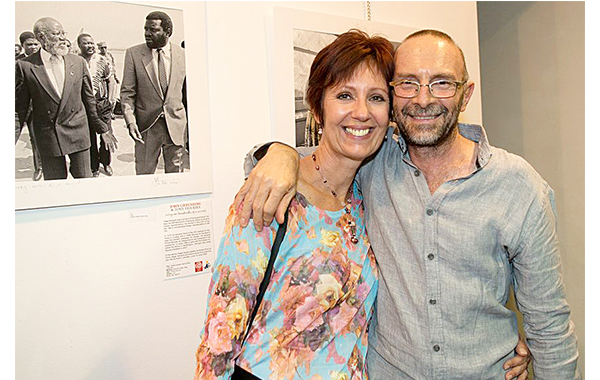
An artist, an activist, a teacher and a friend to many, the renowned photographer passed away in his home at Swakopmund in the early hours of 12 April in the company of his wife Gabi and daughter Gina after a long battle with multiple myeloma.
But before the cancer, there was a boy.
A young man his wife Gabi first met at St Paul’s College in 1972 where he played sport and the drums and nursed the growing sense of unease about the apartheid government that would inspire him to document the liberation struggle in Namibia and across the border with photographers like John Liebenberg who accompanied him on his first trip to southern Angola.
As war waged and boys with white skin were summarily called to arms, Figueira would shoot only with his camera.
“I first met Tony on the hockey field in his final year at St Paul’s in 1979 but we became friends some four years later when he returned from university after completing his degree in journalism,” says judge Dave Smuts.
“He consulted me about avoiding military conscription in the apartheid army which he refused to do and succeeded in this.”
Remembering Figueira’s integrity and steadfast moral compass, Smuts also recalls him as a jazz connoisseur with a legacy consisting of a tremendous body of work ranging from now iconic images of the independence process to his magnificent images of people, particularly children in Namibia and Angola, as well as the ravages of war in both countries.
“But he gave more than this body of work,” says Smuts. “An immense generosity in sharing ideas and showing and training others, thus making photography accessible and meaningful to so many.”
And perhaps particularly to Lukas Amakali.
A young photographer who met Tony when he won ‘A Day in the Life of Namibia on Africa Day’, a photography competition hosted by The Namibian and Figueira’s Studio 77.
Fascinated by Figueira’s ‘mirror imaging’ photography which inspired him to develop his down double exposure aesthetic, Amakali remembers how Figueira would push him to work hard for what he wanted to achieve and cites Studio 77 as the place in which he learnt the value of being a photographer.
“I called Tony ‘The Nikon Man’ because he influenced me to use Nikon cameras and let me use his Nikon equipment, lenses and flashes.”
Another young artist with lasting memories of Figueira is filmmaker Perivi Katjavivi who met him around 2009 when he had just started making short films and launched his production company Old Location Films at Studio 77.
“Studio 77 was also a place where Tony would let my friend Tshuutheni Emvula and I screen documentaries about the Mayan calendar and all sorts of fringe topics,” says Katjavivi.
“He offered us a place to share films about alternative ways of thinking. He was so influential in creating the rarest of things in our society – a space where artists and people from all walks of life could come and create and express themselves.”
This space was Studio 77 at the Old Breweries Complex.
Founded in 2004 by Figueira and his friend, photographer Hans Rack who recalls one afternoon when he and Figueira drove out to Schlip to photograph the lilies and got stuck trying to cross a flowing river after a bout of rain.
Naturally, Figueira photographed all four hours of the frustration.
“Tony was a gifted photographer. To him, constantly having his camera equipment no matter where he was was like wearing a pair of sandals. It was part of his attire. I always admired his energy to seize any and every opportunity to pick up a camera and take pictures,” says Rack.
“It was a privilege to have started Studio 77 with Tony. I remember driving out with him to undertake one of our first lodge photo shoots and, after the weekend shoot was completed, the lodge owner enquired as to whom the cheque should be made out to. Tony and I looked at each other in ambivalence as we had not formally formulated a business account yet. So we both pondered before Tony said ‘um, 77 … Studio 77’. ‘Yes,’ I said, ‘make it out to Studio 77’.
And so Studio 77 was born and this was to be Tony’s passion, hobby, his life and successful business.”
Actually, his second successful business as those who see Figueira as a lesson in following one’s dreams will recall.
“Keep in mind that Tony was also a businessman. He used to work at the family’s Godinho car panel beaters in Northern Industrial Area,” says Papa Shikongeni who first met Figueira in 1994 during the first Tulipamwe International Artist Workshop.
“He gave up all this to follow his heart and his dream, made the dream a full reality, lived his passion to the utmost and created
“It was a learning moment. It was university at its best. He was collected, focused and dedicated, yet he did not take and carry himself too seriously as we would be cracking jokes and still reflect on the depth of life and the realities around us. He was a fighter for the liberation of the mind, the culture and respect for humanity regardless of colour, creed and race.
“He was a teacher. He taught without speaking. He lead without leading. Quietly, reservedly, respectfully.Working with him was wonderful laughter, deep and carefree laughter.”
As was living with him, says his wife Gabi who eventually married Figueira after another life in Cape Town and a chance encounter on a plane.