





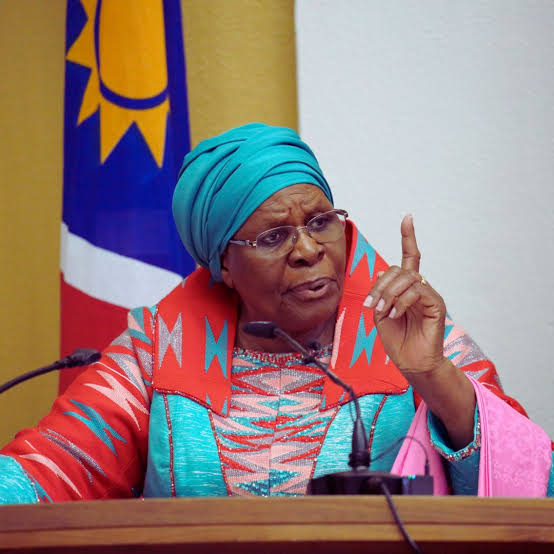
President Netumbo Nandi-Ndaitwah is reportedly less than pleased with the environment commissioner’s decision to give Namibian Marine Phosphate clearance to start mining for fertilisers in the Atlantic Ocean.
The Namibian understands the president held a meeting with senior government officials this week, during which she made it clear Namibia should not be used for an experiment in the ocean.
Last week, environmental commissioner Timoteus Mufeti approved an environmental clearance certificate (ECC) for the Sandpiper Marine Phosphate project, led by businessman Knowledge Katti and his business partner, Mohammed Al Barwani, one of Oman’s richest businessmen.
The licence approval has allegedly left the president and other senior government officials fuming over not being consulted on a decision with massive public interest.
This week’s meeting was attended by ministers and senior government officials such as Mufeti, whose decision is now under scrutiny.
Others include attorney general Festus Mbandeka.
Minister in the Presidency Charles Mubita is said to have hinted that action should be taken against the officials who made the decision.
Mubita yesterday declined to comment on the matter.
“The Presidency has a media team. Talk to them,” he said.
Questions sent to the Office of the President were unanswered at the time of going to print.
The president last week warned she was prepared to be challenged in court.
“I said I’m going to be a disruptive president. I’ll disrupt it for the sake of the Namibian people. I’m going to disrupt. I know there may be a lot of court cases here, but the nation will protect me,” she said.
Another official familiar with the meeting said: “She is upset and every avenue will be taken. The decision has been taken. It will possibly be up to the court to block something as sensitive as that, which could have been prevented.”
The phosphate matter dominated news headlines about 10 years ago when then-environmental commissioner Teofilus Nghitila approved a licence to the same company.
At the time, environment minister Pohamba Shifeta defended the approval.
On the other side was then-fisheries minister Bernhard Esau, who opposed the approval saying it threatened the fishing industry.
A decade later, the politics of sidelining appears to persist.
The Namibian understands that minister of environment and tourism Indileni Daniel had allegedly asked the environment commissioner to brief her before a final decision on phosphate mining is made.
It appears the minister was not briefed.
When approached for comment, ministry spokesperson Vilho Hangula said the ministry had received several queries on the matter and was not yet in a position to respond to specific questions.
“Given the nature of the issue and the many queries that have been received in this regard, the ministry is unable to respond to your specific questions. However, it will provide feedback after further consideration,” he said.
Meanwhile, the Independent Patriots for Change (IPC) has called for the ECC to be suspended pending an independent review.
IPC shadow environment minister Rodrick Likando questions whether the scientific information and public consultations used to approve the project are still current.
Likando says the IPC will raise the matter in the parliament when it resumes on 1 September.
This comes as the Confederation of Namibian Fishing Associations on Monday questioned the environmental commissioner over the decision to grant Namibian Marine Phosphate the ECC.
The fishing industry has appointed lawyer Sisa Namandje to challenge the decision.
Namandje says the confederation had been seeking information from Mufeti about the project since 2022, but some of its concerns had not been addressed.
The industry says it is surprised to learn that the ECC had been approved despite objections to it.
In 2019, then president Hage Geingob pushed the Cabinet to decide on the controversial marine phosphate mining project, despite a government report warning of risks to Namibia’s marine environment.
At the time, the project faced opposition from the fishing industry, which took the government to court over a mining licence granted to the company.
Two years later, the High Court found that Namibian Marine Phosphate had not properly applied for an ECC.
High Court judge Harald Geier ruled that the company could not carry out any marine phosphate mining activities until it obtained the certificate through the required process.
“For a presidential intervention there must be concrete issues. What was not followed? What is ministerial overreach? Has the minister overreached her power? Has she complied with the provisions of the act? All those things matter,” Popular Democratic Movement leader McHenry Venaani said yesterday.
He said the president should not be asked to intervene if the minister still has the legal authority to deal with the matter.
NMP on Monday said the granting of an ECC does not mean marine phosphate mining will start immediately.
“No immediate or urgent commercial operations are planned by NMP,” said NMP country manager Hannelie Scheepers.
She said Mufeti notified NMP and the competent authority on 6 August of his decision to grant the ECC.
The certificate is valid for three years from the date of issue.
According to Scheepers, NMP must also complete additional permitting processes for the land-based component of the project.
“A multisectoral marine environmental scientific advisory committee will also be established to advise on the implementation of the environmental management programme,” she said.
Scheepers said the committee will be modelled on structures used by other marine mining companies, including De Beers.
The sandpiper project involves phosphate deposits in seabed sediments on continental shelf at water depths of between 180m and 250m.
Subject to receiving the remaining permits, NMP plans to use controlled dredging at depths of between 200m and 250m.
The phosphate would be processed onshore, with NMP planning to produce about three million tonnes of phosphate concentrate per year.
Scheepers said mining would cover an average of 1.7 square kilometres, or 0.1% of the ML 170 area, each year.
Over 20 years, mining would cover about 34 square kilometres.